
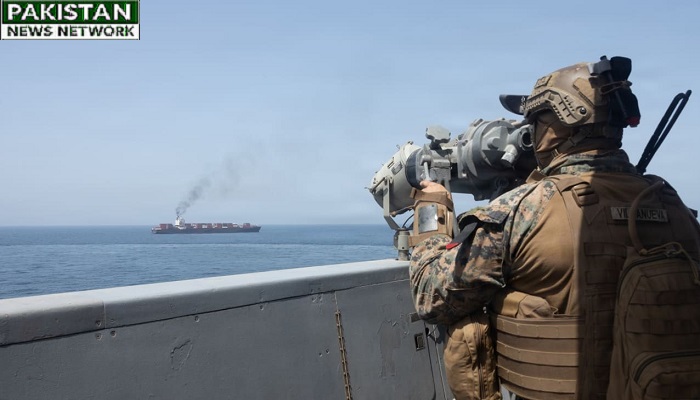
PNN – A reputable Western research center has revealed that CENTCOM is unaware that the oil export figures from the Strait of Hormuz include Iranian oil.
According to the report of Pakistan News Network; contrary to claims by certain domestic and U.S. officials regarding a complete halt to Iran’s maritime exports, satellite data and reports from reputable oil-tracking firms indicate that the flow of Iranian oil via alternative routes continues. New revelations concerning “ship-to-ship transfers” in the offshore waters of the UAE and Oman have exposed a glaring contradiction between the official U.S. narrative and the reality on the ground in the Strait of Hormuz.
Since February 28, 2026, amidst escalating tensions in the Persian Gulf, the Strait of Hormuz has become the epicenter of an unprecedented geopolitical crisis. By forming a maritime coalition and claiming “total control” over this waterway, the United States is attempting to impose its own narrative—portraying itself as the victor in the confrontation with Iran. However, data from oil tanker tracking firms, satellite imagery, and reports from independent research institutes present a starkly different picture.
Contrary to the threadbare claims of U.S. President Donald Trump, Western media estimates indicate a sharp decline in traffic through the Strait of Hormuz and severe disruptions to oil tanker transit. Rising oil prices, skyrocketing insurance costs, and a twelvefold increase in tanker charter rates for Persian Gulf routes further attest to these developments. However, recent revelations point to the existence of parallel, covert stream of Iranian oil exports—a flow that, even by the admission of Western media, continues unabated.
CENTCOM has repeatedly claimed that a certain volume of Persian Gulf oil has passed through the strait with the assistance of this coalition. However, even assuming the validity of CENTCOM’s claim, the volume of oil transiting the strait differs drastically from pre-war levels. On August 28, 2026, HFI Research—a reputable energy analysis firm whose reports are republished by The Wall Street Journal and BeInCrypto—wrote on the social media platform X:
Hush… CENTCOM is unaware that the figures it announces regarding oil in transit actually include Iranian oil.
This tweet challenges CENTCOM’s earlier claim that Iran has not exported a single drop of oil since mid-July—as well as Trump’s assertion regarding a “steel wall of blockade.” In reality, HFI maintains that CENTCOM’s statistics are flawed, as the agency has effectively included Iranian oil exports in its own record of successes.
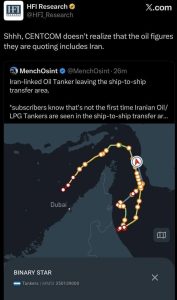
Meanwhile, the maritime tracking account MenchOsint released satellite imagery reporting that an Iran-linked oil tanker had been spotted leaving a ship-to-ship (STS) transfer zone in the Gulf of Oman. MenchOsint emphasized that this was not the first time Iranian oil or LPG tankers had been sighted in this area or at ports in the UAE and Oman, implicitly noting that “TankerTrackers” was overlooking this matter for “reasons” of its own.
Amidst this, perhaps the most significant revelation has come from Reuters. On June 16, the news agency reported that the Strait of Hormuz is “under Iran’s control and management” and that Tehran has effectively shut down the waterway. Furthermore, Reuters disclosed that the United States—unable to fully navigate oil tankers through the Strait—is attempting to maintain the flow of oil exports by establishing a covert ship-to-ship transfer network in offshore waters; this is precisely the area where TankerTrackers.com (often referred to as “Tanker OSINT”) has also been monitoring Iranian tankers.
In other words, both parties to the conflict employ the same method to bypass the blockade of the Strait of Hormuz: ship-to-ship transfers in offshore waters. The United States uses this technique to maintain the flow of oil from the Persian Gulf’s southern neighbors, while Iran—at least according to Western, and primarily American, media—uses the same method to export its own oil, doing so in the very same area confirmed by satellite imagery.
Meanwhile, TankerTrackers.com also challenged CENTCOM’s claim by raising a key question. The company stated that the volume reported by CENTCOM does not align with the total export volumes of Persian Gulf nations—especially following the sharp decline in maritime traffic—suggesting it is quite possible that Iranian oil was included in CENTCOM’s figures. This point echoes the very issue previously highlighted by HFI Research.
It appears—based at least on numerous Western media reports, satellite imagery, and vessel tracking data—that the movement of oil and Iran-linked vessels in the region is continuing.
Based on reports from reputable Western institutions, satellite data, and expert analyses, it appears that Iran’s oil exports are continuing, although the exact volume remains unclear and available statistics are shrouded in ambiguity. What is certain is the glaring contradiction between the official U.S. narrative and the reality on the ground; while CENTCOM claims to have achieved total control and a halt to Iranian exports, tracking data indicates that Iranian oil continues to move and be transported—albeit through indirect methods.
Under these circumstances, domestic officials must exercise due caution when making claims regarding a complete halt to oil exports and refrain from projecting a sense of helplessness or despair amidst the conflict. Economic warfare is a battle of resilience and narratives. Undermining national morale through unsubstantiated claims—or by echoing the enemy’s narrative—runs entirely counter to the national interest.
What is unfolding in the Strait of Hormuz today is not merely an economic or military crisis; the conflict there has evolved into a battle of narratives. In this arena, the ultimate victor will be the party that can best articulate the reality—not necessarily the one that disseminates the most exaggerated statistics.