
PNN – US hostile actions and economic warfare against Iran threaten Eurasian trade ties and transit arteries.
According to the report of Pakistan News Network; repeated acts of aggression, sanctions pressure, and the all-out US economic war against Iran are no longer viewed merely as a bilateral confrontation; rather, they have evolved into a direct threat to trade links, commercial security, and the future of vital corridors across the Eurasian continent.
At a time when the White House has blocked all diplomatic avenues, Washington’s escalatory actions have taken on increasingly alarming dimensions. The rhetoric from U.S. President Donald Trump regarding the launch of what he termed an “economic D-Day” against Tehran—coupled with threats from U.S. Treasury Secretary Scott Bessent—reflects the deep desperation of Washington’s leadership in the face of growing economic and transit integration within the region.
These maneuvers—which serve primarily as a propaganda tool to mask the decline of U.S. hegemony in the new global order—have not only jeopardized the security of international waterways in the Strait of Hormuz and the Red Sea but have also held the interconnected economic networks of dozens of Eurasian nations hostage to unilateralist policies.
Striking at Arteries of Connectivity: Deliberate Targeting of Iran’s Rail Infrastructure
Hostile U.S. actions have now transcended the scope of traditional banking and oil sanctions, extending to the destruction of infrastructure vital to international trade.
In a blatant and brazen violation of international law and norms, invading U.S. forces launched missile strikes against transportation infrastructure within Iranian territory. According to reports, the cruise missiles specifically targeted the strategic “Aq-Tappeh Khan” railway bridge near the city of Aq Qala in northern Iran.
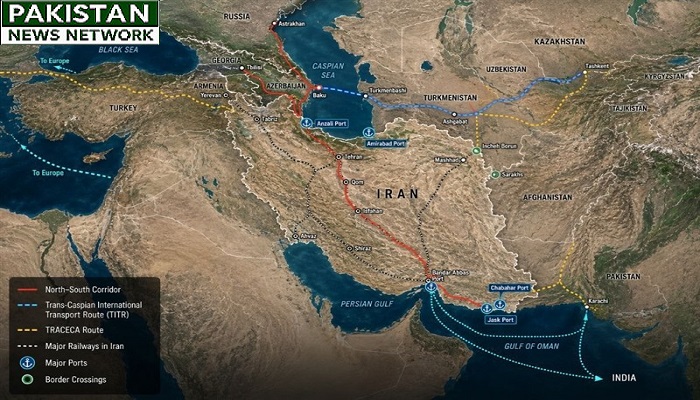
The geoeconomic significance of this bridge extends beyond its local geography; the structure serves as one of the two primary arteries connecting Iran’s national railway network to Turkmenistan and acts as a junction for two major international routes: the joint Iran-Turkmenistan-Kazakhstan railway and the eastern branch of the International North-South Transport Corridor.
The destruction of such infrastructure sends a clear message from Washington to global public opinion: in its pursuit of “maximum pressure” on Iran, the U.S. has no qualms about crippling Central Asia’s supply chains or blocking the trade arteries of its own regional allies and rivals.
Eurasia’s Transit Architecture: Decades of Investment Centered on Iran’s Unrivaled Position
Over the past three decades, Eurasian nations have dedicated substantial investment and intensive diplomacy to establishing an interconnected transit network centered on Iran’s prime geopolitical location. This structural integration—now the target of White House attacks and obstructionist tactics—is the product of decades of fundamental regional agreements:
North-South Corridor (2000): The signing of a strategic agreement among Iran, India, and Russia—later joined by nations such as Kazakhstan, Tajikistan, and dozens of others—which established the route as the shortest and most cost-effective alternative to the Suez Canal.
TRACECA Corridor (2009): Iran’s formal accession to the Transport Corridor Europe-Caucasus-Asia (TRACECA) development program, which officially recognized Iran’s pivotal geographical role in connecting Europe and Central Asia via transit routes.
The Ashgabat Agreement (2011): A key pact among Iran, Oman, Turkmenistan, and Uzbekistan (with the subsequent accession of Kazakhstan, Pakistan, and India) aimed at facilitating and accelerating the transport of goods from the heart of Central Asia to the ports of the Persian Gulf and the Sea of Oman.
A tangible outcome of these agreements is the development of extensive railway lines across Iranian territory—connecting northern borders to strategic southern ocean ports—which serves as a vital “economic lifeline” for the landlocked nations of Central Asia.
Strategic Link between Central Asia and the Ports of Shahid Rajaee and Chabahar
Central Asian capitals are well aware that the shortest, safest, and most cost-effective route to the open seas and global markets lies through Iranian territory. This reality is clearly reflected in recent major agreements and contracts:
First is Kazakhstan’s direct presence at Shahid Rajaee Port. In June, Astana and Tehran signed a strategic agreement based on the Build-Operate-Transfer (BOT) model. The allocation of 15 hectares of land at Shahid Rajaee Port to the Kazakh private sector for a 27-year period—comprising two years of construction and 25 years of operation—demonstrates Astana’s firm resolve to link the two rail corridors traversing its territory to the open waters of the Persian Gulf.
Secondly, Uzbekistan’s economic interests are linked to the port of Chabahar. Tashkent—which requires a reliable route for direct connection to the Indian Ocean and access to the Subcontinent’s markets—signed an agreement with Tehran in 2022 to establish dedicated logistics facilities at Chabahar, enabling it to ship its exports to international destinations via the Iran-Turkmenistan railway line.
India, Chabahar, and Washington’s Blow to New Delhi’s Trade Diplomacy
Since 2015, India has invested hundreds of millions of dollars in developing the oceanic port of Chabahar to secure unobstructed access to Central Asia, bypassing the territories of Pakistan and China (specifically the $62 billion CPEC corridor and Gwadar Port). The recent signing of a ten-year, $370 million agreement between New Delhi and Tehran in 2024 marked a pivotal milestone in solidifying this transport route.
However, the US military offensive—which targeted port facilities, including damage to the Chabahar Port’s marine traffic control tower as well as bridges and tunnels along the route from Bandar Abbas—dealt a stab in the back to Indian investments and international free trade.
The Trump administration’s failure to renew sanctions waivers for Chabahar placed New Delhi in a difficult position; indeed, to shield themselves from the fallout of Washington’s “economic terrorism,” the Indians were compelled to consider scenarios for handing back parts of the port’s management to the Iranian side.
Meanwhile, initiatives by neighboring countries—such as Pakistan granting overland transit rights from Gwadar Port to Iran’s Gabd-Rimdan border crossing—have demonstrated that regional economic ties cannot be severed by White House sanctions mandates.
The “Trans-Afghan” Corridor Mirage vs. Iran’s Inherent, Enduring Advantages
Washington’s disruptive actions have prompted certain regional nations to explore alternative routes. The trilateral agreement among Uzbekistan, Afghanistan, and Pakistan regarding the feasibility of the “Trans-Afghan” railway project, as well as Kazakhstan’s consultations on utilizing Pakistan’s Karachi and Qasim ports, should be viewed in this context.
However, a realistic comparison reveals that attempting to bypass Iranian territory is something of a transit mirage:
Infrastructure and operational readiness: Iran’s rail network is fully developed, continuous, and connected to active ports, whereas the Trans-Afghan project remains merely a plan on paper, with actual construction yet to begin.
Implementation costs and timelines: Fully activating Iran’s transport corridors requires only ongoing investment, while the Trans-Afghan route demands an initial capital outlay of $4.6 to $7 billion and a construction period of at least 5 to 10 years.
Investment Security and Risk Profile: Iran’s geography offers a high level of territorial stability, whereas the Trans-Afghan route faces chronic security challenges within Afghanistan, threats from terrorist groups, and border tensions between Kabul and Islamabad.
Economic and Logistical Rationale: Routes passing through Iran represent the most cost-effective and fastest option compared to bypassing the Arabian Peninsula and the Red Sea; in contrast, alternative hypothetical routes would entail heavy insurance and tariff costs.
The Failure of the Containment Policy; the Enduring Geopolitical Position of Iran along Global Arteries
The greatest threat currently jeopardizing the integration, commercial stability, and mega-projects of Eurasia is not the region’s economic structure, but rather the interventionist, warmongering, and militaristic policies of the United States.
Washington claims to seek expanded cooperation with Central and South Asia at a time when its economic warfare and acts of aggression have become the primary obstacle to the economic prosperity of the region’s nations.
Nevertheless, as evidenced by field data and assessments from senior international analysts, the crises instigated by the White House will never diminish Iran’s fundamental advantages, its unrivaled geostrategic position, or the efficiency with which cargo transits its territory.
Iran’s geography will continue to serve as the most reliable link between East and West and as the beating heart of Eurasian trade; in the long run, no actor will be able to forgo the vital, enduring benefits of this golden corridor simply to align with the United States’ destabilizing policies.