
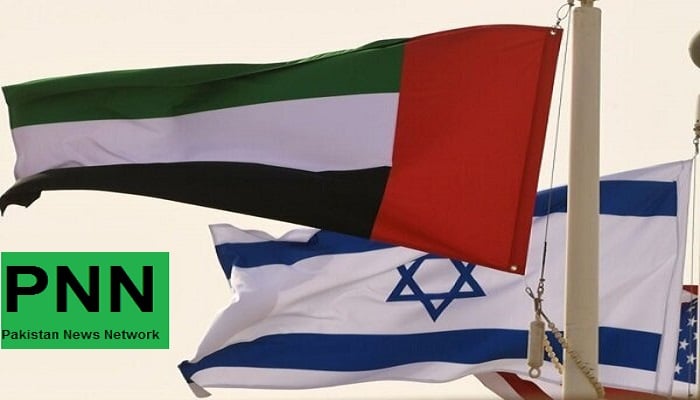
PNN – For years, Emirates has tried to portray the world as a “stable economy,” but its organic ties to Israeli intelligence services have severely damaged this image.
According to the report of Pakistan News Network; When the United Arab Emirates and the Israeli regime signed the Abraham Accords in September 2020, many described it as an economic and diplomatic deal to counter Iranian influence. But developments on the ground and security reports three years later have revealed another face of this relationship. Now, the Emirates has become not a trading partner, but a laboratory for Israeli security and intelligence projects in the heart of the Persian Gulf. Among the six Gulf Cooperation Council countries (Saudi Arabia, Kuwait, Qatar, Bahrain, Oman and the UAE), no country has placed itself at the service of Tel Aviv’s security and espionage strategies as much as Abu Dhabi. The peak of this devotion was not in business agreements, but on the battlefield and in the “Forty-Day War”.
Secret trip of Shin Bet chief to Abu Dhabi
David Zini, head of the Israeli domestic intelligence service (Shi’bak), which is responsible for countering intifadas and resistance operations in the West Bank, recently made a secret visit to the UAE. The purpose of the trip was to meet a key figure: Mohammad Dahlan.
Dahlan, once a senior Fatah commander and head of preventive security in the Gaza Strip, has become one of the most hated figures among the new generation of Palestinians. After falling out with Mahmoud Abbas, he moved to the UAE and now works as a “security advisor” to Abu Dhabi. The Shin Bet chief’s meeting with Dahlan in the UAE establishes a triangular relationship: the UAE (host and financial backer), the Shin Bet (Israel’s intelligence agency), and Dahlan (an instrument of influence in the West Bank and Gaza). This meeting means that the UAE is helping Israel directly influence the political future of Palestine by bringing a figure like Dahlan back into the equation.
Erosion of regional position and political costs
For years, Abu Dhabi has tried to project an image of a “stable economy” to the world. But its organic link to Israeli intelligence services has severely damaged this image. Three major consequences of this subservience are:
A gap with Arab public opinion: Surveys by Arab centers show that more than 80% of citizens in Arab countries consider any security cooperation with Israel a betrayal of the Palestinian cause. The visit of the head of the Shin Bet to Dubai has turned this feeling into disgust.
Loss of Trust in the GCC: Saudi Arabia, which is moving towards gradual normalization with Israel, is alarmed by the speed and depth of the UAE-Israel relationship. Riyadh does not want an armed and spying Israel in its southern neighborhood. This has jeopardized the cohesion of the GCC.
Resistance-centric response: Israel’s overt intelligence presence in the UAE has made the country a legitimate target for cyber, missile, and ground attacks.
Mohammad Dahlan, Israel’s Security Chess Piece in the West Bank
The deepest layer of this cooperation cannot be ignored: the “Dahlan Project”. Israel knows very well that the PA in the West Bank has collapsed and that Mahmoud Abbas has reached the end of the line. Tel Aviv needs a successor who can both suppress armed resistance and ensure Israel’s security with minimal international sensitivity. Mohammad Dahlan, with a history of organizing the “14th and 17th Battalions” (Fatah’s special security forces) and a history of intelligence cooperation with the Mossad in the 1990s, is an ideal choice.
The UAE is not only hosting Dahlan, but also financially and mediating his return to Palestine. Abu Dhabi believes that if Dahlan succeeds Abbas, the West Bank will become Israel’s second base. But this is a gross miscalculation. Gaza and the West Bank have proven that any figure who enters the Palestinians in Israeli garb not only fails, but also fuels the flames of anger.
Why did the UAE choose this path?
The answer can be summed up in one word: fear. The rulers of the UAE are deeply afraid of three things: 1) the victory of Arab democracy (the Arab Spring), 2) the rise of Islamist movements (the Muslim Brotherhood), and 3) the expansion of Iranian influence. Meanwhile, Israel has presented itself as the “guarantor of the survival of the authoritarian Arab regimes of the Persian Gulf.”
Israel provides the UAE with a temporary “security umbrella,” but in return, it uses the UAE as a “forward base” against its neighbors. In other words, Abu Dhabi has effectively ceded its “sovereignty” in a fragmented form to a trans-regional regime. The experience of “Jordan,” which had security cooperation with Israel in the 1970s and eventually became one of the most insecure countries in the region, shows that this path will not lead anywhere.
Conclusion
The recent meeting of the Shin Bet chief with Mohammed Dahlan in the UAE was a rebuke to Abu Dhabi’s claim of “peaceful mediation.” Today, the UAE is not a mediator, but a direct criminal partner in Israel’s crimes against the Palestinians. By becoming Tel Aviv’s intelligence-security bridge to occupied Palestine and the West Bank, the country has staked not only the future of Palestine, but also its own national security.
Any country in the GCC that thinks it can have “limited cooperation” with Israel and remain immune to the fire of conflict is deeply mistaken. The Persian Gulf region is aware of its history: no base that hosts Israeli soldiers and spies will last forever. The sooner the UAE severs this shameful link, the sooner it will not only lose its “regional position” but also become the first victim of “peace” that is not called peace, but “surrender to the occupier.” Abu Dhabi must choose: either part of a regional solution for Palestine, or part of a security problem for itself.