
PNN – Transit disruptions related to the US-Israeli war against Iranian people have put severe pressure on regional and global supply chains, and this pressure is being felt in the Eurasian region.
According to the report of Pakistan News Network; Iran remains at the heart of evolving corridor and logistics architecture across Eurasia. Driven by the crisis stemming from the US-Israel conflict against Iran, heightened geopolitical risks, and the search for new routes to transport goods and energy, Central Asian nations have been compelled to re-evaluate their traditional transit strategies. However, a crucial point is that the “Middle Corridor” suffers from fundamental vulnerabilities, ensuring that routes passing through Iran remain attractive to Central Asian countries.
Transit disruptions linked to the US-Israel conflict with Iran have placed severe pressure on regional and global supply chains. This strain is particularly palpable in Eurasia, where transit interruptions have persisted even after the initial shocks of the conflict subsided. The rerouting of supply chains involving Eurasian nations—specifically regarding freight flows between Europe and China—stems from a combination of geopolitical risks and trade-related concerns. Consequently, the redistribution of logistics flows has emerged as a key issue in the regional policy-making of the five Central Asian states.
Designing Alternative Routes to the North-South Corridor
Intensifying sanctions against Tehran, the existing military bottlenecks in the Strait of Hormuz, and the increasing unpredictability of service delivery conditions in the region have significantly affected Eurasian transit flows. Iran has long served as a pivotal country in the 7,200-kilometer-long international North-South transport corridor, connecting Russia, Central Asian countries, Azerbaijan, and Europe through its integrated rail, road, and maritime networks.
The North-South Corridor reduces the time required for transporting goods by approximately 35 percent compared to traditional routes, aiming to facilitate trade across Eurasia. However, recent disruptions stemming from wartime conditions in the Persian Gulf have diminished the corridor’s efficiency and—amid rising financial instability—prompted a redistribution of freight routes, as commercial enterprises now prioritize route reliability and cost-effectiveness over reliance on a single corridor.
Planning for alternatives is increasingly evident in Central Asian countries. The emerging transit triangle of Turkmenistan, Uzbekistan, and Tajikistan is seeking to strengthen its links to the Caspian Sea and expand land rail links through Kazakhstan to connect China’s Xinjiang region to Europe.
This configuration has significant structural advantages, including reduced dependence on volatile West Asian conditions, along with investments in the digitalization of customs and border mechanisms, electrification of railway lines, and facilitation of customs procedures. These advantages contrast sharply with routes whose reliability has been undermined by recent geopolitical shocks.
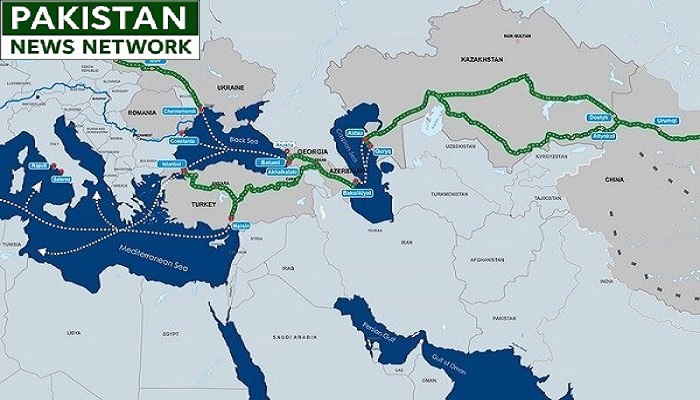
This shift must also be seen in the context of the broader Eurasian logistics system. The Middle or Trans-Caspian Corridor, approximately 6,500 to 7,000 kilometers long, connects northwest China to Europe through Turkey, Georgia, Azerbaijan, Kazakhstan, and the Caspian Sea. It has gained increasing strategic importance as an alternative to the more risky routes through Iran and Russia.
The Middle Corridor transit traffic has increased significantly between 2022 and 2026, and the delivery time on rail routes between China and Europe has decreased to 15-20 days compared to the usual 35-40 days in previous years. In recent months, cargoes that have not passed through the corridor have remained vulnerable to geopolitical disruptions. Rising insurance costs on routes close to the Persian Gulf have also made investment in alternative dry ports in countries such as Uzbekistan an attractive option.
This shift is occurring gradually and in the absence of formal regional agreements among Central Asian states. The strengthening of the Middle Corridor is increasingly based on the risk calculations of logistics companies seeking to reduce dependence, including by limiting reliance on traditional routes such as the North-South Corridor and increasing the number of contingency options. This creates a two-way dynamic for key players, including China, which is heavily dependent on energy transit through the Strait of Hormuz, and Europe, which is seeking relief from disruptions related to Russia’s conflict with Ukraine.
Challenges of the Middle Corridor
This redistribution of corridor routes has other aspects that are usually ignored. The most important point is the resilience of the Middle Corridor. The new route is a hybrid route and does not only pass over land, it has its own bottleneck, and that bottleneck is the Caspian Sea.
The Caspian Sea is at its lowest level in centuries, having fallen by about two meters since the mid-1990s. Officials in various coastal countries report that the volume of cargo has fallen by about a fifth in just one year due to lower ship drafts. Dredging costs have also increased, and some ports in the Caspian Sea countries are losing their loading and unloading capacity. Despite the optimization of railway lines and efforts by various countries to upgrade the limited fleet of commercial ships in the sea, this small loading capacity is becoming a limiting factor for the middle corridor, and this limitation is worsening as the sea itself dries up.
If the resilience of a key corridor is built on a drying sea, its vulnerability will remain unresolved. In such a situation, the middle corridor will not be able to sustainably compete with the north-south corridor of Iran.
What should Iran do?
In light of the above, the main problem in increasing the attractiveness and reliability of the North-South Corridor is not just the recent war, but Iran must also increase the reliability and cost-effectiveness of using the North-South Corridor, problems that have been exacerbated by the intensification of geopolitical risks surrounding Iran. Central Asian countries are seeking to “diversify” their transit routes to reduce their dependence on a single route.
In order to gain the trust of these countries and encourage them to use the North-South Corridor, Iran must adopt a four-pronged strategy that goes beyond traditional diplomacy:
- Ensuring physical security through the “doctrine of positive logistic neutrality”
Central Asian countries are concerned that the North-South corridor will become a battlefield. Iran should announce the creation of a “logistical safe zone” on routes leading to Central Asia. Instead of focusing solely on southern ports (which are subject to tension in the Persian Gulf), Iran should activate combined routes that pass through less tense areas in the Sea of Oman.
Holding joint exercises to protect trade convoys with Central Asian countries and emphasizing the separation of logistical routes from military targets is another practical guarantee. Iran must prove that the North-South corridor on its territory is equipped with a secure shield and will not become a target itself.
- Reducing financial and sanctions risks
Concerns about rising insurance and banking costs are another serious challenge. Iran could establish a joint “transit risk guarantee fund” with countries using the North-South corridor. This fund could cover losses caused by delays in the transfer of cargo or Western sanctions for a limited period of time, reducing concerns for Central Asian shipping companies. Abandoning the dollar and euro and using bilateral monetary agreements with national currencies (rial-samian dollar-tenge) to bypass the sanctioned banking system would also reduce transaction costs.
- Bridging the Middle Corridor and North-South Instead of Competing
Iran should not simply be a competitor to the Middle Corridor, but can position itself as its southern complement. Iran can propose that cargo arriving at the Caspian Sea via the Middle Corridor should reach its destination via Iranian railways, rather than relying on limited ships and low-capacity ports on the shores of the receding Caspian Sea. It is also essential to create a unified electronic customs system between Iran, Turkmenistan, Uzbekistan, and Kazakhstan that would reduce cargo waiting times. Iran should close the time gap with the Middle Corridor by fully digitizing border procedures.
- Acting as a “mediator” between rivals
Iran could host a “transit security summit” with the five Central Asian countries, Russia, India, and China. Iran should appear at this summit not as a party to the crisis, but as a “crisis manager” and guarantor of stability on the southern route. Accepting the role of mediator and providing multilateral guarantees would reduce the political risk of connecting the corridor to Iran.