
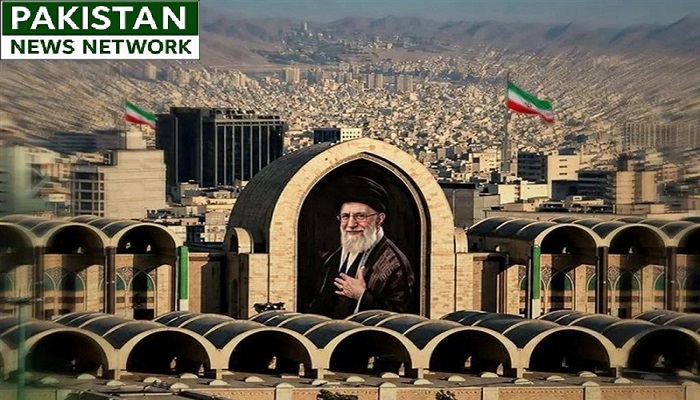
PNN – Despite their habitual bias, international media have acknowledged the role of the martyred Imam in shaping a strong Iran.
According to the report of Pakistan News Network; international media have extensively covered the scheduled farewell of foreign delegations to the martyred Leader of the Islamic Revolution, Ayatollah Seyyed Ali Khamenei, as well as Iran’s preparations for this momentous event.
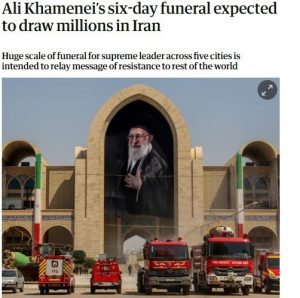
The British newspaper The Guardian reported that millions of people are expected to attend the six-day funeral procession for Ayatollah Khamenei in Iran. The newspaper wrote that the massive funeral ceremony for Iran’s Supreme Leader, spanning five cities, is intended to convey a message of resistance to the rest of the world.
The newspaper also writes: It is intended to be an epic display of personal mourning, national strength, resilience, and social cohesion. The scale of the funeral is such that it conveys political and religious messages of resistance to the rest of the world. At the request of Iraqi politicians, the former leader’s body will also be carried in procession through the Shiite cities of Karbala and Najaf in Iraq.
In the concluding part of the report, The Guardian recalls remarks made by Ayatollah Khamenei during one of his recent speeches on February 17; citing the Shiite symbol of steadfastness, he stated: Someone like me does not pledge allegiance to someone like Yazid. A nation with Iran’s culture does not pledge allegiance to corrupt leaders like the rulers of the United States.
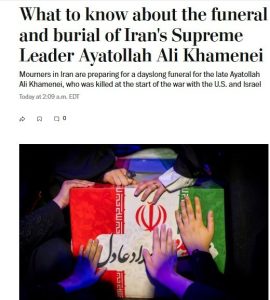
The American newspaper The Washington Post has also published a report titled: What to Know About the Funeral and Burial of Iran’s Supreme Leader Ayatollah Seyyed Ali Khamenei, detailing the ceremonies scheduled to take place in Iran and Iraq.
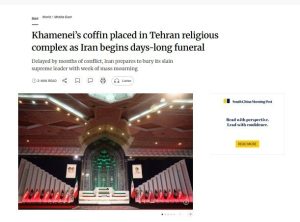
In a report marking the occasion, Agence France-Presse (AFP) noted that the body of the Iranian leader—who was martyred in US and Israeli attacks—was transferred to Tehran’s Grand Mosalla on Friday, prior to the official funeral ceremony, according to Iranian state media reports.
Agence France-Presse also reported that one of the workers at the site—wearing a hat and a scarf to shield himself from the intense heat—said: We are planting flowers and watering the shrubs for the farewell ceremony for our martyred leader. People will come from all over Iran. A massive crowd will be present.
This media outlet has written: Ayatollah Khamenei, regarded by many Shiites as a spiritual figure, was martyred at the age of 86 in attacks on his residential complex in the center of the Iranian capital. His body will lie in state for three days at Tehran’s Grand Mosalla—draped in banners featuring his images and quotes—to allow for a public farewell.
The ceremony is expected to draw between 15 and 20 million mourners, making it the largest funeral in the country’s history. Ghalibaf described the event as “one of the most important moments” in Iran’s history.
The Palestine Chronicle also, referring to the slogan of the farewell ceremony for the martyred Imam, wrote: The time has come to rise: Iran awaits the funeral of [Ayatollah] Khamenei, while an [Iranian] official has issued a region-wide warning.
In a statement, Mohammad Bagher Ghalibaf, the Speaker of the Iranian Parliament, invited the public to attend the funeral procession and described the event as one of the most significant moments in the country’s contemporary history. He said: Today, Iran stands on the threshold of witnessing one of the most momentous scenes in its history, bidding farewell to a great man who dedicated his life to the independence and dignity of his people.
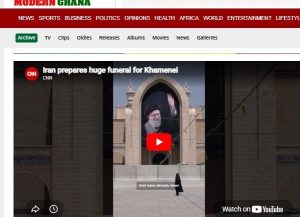
Citing a YouTube video from CNN, the Modern Ghana website reports that Iran is preparing for a massive funeral ceremony for Ayatollah Khamenei. The video provides details regarding the planned ceremony.
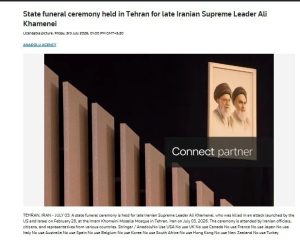
The British news agency Reuters has prepared a report on today’s ceremony at Tehran’s Mosalla, where foreign guests paid their respects to Ayatollah Khamenei.
This media outlet has written: A ceremony paying tribute to Seyyed Ali Khamenei—the late leader of Iran who was martyred in an attack by the United States and Israel on February 28—was held at the Imam Khomeini Mosalla in Tehran. The event was attended by Iranian officials and representatives from various countries.
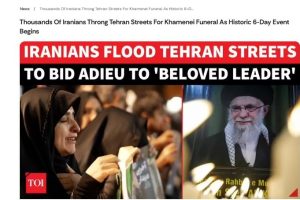
Indian media outlets have also given special coverage to the start of the ceremony. The English-language website India Times wrote: Thousands of Iranians poured into the streets of Tehran as the historic, six-day funeral procession for [Ayatollah] Khamenei began.
In this article, the media outlet has published a video showing Iranians mourning the martyred leader. At the beginning of the video, the following text appears in English: A flood of people took to the streets of Tehran to bid farewell to Iran’s beloved leader.
One of the participants in the ceremony says, with tear-filled eyes, that he feels terrible because Iran has lost its father.
The NDTV network’s website has also published a video and written: Iran bids farewell to Ayatollah Khamenei.
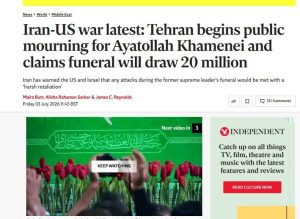
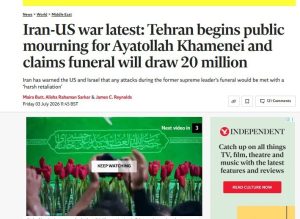
The British newspaper The Independent has also reported that Tehran has begun public mourning for Ayatollah Khamenei, noting that the ceremonies are expected to draw 20 million people into the streets. Elsewhere in its report, the paper states that officials anticipate the funeral procession in Tehran could attract up to 20 million mourners and expect the public turnout to serve as a “referendum” on the Islamic Republic.
The English-language section of the Al Jazeera news network website has also published a detailed report outlining the time and location of the gatherings for mourners attending the ceremony for Imam Khamenei. In part of the report, Al Jazeera introduces Ayatollah Khamenei, noting: Ayatollah Ali Khamenei assumed leadership of Iran in 1989 following the death of Ayatollah Ruhollah Khomeini, who had led the Islamic Revolution a decade earlier and become the country’s first Supreme Leader.
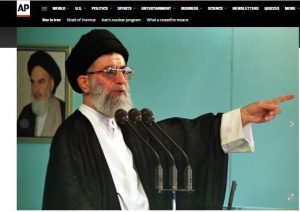
In a detailed report, the American news agency Associated Press also highlighted Ayatollah Khamenei’s role in transforming Iran into a regional power and shaping the powerful armed forces of the Islamic Republic of Iran.
The Associated Press has noted that among Ayatollah Khamenei’s other actions was the strengthening of Iran’s military power, including through support for the country’s regional allies. The outlet reported that during Ayatollah Khamenei’s tenure, Iran built the “Axis of Resistance.” This effort included supporting the Lebanese resistance group Hezbollah, which drove Israel out of southern Lebanon in 2000 and has since clashed repeatedly with Israeli forces.
In another part of its report, the American media outlet highlights the Iranian Supreme Leader’s insistence on pursuing Iran’s nuclear rights, noting that he advanced the country’s nuclear program throughout his decades-long rule. [Ayatollah] Khamenei issued a fatwa declaring nuclear weapons to be contrary to Islamic beliefs, yet vowed that the country would never relinquish its right to develop a “peaceful nuclear energy program.”
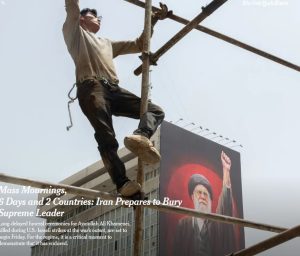
In an article titled Mass Mourning: Iran Prepares for the Burial of Its Supreme Leader Across Six Days and Two Countries, the American newspaper The New York Times writes: Few ceremonies in history match the magnitude, scale, and significance of the one the Iranian government is preparing for its slain leader, Ayatollah Ali Khamenei.
The newspaper reports that government officials expect the ceremonies—which began in Tehran on Friday, are set to last nearly a week, and are taking place in at least five cities across Iran and Iraq—to draw tens of millions of people.
According to The New York Times, Ayatollah Khamenei was not merely Iran’s head of state; he was a Shiite cleric with followers in Iraq, Lebanon, Pakistan, and other countries in the region, and his image is frequently seen at Shiite processions.
The newspaper reports that Iran is seeking to frame the funeral ceremony as a moment of national unity and shared grief, a display of bureaucratic capability, and a demonstration of resistance against a foreign enemy. The emblem for the event, released by the official planning body, features Ayatollah Khamenei’s clenched fist alongside the slogan “We Must Rise.”
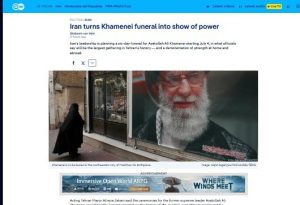
The English-language service of the German broadcaster Deutsche Welle has also stated in a report that Iran turned the funeral of its former leader into a show of strength. Noting the memorandum of understanding signed between Iran and the United States, the outlet wrote that the inclusion of the “Lebanon front” as the first clause in the agreement indicates that Ayatollah Khamenei’s foreign policy will continue under his son’s leadership.
Many other international media outlets—such as The Wall Street Journal (US), CNN (US), NBC (US), CBS (US), i24 (Israel), The Hill (US), The Telegraph (UK), Daily Mail (UK), the BBC (UK), Sky News (UK), and Financial Times (UK)—have also published similar reports, affirming the role of the martyred leader in shaping a strong Iran.