
PNN – Yemen is no longer just a war front; it has become a key component of regional deterrence.
According to the report of Pakistan News Network; The recent statements by Abdul-Malik Houthi, the leader of Yemen’s Ansarullah movement, that the movement is prepared for “any level of escalation of conflict in the region” are part of a deterrent message to the United States, the Zionist regime, and regional actors who have tried in recent months to change the balance of power in West Asia in their favor through military and political pressure.
The developments of the last two years have shown that Yemen is no longer a marginal player in the regional equations. A country that was involved in civil war and foreign aggression for years, has today become one of the most important deterrent components in the axis of resistance; a component that has been able to affect the global economy, international trade, and the security calculations of major powers beyond its geography.
Greater Israel; a Plan to Change the Map of the Region
In his speech, the Ansarullah leader spoke of a project he described as “Greater Israel” and an attempt to change the map of the Middle East. After the Gaza war, many observers believe that the Zionist regime and its Western supporters are seeking to shape new security arrangements in the region; arrangements whose main goal is to limit independent actors and eliminate resistance capacities from the future equations of West Asia.
In such circumstances, Yemen does not see itself as simply defending its national interests, but rather as part of a regional front that extends from Gaza to Lebanon, Iraq, and other parts of the region. It is from this perspective that Abdul-Malik Houthi speaks of continuous coordination with the axis of resistance and warns that any all-out war against this front will be met with a reciprocal response.
The Geopolitical Position of Bab al-Mandab
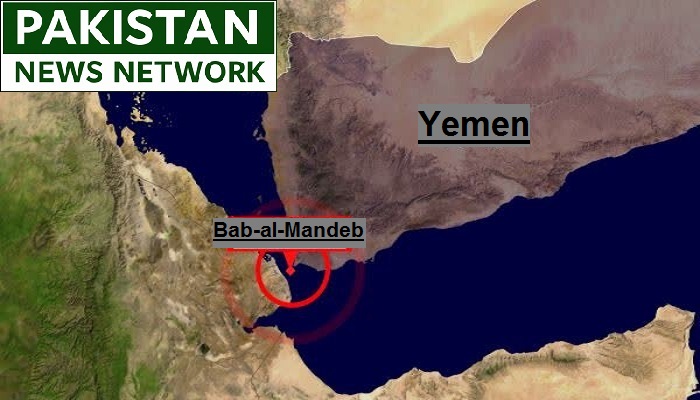
What give these warnings more weight is not simply Yemen’s missile and drone capabilities; it is the country’s unique geopolitical position. Bab al-Mandab is one of the world’s most sensitive energy and trade bottlenecks. The Bab al-Mandab Strait is one of the world’s most important strategic chokepoints, connecting the Red Sea to the Gulf of Aden and the Indian Ocean. The sea passage is about 30 kilometers wide at its narrowest point and is located between Yemen on the Arabian Peninsula and Djibouti and Eritrea on the Horn of Africa. The Bab al-Mandab is so important that many experts consider it one of the three main highways of global trade, along with the Strait of Hormuz and the Suez Canal.
According to international estimates, more than 6 million barrels of oil and petroleum products pass through this route every day. Also, about 12 percent of the world’s maritime trade and nearly 30 percent of the world’s container traffic depend directly or indirectly on the security of this waterway. Tens of thousands of commercial ships, tankers and military vessels pass through Bab el-Mandeb every year.
Any disruption in this passage could force ships to bypass the African continent via the Cape of Good Hope; a route that adds about 6 to 10 thousand kilometers to the sea voyage and greatly increases the cost of global transportation. For this reason, the control and security of Bab el-Mandeb is not only a regional issue, but also a vital issue for the economy and international security.
The importance of this passage is such that even Western media and think tanks have repeatedly warned about Yemen’s decisive role in global maritime security. Millions of barrels of oil and a huge volume of global trade pass through Bab al-Mandab every day, causing any insecurity in this region to immediately affect global energy markets, maritime transport costs, and the international supply chain.
Yemen; a Power beyond Missiles and Drones
For this reason, contrary to popular belief, Yemen’s power is not limited to the number of missiles or drones it has. The country’s most important strategic advantage is its ability to influence one of the most sensitive arteries of the global economy. This is the same factor that has forced many international shipping companies to change the route of their ships and increase transportation costs in recent months.
In fact, if Gaza has become a symbol of popular resistance, Yemen has become one of the symbols of the ability to transform geography into strategic power. A country that was under siege for years is now able to influence some of the world’s most important security equations.
From the American perspective, the situation is also more complicated than in the past. In recent years, Washington has tried to manage several crises simultaneously; from the war in Ukraine to competition with China in East Asia and support for the Zionist regime in West Asia. In such a situation, the opening of a new broad front in the region could bring heavy costs for the United States.
Abdulmalek Houthi’s warning about Washington’s attempt to drag the axis of resistance into a comprehensive confrontation can also be analyzed in this framework. Experience has shown that whenever the United States and its allies have sought to increase military pressure, the resistance front has tried to increase the cost of decision-making for the other side by creating a balance of threat.
From this perspective, the Ansarullah leader’s remarks can be seen as part of a strategy of deterrence, a strategy aimed at preventing miscalculations in Washington and Tel Aviv. In security literature, deterrence is effective when the other side concludes that the costs of military action outweigh its potential benefits. Yemen is now trying to convey such a message.
Warning to regional countries
Another important point is Abdul-Malik Houthi’s explicit warning to regional countries about entering a war on behalf of the Zionist regime. This part of his speech shows that the Ansarullah leaders believe that some regional actors may enter the arena within the framework of American plans to contain the resistance. However, the experience of the past years has shown that many regional governments are also aware of the consequences of any all-out war and have little desire to become part of a widespread conflict.
The reality is that the West Asian region is at a critical juncture today. On the one hand, the Zionist regime is trying to manage its security crises through military pressure and changing regional balances, and on the other hand, the axis of resistance is seeking to prevent the realization of such goals by maintaining and strengthening deterrence.
In the meantime, the role of Yemen has become more important than ever. A country that was once considered a purely humanitarian and security issue has now become one of the decisive players in the geopolitical equations of the region. This development not only indicates a change in the balance of power in West Asia, but also indicates the emergence of a new reality; a reality based on which the security of the region can no longer be analyzed without considering the role of non-state actors and resistance movements.
Conclusion
Finally, the main message of Abdul-Malik Houthi’s speech is clear: any attempt to expand the war and impose the order desired by the US and the Zionist regime will be met with a widespread response, one of the most important centers of which is Yemen. A country that today is not on the periphery, but within the context of the security and strategic equations of West Asia and can play a decisive role in shaping the results of any new confrontation.
For this reason, perhaps the most important point in the current developments is that Yemen is no longer just a war front; it has become one of the main components of regional deterrence; a component that can make any calculation to start a new war face unpredictable complications and costs.