
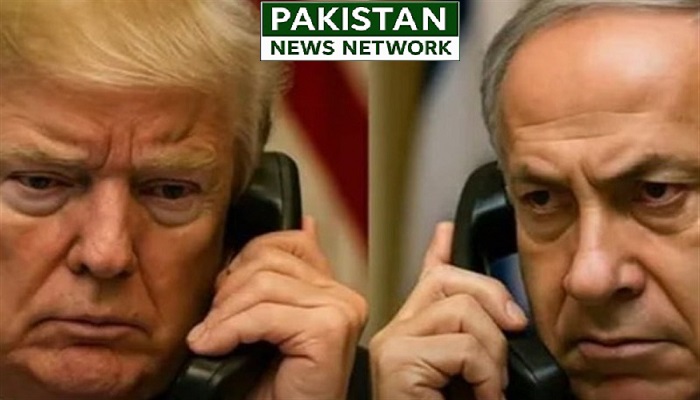
PNN – The Zionist military analyst admitted that the names of Netanyahu and Trump will be recorded in history as failures.
According to the report of Pakistan News Network: Alon Ben-David admitted in a note published on the website of the Ma’ariv newspaper today, Saturday: The Israeli army will be forced to learn one of the biggest lessons from the defeat it suffered in the war with Iran, and in various dimensions, and the most important lesson is that it should no longer allow its political structure to be used for unrealistic and illusory goals.
Ben David, who is also an analyst for the Israeli Channel 13 television, continued: This week could go down in history as the week when the strategic balance of power in the Middle East changed: Israel, which was until now the strongest regional power with American support, has lost its ability to influence and shape the region, and the Iran-US agreement will transform Iran into the strongest and most influential regional power.
For years, Israel was a power that all countries in the region sought to attract, exploiting our technology and expertise and trying to get closer to us, even if these actions were carried out in secret.
But this agreement pushes the countries of the region away from us and eastward, towards the Islamic Republic, as the dominant power in the region, which must now be respected and appeased.
The agreement gives Iran a financial boost, estimated at at least tens of billions of dollars this year through oil revenues and the release of frozen funds.
It is not yet clear whether the agreement will allow Iran to impose transit fees through the Strait of Hormuz, which would also bring in more revenue.
According to this Zionist analyst, Iran, which was subjected to international pressure in February (under various pretexts), is today gaining more and more international and regional legitimacy, while Israel is now viewed as a belligerent structure that destabilizes the region.
According to this Hebrew-language media outlet: Iran is now legitimizing its nuclear program by recognizing its right to enrich uranium on its soil, while the fate of the enriched materials, at various levels, remains uncertain.
Ben-David also reiterated Tel Aviv’s wishes, telling his audience: It is unlikely that the Americans will be able to produce a detailed and stable nuclear agreement within sixty days, and the interim status of the agreement could continue for a long time.
Another part of the memo states: The US President publicly recognizes Iran’s right to have a ballistic missile program, and no one is talking about Iran’s support for its proxies: Hezbollah, the Houthis, Hamas, and Islamic Jihad.
He also asked: How did we get to this point (of failure) after all the powerful blows the Israeli military has dealt to Iran?
The answer lies in setting unrealistic war goals. Israel explicitly defined regime change as a war goal, even though it was not among the goals set by the Israeli military. Benjamin Netanyahu also managed to convince Donald Trump that regime change was within reach. The entire justification for the war was based on this goal, and when it was not achieved, all other gains from the war were also lost, (and we failed).
The prominent Zionist analyst claimed that in the Twelve Days War of last June, Israel set realistic goals for itself, however, from the moment the United States and Israel set the goal of regime change for the recent war, the survival of the Iranian regime as a structure that resisted and survived against the world’s superpowers and powerful regional forces will be recorded in history.
Even worse, Israel is now unable to take overt action against Iran. Therefore, its main task is to develop intelligence and deterrence capabilities that will prevent Iran from obtaining nuclear weapons. This will not be an easy task for the Israeli Mossad, led by Roman Goffman, who runs the Mossad with his inexperienced assistants.
The war also exposed the weakness of the United States, and this weakness will be reflected in its policies in other areas of conflict.
Israel’s success in bringing the United States to its side in the war against Iran was remarkable, but since the war was lost, it is doubtful that any American would have dared to confront Iran. We were left alone in this battle.
The regional and global lesson learned from the 40-day war against Iran is how easily and simply one country can influence the entire world.
According to a military analyst on Israeli Channel 13 television, Iran, without a navy or air force, and under attack from two superpowers, was able to close an international waterway.
This is a lesson that Hezbollah and the Houthis have learned, and from now on, any conflict could potentially harm Israel’s supply lines or international shipping.