
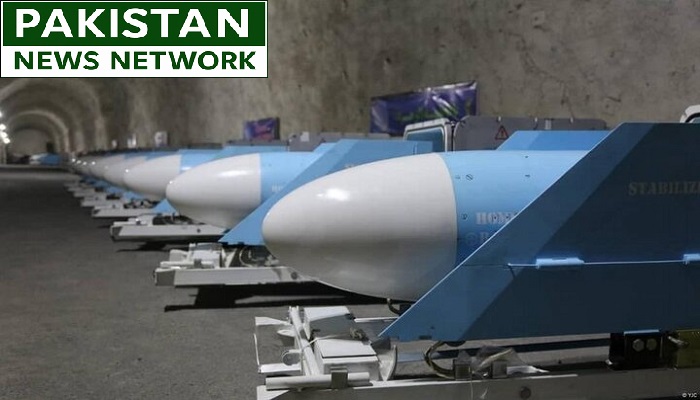
PNN – A Zionist newspaper, citing the activation of many of Iran’s damaged missile cities during the 40-day war, wrote that Iran has designed its missile defense infrastructure for a long war.
According to the report of Pakistan News Network, the Hebrew-language Ma’ariv newspaper, in a report referring to Iran’s underground missile infrastructure, wrote that satellite images and new intelligence analysis show that Tehran has succeeded in reactivating a large part of its underground missile infrastructure in a short period of time.
According to the report of the Zionist newspaper, new satellite data and geographical analysis show that Iranian engineering and security teams have been able to reopen most of the tunnel entrances that were damaged or blocked by US attacks.
Ma’ariv cited analysis published by CNN that showed that Iran has been able to reopen 50 of the 69 tunnel entrances in 18 underground missile facilities that were previously targeted and directly damaged or blocked by airstrikes.
Based on data from satellite imagery and new geospatial analysis, Iranian engineering and maintenance teams have been able to reopen most of the tunnel entrances that were damaged or blocked by bombing, allowing large parts of the missile cities to be reconnected to road networks and critical operational corridors.
Western intelligence reports indicate that Iranian engineering and maintenance teams are using bulldozers, cranes, and conventional trucks, suggesting that they have contingency plans in place to deal with severe attack scenarios and attempts to disrupt the missile cities’ infrastructure.
According to the report, the speed of reopening the tunnel entrances not only demonstrates Iran’s engineering capabilities, but also demonstrates Iran’s defense concept, which is based on the continuity of operations even in the event of a direct attack. Iran’s defense equation emphasizes the creation of alternative access routes and additional operational routes, which aim to ensure freedom of movement inside the underground facilities even after some entrances are targeted.
The Ma’ariv newspaper, for example, points to the Dezful base as one of the most prominent pivotal points, where technical teams have been able to reactivate four of the five damaged entrances.
On the other hand, military experts believe that recent developments show the limited impact of airstrikes on Iran’s underground protected facilities and missile cities.
The Arabi 21 website writes in this regard that, according to these experts, a large part of the American and Zionist attacks have been focused on external entrances, road networks and surface radars, while it is likely that the central warehouses and missile reserves of these cities, which are located deep underground, were out of range of direct attack.
Retired Major General and military analyst Hashem Ahmad described the US-Zionist attacks on Iran’s missile cities as only causing a “temporary tactical disruption,” explaining that the attacks only succeeded in slowing down the missile firing operations of these cities for a limited time, but did not cause any damage to the missile power deployed inside Iran’s fortified missile cities.
Ahmad added that the strategy of branching tunnels and multiple layers of defense has given Iran the ability to contain the consequences of the attacks and reactivate the facilities at a faster pace than initially estimated.
Retired Major General Jalal al-Khawaldeh, a military analyst, said that Iran’s missile cities are designed with an extensive network of tunnels and alternate exits. This structure, he said, reduces the effectiveness of attempts to disrupt the facilities by targeting the main gates.
Al-Khawaldeh stressed that the resumption of operations of a large number of these bases in a short period of time is an operational message that Iran’s missile infrastructure is designed to withstand attacks and continue to operate even in a prolonged conflict scenario.