
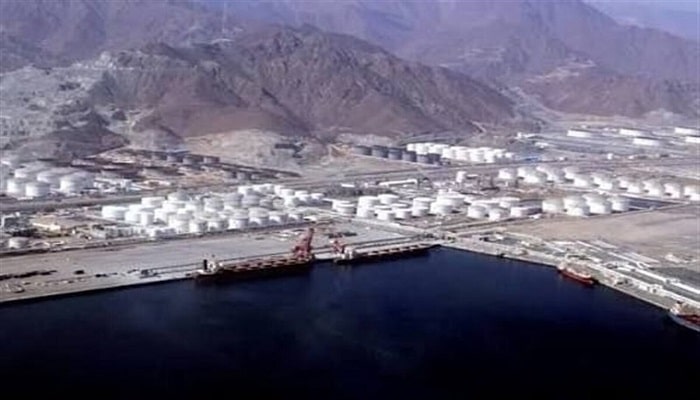
PNN – In addition to the UAE’s growing concern over the sharp decline in Fujairah Port’s oil reserves, the global energy market is also on the verge of a new shock.
According to the report of Pakistan News Network, while the world is watching the situation in the Strait of Hormuz with concern and Iran has managed to stabilize its equation in this strait and the passage through it depends on the will of our country, yesterday Reuters reported that the oil reserves of the UAE’s Fujairah port are experiencing their worst decline in the past 9 years. But what does this mean? And what is the importance of the Fujairah port for the oil market?
The strategic importance of the UAE’s Fujairah port in the world oil market
According to Al-Masirah, the port of Fujairah is located on the east coast of the United Arab Emirates and is about 70 nautical miles from the Strait of Hormuz, giving it a strategically important position on one of the world’s most important trade and energy routes. Today, the port is one of the world’s most important ports for supplying commercial ships.
Fujairah, due to its geographical location, is the destination the world turns to when the Strait of Hormuz is closed. The city is considered the “lung” of the global energy market and is one of the most strategic points on the maritime trade map.
The Port of Fujairah is ranked as a major global bunkering hub after Singapore, Rotterdam and Zhoushan, with thousands of giant oil tankers passing through and stopping there to refuel and complete their voyages between East and West.
Because of this strategic role in maritime trade, Fujairah has vast areas of huge storage tanks owned by international and local companies. These tanks act as a kind of “bank” where companies store oil, gasoline, diesel and jet fuel, waiting for prices to improve or to ensure immediate supply to their customers in Asia and Africa.
In addition to storage, Fujairah is home to advanced refineries such as the Vitol Refinery and the ENOC Refinery, which convert crude oil into finished, ready-to-use products. This makes the Port of Fujairah one of the largest crude oil and fuel storage centers in the world.
What does the decline in Fujairah Port’s oil reserves mean?
Given the port’s strategic importance, the announcement of a decline in oil reserves below 7 million barrels means that the port, which was supposed to save the world if the Strait of Hormuz were closed, will soon be almost completely empty, especially after the Abyssinian pipeline that carries Abu Dhabi oil to Fujairah to bypass the strait was damaged during the recent war.
The fact that oil reserves in Fujairah have fallen to this low, below 7 million barrels and reaching an all-time low, is not just a statistical figure. It is a highly sensitive geopolitical and economic indicator of risk. It means that the “alternative storage” that ships rely on to avoid entering the conflict zone in the Persian Gulf is running out.
This, in addition to straining the UAE economy, which had previously requested financial support in dollars from its Zionist-American ally, puts global trade in a severe logistical predicament.
The American newspaper The Wall Street Journal reported on Sunday that the UAE has requested financial support from the United States to prevent a deeper crisis caused by the Zionist-American war against Iran.
Heavy fuel oil stocks at the Fujairah storage facility have recently hit their lowest level, reaching 3.91 million barrels in the week to April 13, according to data from the Fujairah Petroleum Industrial Park, Reuters reported.
Ships are avoiding Fujairah port
Even with Fujairah reporting this significant shortage, ships are now avoiding the port, as well as the port of Khor Fakkan in Bahrain, given the UAE’s 120 million barrel storage capacity.
Reuters reports that ships are avoiding the port due to the risks associated with refueling there, combined with high fuel prices. These factors have led to a decline in demand for Emirati fuel in recent weeks, prompting shipping companies to shift orders to alternative ports in Asia, including Rotterdam, the Mediterranean, Colombo and India. Singapore saw the highest sales volume in the first two weeks of the war.
In any case, with the reduction in fuel supplies at Fujairah, other tankers refueling at the port will be forced to wait for weeks as fuel supplies dwindle, or travel long distances to refuel at alternative ports such as Singapore.
This will further increase insurance and transportation costs, which will be immediately reflected in the price of goods for the end consumer, including oil prices. Although Fujairah’s share of the global bunkering market is only 1.7-2%, which may seem small, it is in fact a misleading figure that conceals major strategic importance.
Fujairah Port Ineffective in Coping with Consequences of Strait of Hormuz Closure
Fujairah is not just a storage center; it is a global transportation hub connecting East and West. The giant tankers that transport oil from the Persian Gulf to Asia and Europe have no realistic logistical option to complete their journeys without refueling at this particular point.
If the port becomes unusable, available alternatives such as Singapore are far away. This means that any disruption to Fujairah will result in significant disruption.
Fujairah’s value goes beyond its role as a mere “refueling station” and has become a vital “emergency exit” for energy. Its crude oil export capacity via the Abyssinian pipeline ensures a flow of 1.5 million barrels per day out of the Strait of Hormuz.
As a result, the decline in Fujairah’s reserves is a clear sign of the decline of this foreign “lion of safety” and its position as the only “lifeline” for the UAE’s continued energy supply in the event of the closure of the Strait of Hormuz.