
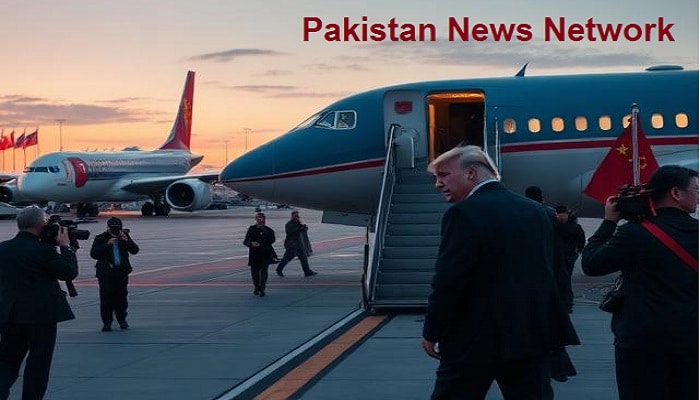
PNN – US President Donald Trump’s visit to China took place at a time when the country’s position in the domestic and international arena has been significantly weakened.
According to the report of Pakistan News Network; US President Donald Trump’s visit to China comes at a time when the country’s domestic and international standing has been significantly weakened. The escalating war with Iran, the closure of the Strait of Hormuz, the wide-ranging economic fallout in the West, and Trump’s unprecedented decline in popularity at home all suggest that the president traveled to Beijing not from a position of power but out of necessity. On the other hand, China has taken advantage of Washington’s crises to strengthen its position in the global system, especially in the global South.
The Decline of American Power in the World System
The war with Iran, the main focus of the current crisis, has painted a picture of America’s strategic weakness. The Atlantic magazine wrote in a frank analysis: America has been silenced in Iran. China and Russia have strengthened their role as Iran’s allies, and America’s role is significantly reduced. This assessment is not limited to the media; Democratic Senator Chris Murphy also acknowledged: Iran still has most of its missiles and drones. Iran’s nuclear program is intact. Iran has become even more powerful after the war. This is a complete disaster for Washington.
From a geostrategic perspective, Washington is under pressure on several fronts at once. The closure of the Strait of Hormuz has not only challenged the logistical capabilities of the US Navy, but has also disrupted global energy security, prompting Trump to release 53 million barrels of oil from strategic reserves, a move that is itself indicative of a supply crunch. JPMorgan Chase has warned that developed-country oil reserves could reach “operational stress levels” by early June. This failure to ensure the stability of a vital thoroughfare highlights the decline of US logistical hegemony.
At the same time, China has consolidated its position by maintaining strategic composure and not directly engaging in conflict. The Council on Foreign Relations (CFR) says: China has the upper hand. The Iran war and America’s dependence on vital minerals have increased Beijing’s leverage. The Center for Strategic and International Studies (CSIS) also emphasizes that China “stands up to the US with confidence” on issues such as Iran, tariffs, technology and rare earths, and has set its goal of “making US behavior predictable.” In the Chinese public sphere, Weibo and other social media users have widely pointed to the weakening of the US in the war with Iran and described Trump’s trip as a “needy trip.”
Moreover, the regional architecture of the Middle East is also changing to America’s detriment. A Chatham House analysis shows that Gulf States have lost confidence in the US security umbrella and are viewing China as a complementary partner. This shift in perspective has weakened Washington’s traditional leverage and made Beijing an active actor in regional order-building.
America’s Dispute with Allies
The Iran war and its economic consequences have created deep rifts between the United States and its long-time allies. The closure of the Strait of Hormuz has sent a severe inflationary shock to European and Asian economies and has increased protests against the White House’s unilateral policies. The rise in food and energy prices, which the Washington Post described as the fastest growth in the last four years, is not unique to the United States; this crisis has also affected allies in the West and put them in a difficult position.
The Gulf Arab states, traditionally strategic pillars of US alliances, are now wary of Washington’s security umbrella. The Chatham House analysis explicitly speaks of a “loss of trust” in the US, and emphasizes that they see China as a “complementary partner.” This shift is part of a broader trend in which traditional allies are shielding themselves from the costs of US adventurism.
China’s Foreign Ministry is also cleverly exploiting this gap. In a statement issued on May 13, 2026, Beijing welcomed Pakistan’s mediation efforts between Iran and the United States, called for the lifting of unilateral US sanctions, and stressed the need to “intensify mediation efforts.” This stance, in clear contrast to Washington’s maximum pressure approach, is appealing to allies who are suffering from continued sanctions and energy insecurity. Even countries like Pakistan, which were defined as being within the US sphere of influence, are tacitly distancing themselves from Washington’s monopoly on regional crisis management by accepting the role of mediator.
Trump’s domestic approval rating is also eroding.
A May 2026 Reuters/Ipsos poll found that 62 percent of Americans believe Trump has not provided a clear reason for war with Iran, and only 28 percent find the administration’s goals convincing. Fox News reports that 66 percent of respondents disapprove of the president’s economic performance and 63 percent disapprove of his foreign policy. The Morning Consult Institute also reported Trump’s net approval rating at minus 12, the lowest level in his second term.
The roots of this discontent lie largely in the economic consequences of the war. The Washington Post reported that food prices rose at their fastest rate in four years in April 2026. Energy inflation and the closure of the Strait of Hormuz have taken a direct toll on people’s tables. The release of 53 million barrels of oil from the Strategic Petroleum Reserve, while temporary, was seen as a sign of the depth of the crisis rather than a relief.
The confessions of political figures have also added to the deterioration of the situation. Senator Chris Murphy called the defeat in Iran “a complete disaster for Washington” and stated that “Iran has become more powerful than before.” Such confessions have destroyed the political capital of the White House to exploit the China trip. American social networks are also full of criticism of the “futile and attrition war” and “weakness against China.” Accordingly, Trump returned from Beijing with his domestic support at its lowest point and his bargaining power with Chinese leaders has been sharply reduced.
A Trip That Achieved Nothing
The above three axes clearly show that Trump’s trip to China was not made in the position of a victorious superpower, but in the position of a defeated one. The decline of American global power with the stalemate in Iran and the shift in the balance in favor of China, the rift with traditional allies over the costs of war and sanctions, and the collapse of the president’s domestic popularity have all combined to minimize Washington’s maneuverability.
US President Donald Trump’s two-day visit to China was more about the sidelines than the text. The media captured a wealth of sidelines during the trip. The first point was that Trump, unlike usual, stood next to his Chinese counterpart with courtesy and did not act bossy or bossy. The image that everyone has in mind of Trump is that of someone who likes to humiliate the leaders of other countries and somehow conveys America’s superiority through body language; but during the trip to Beijing, there was no such gesture and behavior, and Trump was made to understand that he should not be rude to the Chinese president.
Of course, the Chinese were also smart and took the lead in humiliating Trump. Trump arrived in Beijing angry and humiliated after being greeted by a staff member of the Chinese president’s office. The media wrote upon the US president’s arrival in Beijing that Trump had been insulted for the first time and that the Chinese president ignored him and did not come to greet him in person.
Franklin Flores wrote in The Atlantic: Trump’s visit to Beijing was a symbol of the decline of American power, with China entertaining the president without offering any real concessions. Despite the lavish protocols and ceremonies, the Xi-Trump meeting yielded no significant political or economic gains for Washington.
The Atlantic wrote: When America extends its hand, no one rushes to take it, and when it threatens, no one is afraid. Xi not only refused to offer a concrete plan to end the Iran war, he also refused to sign a major trade deal or provide guarantees about America’s access to rare earth minerals.