
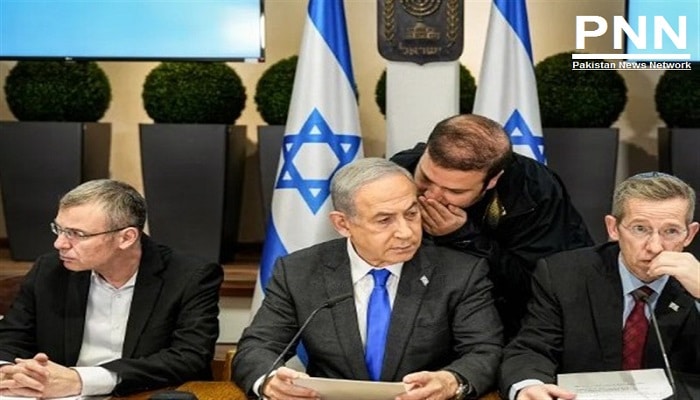
PNN – In order to prevent defeat in the upcoming elections, circles close to Netanyahu have called for the Ra’am party to be declared a terrorist organization.
According to the report of Pakistan News Network, the three main Arab parties in occupied Palestine have once again announced their readiness to form a joint electoral list on the eve of the upcoming elections; an issue that has entered a sensitive stage in light of the months-long deadlock in negotiations and reports about efforts by those close to Benjamin Netanyahu to declare the Ra’am party illegal and terrorist.
The “Khodash”, “Ta’al” and “Balad” parties issued a joint statement on Sunday, emphasizing that they still want to re-form the “Joint List” and would like the Islamist “Ra’m” party led by Mansour Abbas to be present in this framework; however, according to them, there are significant differences between the parties regarding the nature of this list and its political direction.
This event comes as negotiations to revive the four-party Arab coalition have made virtually no tangible progress in recent months. The Joint List was first formed in 2015 and for several years managed to bring together mainly Arab parties as a single bloc in the Knesset, but the coalition fell apart in 2021 after the Ra’am party, led by Mansour Abbas, split from the other parties and joined the ruling coalition led by Naftali Bennett and Yair Lapid.
This framework completely collapsed on the eve of the 2022 elections. At that time, the Balad party decided to run independently, but it failed to pass the required threshold by a margin of only 16,000 votes, and as a result, the two remaining parties, Khodash and Taal, entered the race as a separate joint list.
Khodash, Taal and Balad parties announced in their statement on Sunday: We want Raam to be a partner in this political agreement, but at the same time we are aware of the serious gaps in the positions between the parties, especially regarding the nature and direction of the “joint list.”
This stance directly stems from the differences in views between Raam and other Arab parties. Raam, unlike other Arab parties in recent years, has openly declared its readiness to join the ruling coalition in the occupied territories after the elections, and this issue has become one of the main points of disagreement between this party and other Arab movements.
However, the three parties, God’s Prayer, Ta’al, and Balad, stated in their statement that, in light of what they described as the “existential dangers” arising from the current right-wing government’s actions, they still want Raam to participate in the agreement to form a new “joint list.” In their view, this strategy could strengthen Arab political representation and lead to the defeat of Netanyahu’s far-right cabinet.
In contrast, reports indicate that the “Ra’am” party has not rejected the principle of joining a joint electoral list, but emphasizes that this presence should be solely in the form of a “tactical” list to maximize Arab seats, and that the party’s political independence and freedom of action should be fully preserved after the elections.
According to Haaretz, the Ra’am party stated that the “joint tactical list” is intended to allow each party to maintain its political program, freedom of decision-making and independent communication with its voters without restrictions. The party also warned that any clause or binding agreement that seeks to impose restrictions on member parties would destroy the technical nature of the list and transform it into a different structure.
Ra’am also stressed that such a model could be a suitable and desirable solution, as it would both satisfy the demands of the party’s voters and preserve the parties’ organizational cohesion.
The Khudaash party, traditionally the largest and most influential among Arab parties, has long been a leading advocate for the revival of the Joint List. In this context, four Arab parties signed an agreement in January, under which they pledged to work together to revive the coalition in the run-up to this year’s elections. By law, the elections must be held no later than October 27.
This agreement was reached in a situation where the Arab community in occupied Palestine has recently faced an unprecedented wave of violence and deadly crimes, and popular pressure within this community to increase the level of coordination and unity among Arab parties has increased.
However, no tangible progress has been made in the negotiations over the past months; the main reason for this is stated to be Ra’am’s insistence that this party is only willing to be present on a joint list to pass the elections and that after the elections, it can separate from this framework and enter into negotiations independently to be present in the ruling coalition.
Meanwhile, Naftali Bennett, who is considered one of the most serious options to remove Benjamin Netanyahu from power, has once again ruled out the possibility of working with Raam. This is despite the fact that Bennett himself headed a cabinet that included Raam between 2021 and 2022.
Bennett has announced that his future cabinet will consist only of Zionist parties and that after the October 7, 2023, Hamas-led operation; the governing coalition structure in Israel should no longer rely on an Arab party.
Other leaders of the opposition to Netanyahu’s cabinet have either explicitly rejected the presence of Arab parties in the coalition or have spoken of forming a cabinet consisting solely of Zionist parties; positions that practically mean eliminating Arab parties from the coalition equation. On the other hand, Netanyahu and his supporters have also continuously targeted Arab parties in their political positions and propaganda, attacking and delegitimizing them.
In this context, the Israeli regime’s Channel 13 television reported on Sunday that Netanyahu’s entourage and allies are trying to outlaw the “Ra’am” party as a “terrorist group” before the elections.
According to the report, the implementation of such a measure would require the approval of the law in the Knesset and the opinion of the relevant security agencies headed by the Israeli internal security agency, the Shin Bet. However, it is not yet clear whether there is enough time to complete this legal and security process before the elections are scheduled.
In response to the report, Mansour Abbas, the leader of the Ra’am party, described the plan as “anti-democratic” in a message on the social network X, saying that his party would respond to such measures at the ballot box.
Meanwhile, only Yair Golan, the leader of the leftist Democratic Party, has publicly called on other opposition leaders to work with Rem once again. He also called on them to stop following the trend that he said seeks to “demonize” the party.
Despite serious ideological differences between its member parties, including the difference between the secular and socialist Knesset and the religious and conservative Rem, the Joint List coalition has been able to mobilize a significant portion of Arab voters in recent years and create unprecedented political influence for Arab parties in the Knesset.
From its formation in 2015 until the departure of “Ra’am” in 2021, this coalition was known as the third largest bloc in the Israeli Knesset, and at the peak of its power in 2020, it managed to win 15 seats.
Experience has proven that whenever a joint Arab list is formed, both the participation rate of the Arab community living in the occupied territories in the elections increases and the overwhelming majority of this community votes for the joint Arab list. Also, when there is division among the Arab lists, both the general willingness of the Arab community to vote decreases and the number of votes this community gives to Zionist parties increases to some extent.
Recent developments show that, as pressure for Arab party unity increases, the right-wing movement led by Netanyahu is trying to shift the electoral balance in its favor by eliminating or weakening Arab rivals; a path that could both affect Arab participation and the fate of future elections.