
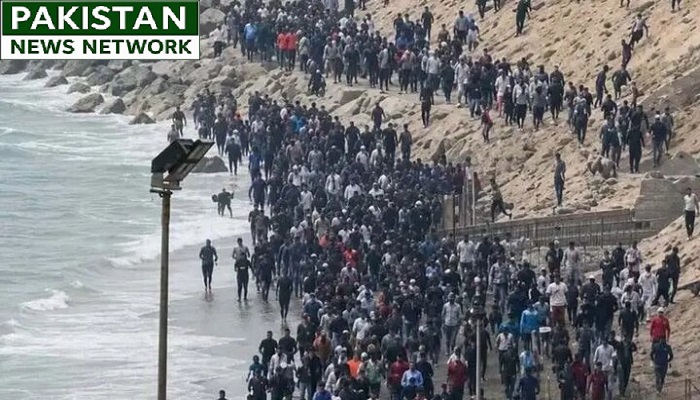
PNN – The arrival of tens of thousands of migrants from Morocco into the city of Ceuta triggered one of Europe’s biggest border crises in recent years and once again drew attention to the European Union’s security challenges.
According to the report of Pakistan News Network; The arrival of tens of thousands of migrants from Morocco into the city of Ceuta has triggered one of Europe’s most significant border crises in recent years—a crisis that, beyond its humanitarian dimensions, has once again brought to the fore the historical disputes between Morocco and Spain, the European Union’s security challenges, and the ineffectiveness of the bloc’s migration policies. Located on Morocco’s northern coast and separated from the Spanish mainland by the Strait of Gibraltar, Ceuta has long been a focal point for migrants seeking to reach Europe.
In recent days, the city of Ceuta—a Spanish-administered territory in North Africa—has witnessed a massive influx of migrants arriving from the Moroccan coast by both sea and land routes. Spanish and Moroccan sources have described this event as the largest wave of migration to Ceuta since the 2021 crisis, during which thousands of people also entered the territory within a short period.
While initial reports indicated the arrival of approximately 1,500 people, thousands more joined the influx within just twenty-four hours; ultimately, local authorities announced that the number of people entering Ceuta over the course of a few days had reached around 60,000—a figure representing more than half the region’s population and creating an unprecedented situation for the Spanish government in terms of demographics and security.
Humanitarian Crisis amidst the Wave of Migration
The sudden surge in the number of migrants has also triggered a widespread humanitarian crisis. Spanish authorities have announced that at least 57 bodies have been recovered from the waters off Ceuta; some of the victims drowned, while others lost their lives attempting to cross border barriers. However, the death toll could still rise, as reports indicate that a number of other migrants remain missing.
Meanwhile, migrant accommodation centers in Ceuta faced a severe capacity shortage within just a few hours. Local officials announced that all reception centers were full and unable to accommodate new arrivals—a situation that compelled the Spanish central government to mobilize emergency resources.
Army Deployment: Madrid’s Response to the Crisis
As the crisis escalated, the Spanish government deployed the army to Ceuta to assist border guards and police forces. The country’s Interior Ministry also announced the deployment of military personnel to maintain security and control the borders.
Meanwhile, Moroccan security forces deployed water cannons and crowd-control equipment around the city of Fnideq and along routes leading to the border to prevent new groups from moving toward Ceuta.
Memories of the 2021 Crisis Resurface
This is not the first time Ceuta has faced a massive wave of migration. In 2021, amidst diplomatic tensions between Madrid and Rabat, more than 10,000 migrants entered the territory over the course of just two days.
Many analysts now believe the current situation could be a repeat of that crisis—albeit on a much larger scale. Local authorities in Ceuta have described the situation as a “humanitarian and social emergency,” warning that if the current trend continues, the region’s public service infrastructure could collapse.
Migrant Returns: Madrid and Rabat’s Cautious Cooperation
Alongside border control measures, the Spanish government has initiated the process of returning migrants. The country’s Interior Ministry announced that Madrid and Rabat have reached an agreement to expedite the return of individuals who entered Ceuta illegally.
Under this agreement, security forces from both nations will step up cooperation to prevent new arrivals and facilitate the return of migrants. Published figures indicate that a significant number of migrants have already returned to Morocco in recent hours. Local officials report that tens of thousands of people have left Ceuta, although thousands still remain in the area.
Migration Crisis Exposes European Divisions
The repercussions of this crisis have extended beyond Spain’s borders. Across Europe, disagreements regarding the management of migration have once again come to the fore. Italy was the first country to react sharply; its officials called for the suspension of Spain’s Schengen membership, arguing that Madrid had failed to secure the European Union’s external borders. Italian Prime Minister Meloni announced her country’s readiness to implement extraordinary measures, while the Foreign Minister called for closing Schengen borders to Spain.
In contrast, the Spanish government described these stances as irresponsible. Spanish Foreign Minister José Manuel Albares emphasized that Madrid expects solidarity from its European partners rather than political statements. In response to these developments, France tightened controls at its border with Spain, and Finland backed Italy’s position—a development indicating that disagreements over EU migration policy have entered a new phase.
Ceuta: The Intersection of Geography and Politics
The significance of Ceuta extends beyond the migration crisis. This small territory, covering an area of approximately 19 square kilometers, has been under Spanish control for centuries; however, Morocco considers it part of its own territory and has consistently insisted on reclaiming it.
This situation has made Ceuta one of the most sensitive geopolitical points in North Africa. Any security or humanitarian development in the area—beyond its border-related implications—can also impact political relations between Madrid and Rabat.
Why does this crisis keep recurring?
An examination of the root causes of this wave of migration reveals that economic factors play a decisive role. Morocco’s unemployment rate has reached approximately 13 percent, leaving hundreds of thousands of young people outside the labor market. Many migrants also hope that by entering Ceuta, they can find a way to reach mainland Europe.
Alongside economic hardships, the spread of rumors regarding open borders has also played a significant part in fueling this wave. Local witnesses report that unofficial news circulating on social media drew thousands of young people to the Ceuta border in a very short span of time.
A New Test for Europe
The Ceuta crisis has once again demonstrated that the European Union still lacks a unified strategy for managing migration. Divisions among member states, mounting pressure on border nations, the rise of right-wing movements, and the framing of migration as a security issue all indicate that Europe has yet to strike a balance between humanitarian considerations and security imperatives.
Although recent cooperation between Spain and Morocco has somewhat alleviated the crisis, the risk of such crises recurring persists as long as the economic and social root causes of migration in North Africa remain unaddressed and the European Union fails to establish a unified mechanism for managing its external borders—crises that, this time, have challenged not only Ceuta but Europe’s entire security and political architecture.
Spanish Analysts’ Views on Israel’s Intervention
Analysts and experts in Spain believe that the Zionist regime is exploiting the migrant crisis in the city of Ceuta to sow chaos in the country.
Yesterday, Danny Danon, the Zionist regime’s representative to the United Nations, remarked that Spain continues to criticize Israel yet is itself facing an emergency situation due to the migrant crisis. In response to this intervention and the Zionist regime’s involvement in the crisis, Spain stated that the situation has now become clearer.
Spanish analysts believe that the events in the North African city of Ceuta represent an attempt by the Zionist regime to undermine the Spanish government, given that the latter has repeatedly criticized the genocide committed by the Zionist occupiers in the Gaza Strip. These developments in Ceuta have unfolded with the backing of the Zionist regime and far-right factions.
They added that the United States also welcomes the weakening of the Spanish government. Spanish journalist José Wessner also pointed to a 2019 post by Netanyahu’s son, noting that he had mentioned at the time that Tel Aviv was providing financial support to separatist movements in Ceuta and Melilla. So, is there still any doubt that what is happening today is an act of retaliation against the country’s government?