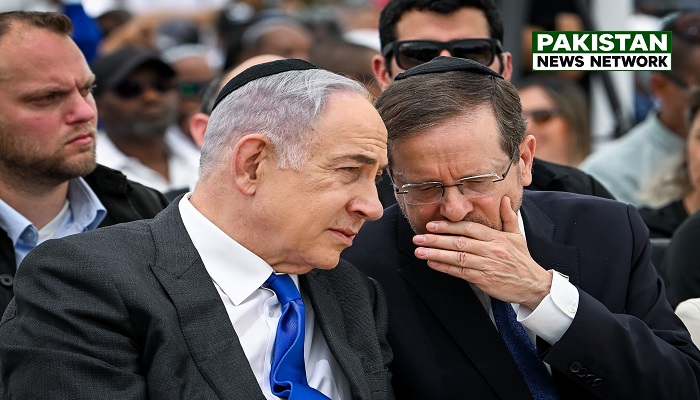
PNN – Netanyahu is attempting to escape prosecution and punishment by remaining in power and securing political guarantees.
According to the report of Pakistan News Network; Gadi Eizenkot—leader of the Yashar party—has been tasked with forming a new cabinet for the Zionist regime, having received 67 recommendations from the 120 members of the new Knesset. He now has a four-week window to complete this process. At the end of this period, he may request an extension; should he do so, the President of the Zionist regime, Isaac Herzog, has the authority to extend the deadline by up to two weeks.
Now, if he fails to form a cabinet by the end of this six-week period, Herzog may task a second individual with the task—and should events unfold in this direction, that person would likely be Benjamin Netanyahu. But what is Netanyahu’s plan for forming a cabinet?
The Unity Cabinet Plan
Benjamin Netanyahu’s plan to form a cabinet should be viewed as an attempt to prevent his complete exit from power. He is seeking to form a “unity cabinet” by bringing together Likud and certain opposition parties—a cabinet that would allow him to remain within the power structure, even though his traditional right-wing coalition no longer commands the necessary majority.
His initial proposal, presented in early November during negotiations between Likud and the opposition parties, included the following terms:
- Retention of Netanyahu’s Premiership
Netanyahu remains Prime Minister for a full four-year term, with no rotation of power taking place.
- Legislation Exempting Haredim from Military Service
Enactment of a military service law based on the proposal by Boaz Bismuth and an agreement reached with the Haredi parties.
- Prevention of an Internal Commission of Inquiry into October 7
Instead of an independent internal commission, a commission is to be established with a mechanism preferred by Likud, the composition of which is to be determined through political agreement.
- Inclusion of Itamar Ben-Gvir in the Cabinet
The Jewish Power (Otzma Yehudit) party must also be part of the unity cabinet.
- Preservation of Judicial Reform Laws
The laws enacted during the previous term—specifically those concerning the weakening of the Cabinet’s legal advisor and the modification of the mechanism for selecting judges—must not be weakened or repealed.
These terms would certainly not have been acceptable to the opposition, as they have consistently opposed such conditions—conditions that stand in direct contradiction to the opposition’s own electoral platforms. However, following a proposal from Eisenkot regarding the formation of a cabinet, Netanyahu’s tone shifted; in a video message released on November 14, 2026, he called upon Eisenkot to enter into negotiations without any preconditions. In this same video, he outlined his own terms for the formation of a unity government, as follows:
- It should encompass Zionist parties as well as religious and Haredi parties;
- According to him, it should not rely on the support of Arab parties;
- It should maintain a unified stance regarding the threat from Iran;
- It should reach an agreement concerning the law on military service for the Haredi community;
- It should be capable of continuing the cabinet’s security and economic policies.
A significant point in these remarks was that, contrary to his previous statements, Netanyahu did not explicitly assert that he himself must serve as Prime Minister of a unity government in the Zionist regime. This stands in contrast to his video message on November 9, in which he had declared that he must be the Prime Minister of such a unity government.
Rotation of the Premiership between Netanyahu and Eisenkot
Despite all the aforementioned developments, on November 19, 2026, Netanyahu proposed a plan for a rotating premiership. The core of this proposal was that Netanyahu would serve as Prime Minister within a unity cabinet for the first two years—until 2028. During this period, the law governing the election of the President of the Zionist regime would be amended, allowing Netanyahu to assume the presidency in 2028 and hand over the position of Prime Minister to Eisenkot.
In effect, under this plan, Netanyahu is using the prospect of assuming the presidency of the Zionist regime as leverage—securing a guarantee against prosecution in exchange for stepping down as Prime Minister. For their part, the opposition factions are willing to accept his transition to the presidency as a guarantee that he will relinquish power.
As of now, this proposal has not been accepted by any political faction. In recent days, Netanyahu has reiterated his opposition to the establishment of an investigative committee regarding the events of October 7th. Furthermore, he has emphasized that the formation of a minority government by Gadi Eizenkot poses a serious risk.
All of this indicates that Netanyahu senses his time in power is coming to an end, and he is now scrambling to hold onto it. Given these circumstances, it appears that Netanyahu must prepare for his departure from power—and the subsequent consequences, which could include standing trial, being found guilty, facing financial penalties, and imprisonment.