
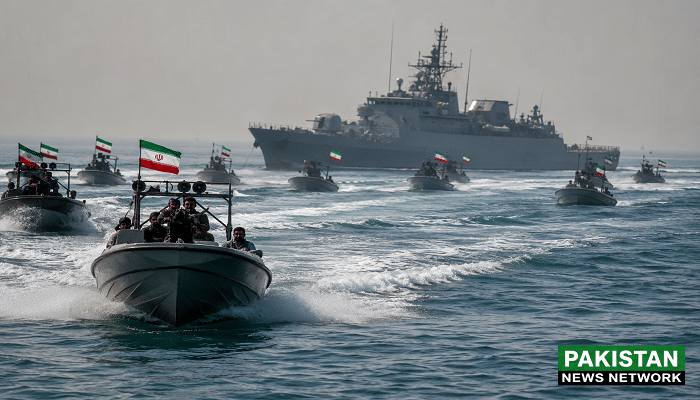
PNN – According to experts, these boats are part of a war strategy designed to counter strong naval powers like the United States.
According to the report of Pakistan News Network; US President Donald Trump recently claimed that he had completely destroyed Iran’s navy, reducing it to “small boats armed with machine guns.”
However, analysts say these “small boats,” sometimes referred to by Western experts as the “mosquito fleet,” have proven effective and dangerous despite their small size.
According to experts, Iran is trying to influence the global economy through this strategy and put pressure on Washington to abandon its war policy against Tehran.
However, the question is, what exactly is this ‘Mosquito Fleet’ and how is it proving to be so effective and dangerous despite its limited resources?
A mosquito fleet is a group of small but fast boats that, due to their numbers and speed, can pose a challenge to even a large naval force.
‘Harassment, swarming and confusing the enemy’
Iran’s ‘Mosquito Fleet’ was founded in the 1980s during the Iran-Iraq War.
Although Iran was at war with Iraq at the time, the fighting spread to the Persian Gulf during the ‘Tanker Wars’ of the 1980s, which led to the US intervention to protect oil tankers.
Saeed Gulkar, an associate professor at the University of Tennessee at Chattanooga and senior advisor to United against Nuclear Iran, says that the fleet, which is controlled by the powerful Revolutionary Guards, is not designed for traditional naval warfare, but rather for “harboring, swarming, confusing the enemy, and disrupting shipping.”
According to experts, the fleet’s tactics include firing at merchant ships, laying mines at sea, and attacking in groups of high-speed boats from different directions.
These small, fast boats are usually armed with machine guns, rockets, or anti-ship missiles. Many of these boats are manufactured in Iran, while some have been converted from ordinary fishing boats for combat purposes.
One of the main characteristics of these boats is that they are very low in the water, making them difficult to see on radar from a distance. Their effective surveillance requires constant drones, helicopters or patrol aircraft.
The exact size of this fleet is unknown because many of the boats are hidden in caves and underground tunnels on the southern coast of Iran. However, it is estimated that their number may be between 500 and more than 1,000.
The Iranian government also periodically conducts large naval exercises with this ‘mosquito fleet’.
Is the Iranian strategy working?
Shipping through the Strait of Hormuz has fallen to a record low compared to pre-war levels.
According to the real-time monitoring platform Hormuz Strait Monitor, around 10 ships are currently passing through the waterway daily, about 8 percent of the usual average of 60 ships per day.
According to a team from the UK Royal Navy stationed in the area, overall maritime traffic has fallen by more than 90 percent compared to pre-war levels.
According to the International Maritime Organization, a subsidiary of the United Nations, about 1,500 ships and more than 20,000 crew members are affected by the blockade.
The reduction in the amount of oil passing through the Strait of Hormuz has caused what some experts say is the largest oil supply crisis in history, and oil prices on the global market have reached near record levels.