
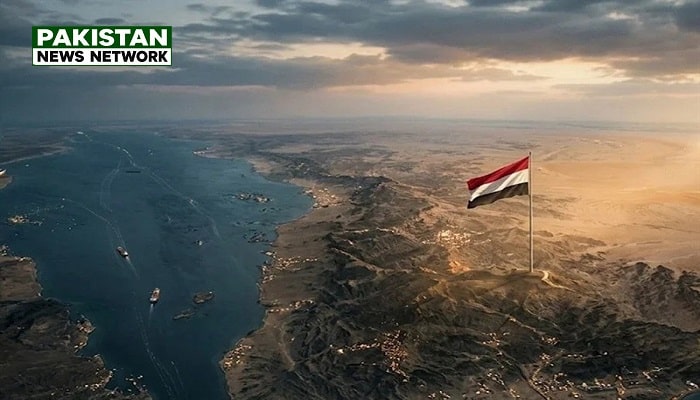
PNN – Yemen has articulated a “blockade-for-blockade” equation and succeeded in establishing it as a rule within the West Asian order.
According to the report of Pakistan News Network; the spokesperson for the Yemeni Armed Forces has recently spoken of “airport-for-airport, blockade-for-blockade, and escalation-for-escalation.” Previously, they had proposed equations such as “capital-for-capital” in response to threats from Saudi aggressors. While some dismissed these Yemeni claims as mere propaganda, recent developments on the ground demonstrate that, over the course of the recent two-month conflict, the Yemeni army and armed forces have managed to transform this equation into a new rule—one imposed by Yemen’s defenders upon the security order of West Asia.
From Mere Response to a New Equation
In modern naval warfare, a constant logic prevailed: a major power would seize a strategic chokepoint, while the weaker party issued threats. The current situation in Yemen has inverted this logic. Saudi Arabia halts flights from Yemeni airports, yet Saudi airports themselves come under fire. Saudi Arabia blockades Yemen’s ports and exports, yet its own exports via the Red Sea face restrictions. Escalated air operations are met with missile and drone strikes deep within Saudi territory.
Put simply, Yemen is no longer merely defending itself; it is shaping the strategic equation—an equation that is inextricably linked to the Strait of Hormuz. A report by the UK Parliament Library (dated October 5) noted that approximately seven percent of the world’s oil passes through the Bab el-Mandeb Strait. According to the same report, Saudi Arabia has shifted the bulk of its oil exports to alternative routes; meanwhile, the two waterways—the Persian Gulf and the Red Sea—have strengthened the bargaining position of both sides in the conflict. In other words, neither side can view one chokepoint in isolation from the other; closing one drives up the costs associated with the other.
The Field Test
Every rule is put to the test in the field, and this particular rule has been tested over the past two months. Saudi Arabia announced the recapture of Bab al-Mandab following a major operation along Yemen’s western coast; however, the U.S.-based Institute for the Study of War revised its assessment several times before ultimately concluding that the coastal advance had stalled. Reuters, citing field sources and analysts, also reported that the claim had been made prematurely. In the highlands surrounding Taiz, Yemeni forces halted the ground advance of Saudi-backed mercenaries by securing the high ground and constructing extensive earthworks; meanwhile, missile and drone strikes against Saudi airports and export facilities continued.
The outcome is evident in two signs. The first is military: seizing territory proved possible, but holding it did not. The second is structural: Saudi Arabia sought external assistance to sustain the war. A joint defense pact with Turkey and Pakistan was activated; however, according to media reports from both nations, the role of the foreign forces was defined as defensive rather than combat-oriented. In other words, the opposing side failed to break this rule and was compelled to redefine its alliances.
A rift that opened up in the opposing camp
The most profound impact of this shift is evident on the opposing front. The UAE—a key partner during the early years of the Yemen war—is absent from the current escalation; according to regional media reports, Abu Dhabi is unwilling to risk attacks on its ports and projects, preferring instead to continue its investments in southern Yemeni ports. This absence has placed the full burden of operations on Saudi Arabia. Meanwhile, citing Axios, Washington has refrained from direct combat involvement, limiting its role to intelligence support and advisory services. To compensate, Saudi Arabia has turned to Turkey and Pakistan—two nations that have both stated they will not engage in ground combat. The result is a front that enjoys significant backing but lacks sufficient combat forces, leaving the primary cost of the conflict to be borne by the very country that initiated the war.
Negotiations in Light of This Development
This development also determines the fate of the negotiations. The Yemeni delegation is meeting with the UN Special Envoy in Muscat, and some news reports indicate that the two sides have reached an agreement in principle on a six-month ceasefire framework—though this report has not yet been officially confirmed. The UN Envoy stated at the Security Council that battlefield gains cannot replace negotiations. However, this new dynamic does not offer a simpler path to ending the war, as the established equation does not vanish through withdrawal; it merely shifts.
The question remaining for the coming months is this: can the six-month framework bring this equation to the negotiating table, or will Sanaa keep the equation exactly where it has established it? The answer will be revealed in the months ahead—in the highlands surrounding Taiz and in the rates insurers set for Red Sea transits.