

PNN – It is impossible to understand the logic of America’s endless wars on various countries without understanding the international monetary system.
According to the report of Pakistan News Network, it is impossible to understand the logic of America’s repeated attacks on various countries – from Vietnam and Iraq to Iran – without understanding the international monetary system. By designing a global mechanism, the United States has been able to shift the “costs of war” onto other countries and continue endless military interventions without suffering chronic inflation or crippling budget deficits.
This structural context is a prerequisite for analyzing any US extra-regional war – including the recent invasion of Iran.
- Bretton Woods Conference (1944): The Birth of Dollar Hegemony
The beginning of the dollar’s dominance of the global economy was the Bretton Woods Conference at the end of World War II. At this conference, 44 countries came together to create a stable global financial system.
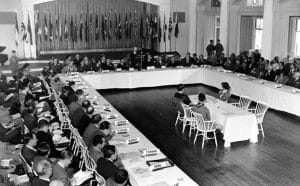
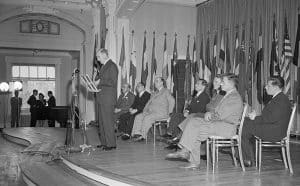
John Maynard Keynes, a prominent British economist, proposed a plan to create a supranational international currency called the Bancor to provide greater stability to global trade. However, the economic and political power of the United States at the time led to the acceptance of Harry Dexter White’s proposal – based on the centrality of the US dollar. According to the final agreement:
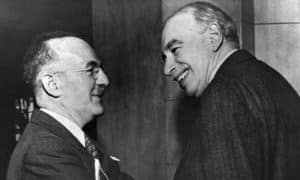
– The value of world currencies was tied to the dollar.
– The US government pledged that each ounce of gold would be equal to $35 (to prevent excessive printing)
– Countries could convert their dollars into gold at any time.
– Two new institutions, the International Monetary Fund (IMF) and the World Bank, were created, which were effectively dominated by the US.
This agreement placed Britain and other world powers in a position inferior to the United States. Winston Churchill, the British Prime Minister at the time, expressed concern that in the future they would not even have the opportunity to be on the same level as one of the American states. With this agreement, the dollar effectively became the main support for global trade and assets, and countries held their main reserves in dollars instead of gold.
- US lending to the world based on dollars
After the world adopted the dollar as its base currency, the US was able to lend to various countries by printing money, receive its exports in the same dollars, and pay its foreign expenses without leaving gold. Thus, the world became dependent on the dollar, and the United States practically financed the global economy with its printed money; a mechanism that is considered the first step in laying the “financial foundation for endless wars.”
- The Gold Crisis and the End of the Bretton Woods System
In the 1960s, due to the high costs of the Vietnam War, rising welfare spending, and the massive printing of dollars to expand the economy, various countries realized that the United States had printed more dollars than it had gold reserves. France, led by Charles de Gaulle, Britain, and several other countries gradually converted their dollars into gold—a move that drastically reduced the United States’ gold reserves. By early 1971, the United States’ gold reserves had fallen from 20,000 tons in 1949 to about 9,000 tons, while the volume of dollars printed outside the United States had reached more than $50 billion. There was no longer any correlation between gold and foreign dollars.
- Nixon Shock (Breaking the Dollar-Gold Link)
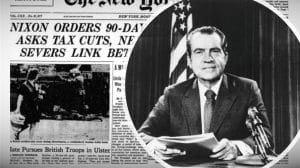
On Sunday, August 15, 1971, Richard Nixon announced in a sudden televised speech (later known as the “Nixon Shock”) that the United States would no longer convert the dollar into gold. Thus, the dollar-gold link was broken and exchange rates were set to float. This decision had many consequences for the world economy: including that the dollar became unbacked by gold and the purchasing power of the dollar fell, but the dollar remained the main unit of trade, because the world kept its reserves in dollars and there was no suitable alternative. Here the world entered the “era of unbacked money.”
- Failed attempt to create a common global currency
After the collapse of the Bretton Woods system, the idea of creating a common global currency was raised by some economists and politicians, but this proposal never came to fruition. The main reason was the United States’ firm opposition to giving up its monetary power. On the other hand, Europe and Japan at that time had neither sufficient experience nor the necessary infrastructure to introduce an alternative to the dollar. In addition, the foreign exchange reserves of the world’s countries had already been completely dollarized. In such circumstances, the dollar remained the undisputed ruler of world trade.
Conclusion
The Bretton Woods system institutionalized the world’s dependence on the dollar. Nixon’s shock freed the dollar from its gold standard—but this liberation was to America’s advantage, not its disadvantage. The world still needed the dollar, and no alternative currency was available. This “structural framework” allowed the United States to finance its endless wars—from Vietnam to Iraq and even the scenario of an invasion of Iran—by printing money and transmitting inflation to other countries. Understanding this mechanism is a prerequisite for any serious analysis of the future of the dollar’s dominance and its possible end. In the following notes, we will see how the “petrodollar” system consolidated this dominance for half a century and what factors now threaten it.