
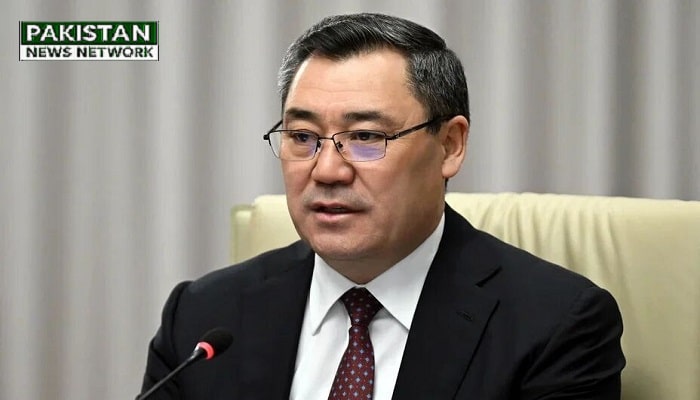
PNN – Criticizing the use of sanctions as a tool for political pressure, the President of Kyrgyzstan emphasized that decisions regarding sanctions should rest exclusively with the United Nations and the Security Council.
According to the report of Pakistan News Network; Sadyr Japarov stated on Tuesday at the 81st session of the UN General Assembly: Today, we witness sanctions being used in some instances by individual nations as a tool to interfere in the internal affairs of sovereign states.
He added: The negative consequences of unjustified unilateral sanctions also affect small and developing nations like Kyrgyzstan, a matter that has raised concerns among other small countries as well.
The President of Kyrgyzstan stated: In some instances, such practices lead to interference in the internal affairs of sovereign states and conflict with the fundamental principles of international law.
Pointing to the pressure exerted by certain major powers on smaller nations, Japarov remarked: Some major powers, in pursuit of their own interests, pressure countries like Kyrgyzstan, attempting to force them into bargaining and issuing ultimatums.
He emphasized: Decisions regarding the imposition of sanctions must be made in accordance with the UN Charter and exclusively within the mandate of the Security Council; the authority to impose sanctions on a country should rest solely with the United Nations.
The President of Kyrgyzstan proposed the establishment of a mandatory mechanism requiring the United Nations to review all sanctions measures prior to their implementation, in order to take into account their potential humanitarian, economic, and social consequences.
He added that the countries initiating sanctions must clearly define the legal basis, necessity, objectives, and criteria for lifting the sanctions.
Japarov also called for the creation of a unified international mechanism—under UN oversight—to monitor and regularly review sanctions, stating that only in this way can the risk of one country arbitrarily using sanctions against another for political or economic gain be eliminated.
Weaknesses in the UN’s Implementation Mechanisms
In another part of his remarks, the President of Kyrgyzstan criticized the weaknesses in the United Nations’ implementation mechanisms, stating that the failure to systematically implement the organization’s decisions undermines the legitimacy of multilateralism and fosters the perception that international law is not binding.
Japarov added that this situation encourages disregard for international obligations; therefore, the authority of the United Nations must be expanded and strengthened.
He proposed the establishment of a permanent registry office within the framework of the General Assembly to track the implementation of resolutions and the fulfillment of obligations by member states.
Regarding the functions of this office, the President of Kyrgyzstan stated that the body would be responsible for the systematic recording and verification of the implementation status of decisions, requiring member states to submit regular reports, providing analytical reviews concerning specific sectors and regions, and ensuring transparency and equal access to information for all countries.
He also proposed a mechanism for a graduated response to non-implementation of decisions, outlining the following stages: first, formal notification of the concerned country and consultation with the organization’s bodies; second, the dispatch of a monitoring mission to the country in question; third, consideration of the matter at a plenary session of the General Assembly; and fourth, the initiation of appropriate procedures under the UN Charter.
Japarov added that in cases involving the systematic non-implementation of decisions, permanent members of the Security Council should voluntarily refrain from exercising their veto power.
He stated that if the mechanism for ensuring the implementation of the Organization’s decisions is systematically blocked by permanent members through the use of the veto, such a practice would be incompatible with the spirit of the UN Charter and the principle of the equal responsibility of member states.
The President of Kyrgyzstan called for a reconsideration of the possibility of voluntarily exercising restraint regarding the veto in matters concerning the implementation of the Organization’s decisions, noting that this approach could promote universality, the equality of all nations—regardless of size—and the primacy of diplomacy, while avoiding double standards.
He also proposed the formation of an open-ended working group within the framework of the General Assembly, involving interested member states, stating that the strategic goal of this initiative is to ensure that the Organization’s decisions are regarded not merely as political recommendations, but as genuine international obligations.
Jabarov emphasized that, otherwise, certain United Nations decisions might no longer be taken seriously, leading countries to act solely at their own discretion.
He added that every UN decision must be implemented without delay; if a country fails to implement such a decision and other nations cease cooperation with it, the effectiveness of sanctions is enhanced.
The President of Kyrgyzstan stated: Only in this way will the United Nations become a strong and respected organization; otherwise, existing sanctions will effectively turn into children’s toys.