
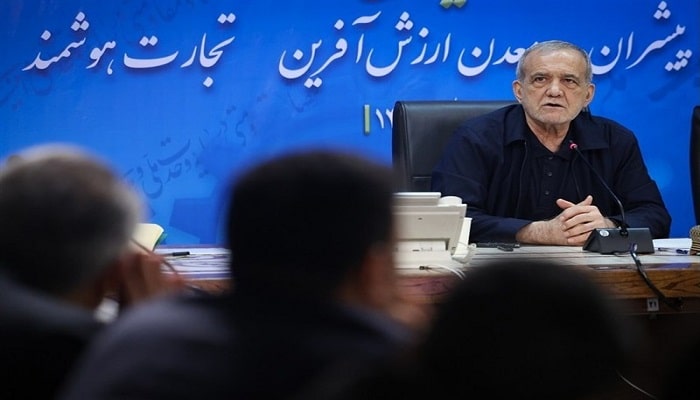
PNN – The President of Iran, making an unannounced appearance at the Ministry of Industry, Mine and Trade, told a story about his recent meeting with the Supreme Leader of the Revolution.
According to the report of Pakistan News Network, on the evening of Wednesday, President Masoud Pezishkiyan made an unannounced appearance at the Ministry of Industry, Mine and Trade to participate in a meeting of representatives of the country’s guilds and marketers, which was held with the aim of examining the latest market situation, assessing the economic effects of the recent war imposed by the United States and the Zionist regime against the Islamic Republic of Iran, and also adopting executive and operational solutions to control inflation, confront high prices, and prevent hoarding.
Emphasizing market stability and strengthening government-market coordination
In this meeting, while listening to the views, concerns, and reports of representatives of guilds and market activists, the President emphasized the need to strengthen coordination between the government, guilds, and the country’s distribution network to maintain market stability and protect people’s livelihoods, and issued important orders and recommendations in the areas of market regulation, consumption management, supporting production, and confronting economic disruptors.
At the beginning of his speech, Dr. Pezishkiyan expressed his pleasure at being present among the guild activists and marketers, and considered the relative peace and stability prevailing in the country’s market to be the result of the cooperation, support, and struggle of guilds, marketers, and economic activists, and stated: If this cooperation and empathy did not exist, achieving the current level of market stability in wartime conditions and economic pressures would not have been possible.
In another part of his speech, the President referred to his recent meeting with Ayatollah Seyyed Mojtaba Khamenei, the Supreme Leader of the Islamic Revolution, and described the atmosphere prevailing in this meeting and his personality, moral, and managerial dimensions.
Referring to the need to strengthen cohesion, trust, and empathy at the country’s management levels, the President stated: When the highest official in the country encounters officials and individuals with such moral character, humility, and a people’s spirit, this behavior can naturally be a model for the country’s management and administrative system; a model based on responsibility, being close to the people, and truly listening to issues and problems, just as the martyred and supreme leader of the Islamic Revolution was committed to in his character and actions.
The President added: The Supreme Leader was present in this meeting with exactly this kind of spirit; a spirit based on simplicity, humility, sincerity, and mutual respect, which made the atmosphere of dialogue completely direct, frank, and accompanied by a sense of closeness and trust.
The President continued by describing the difficult conditions of the country since the beginning of the government’s work, referring to a series of combined pressures and crises, and said: Since the first days of the government’s activity, the country has faced numerous challenges and pressures, including economic crises, an imposed war, attempts to activate the so-called “snapback” mechanism, and also creating social unrest; measures that were all designed towards a common goal, namely increasing economic pressure, internal destabilization, and weakening national cohesion.
Referring to the country’s economic and social conditions during the recent war, the President added: While inflation and high prices lead to widespread protests in many countries around the world, the Iranian nation, in wartime conditions and against a large volume of attacks and pressures, supported the country with unity, solidarity, and cooperation, and thwarted the enemies’ plans.
“Consumption Management” is the First Step on the Path to Overcoming Crises
In another part of his speech, Pezishkiyan considered “consumption management” to be the first step on the path to overcoming crises and maintaining the country’s economic stability, and emphasized: The amount of electricity consumption in Iran is about three times the average consumption in European countries, and therefore, reforming the consumption pattern should be considered as a national necessity.
Referring to the government’s policy in supporting the production sector, the President stated: The government’s clear priority is to prevent power and gas outages in production units, and achieving this goal requires controlling unnecessary consumption in the household and office sectors so that the necessary energy is provided for the continuation of producers’ activities.
The President considered these measures an example of simple but effective interventions that can be implemented with the participation of guilds, people, economic enterprises, and local groups and can play an important role in reducing pressure on the country’s energy network.
The choice of the government and the nation is to stand firm and resist
Pezishkiyan continued, emphasizing the government’s approach of relying on the people’s capacities and noted: The Islamic Republic of Iran has two paths ahead; either to stand firm by relying on the people and alongside them, or to surrender to pressure, and the choice of the Iranian nation and government is undoubtedly to stand firm, resist, and preserve national dignity.
Addressing the country’s guild officials and managers, the President also emphasized the need to strengthen integrated management in guild complexes and said: The government will use all its capacities to support guilds, marketers, and economic activists, and in areas where we face limitations, we need your cooperation, consensus, and active participation to continue the path of development, increase exports, and strengthen the country’s foreign exchange earnings.
The President continued, referring to some of the country’s economic limitations and structural challenges, including the budget deficit, and noted: We must move realistically, based on the country’s capacities and assets, and at the same time, not allow foreign pressures and excesses to affect the will of the Iranian nation.