

PNN – A new poll indicates the rise of Gadi Eisenkot and the challenge to the political supremacy of Benjamin Netanyahu and Naftali Bennett.
According to the report of Pakistan News Network, the results of a recent poll by the Israeli regime’s Channel 12 television, which reflects unprecedented political tensions in this society, indicate a profound cognitive change in the political psychology of the Zionist society.
This poll shows the initial signs of a very important transformation in the Israeli political sphere, namely the emergence of Gadi Eisenkot, the former commander of the regime’s army, as a serious option to succeed Netanyahu and the shaking of Bennett’s seat as the only competitor to Bibi.
This is interesting because in recent years we have rarely seen such success among non-right-wing figures. Naftali Bennett also argues on this basis that right-wingers who are cut off from Netanyahu and Likud will never be willing to go to someone like Eisenkot, who is even more left-wing than Benny Gantz. However, the current trend seems to be on the way to becoming the main chance to face Netanyahu.
If the current trend is maintained, or at least Eisenkot’s current popularity remains stable, it can be said that Zionist society has broken not only the spell of “Netanyahu being irreplaceable” but also the spell of “only right-wingers”.
Likud Stalls, Yashar Rises Unrelentingly!
According to the poll, if a general election were held today, Benjamin Netanyahu’s Likud would retain its position as the largest party with 23 seats. However, Likud’s stagnation at 23 sends a clear message to the Prime Minister’s Office: the party has temporarily lost its flying ceiling and is unable to attract gray votes. Part of the problem, of course, is that Smotrich’s Religious Zionist Party has returned above the quorum and won four seats, which has reduced Likud’s lead by at least two seats.
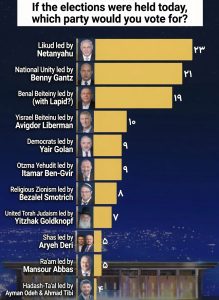
In contrast, the Yashar! Party, led by former IDF chief of staff Gadi Eisenkot, has become a major player in the field, winning 19 seats. The increase of two seats in a week shows the stunning momentum of this trend. Meanwhile, the together coalition led by Naftali Bennett, until recently the opposition’s main hope for defeating Netanyahu, has fallen by one seat to 21. This shift in the vote pool shows that opposition voters are moving towards options that promise more decisive and less marginal approaches.
Other parties remained in their established positions: the “Democrats” led by Yair Golan with 10 seats, Shas and “Israel Our Home” and the Haredi Shas party led by Aryeh Deri with 9 seats each, “Jewish Power” with 8 and “United Torah Judaism” with 7 seats, the Arab coalition “God-Glory-O-God” led by Ahmed Tayyibi and Yousef Jabarin with 5 seats are in the next positions. Another Arab party, Ra’am, led by Mansour Abbas, also won 5 seats, and finally the second far-right party, Religious Zionism, led by Bezalel Smotrich, with 4 seats, was the last party above the quota.
Finally, the arrangement of the blocs, with 69 seats for the opposition against 51 seats for the ruling coalition, still paints an unfavorable situation for the survival of the current government.
Of course, among the parties opposing Netanyahu, the Zionist opposition, without the support of the Arab Ra’em party with 59 seats, lacks sufficient strength to form a majority coalition, and will only achieve more than 61 seats with the help of this party.
Paradigm Shift: The Emergence of a Charismatic Challenger?
The most important part of this poll is not the number of seats, but the assessment of the “competence of the prime ministerial candidates.” For the first time in recent political history, Gadi Eisenkot has managed to surpass Benjamin Netanyahu with 38 percent of the vote in this indicator, with 35 percent. This figure is considered a “turning point” in political terms, because Netanyahu had been based on the proposition for decades that “there is no alternative to him.”
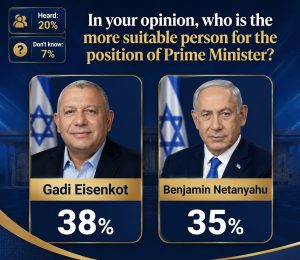
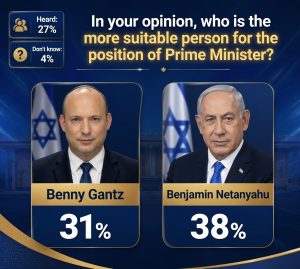
The results of other direct confrontations also indicate the same reality. While Netanyahu still has a significant margin of safety against Bennett or Lieberman, he has slipped against Eisenkot. Even among the opposition support base, Eisenkot, with 46 percent popularity, is trailing Bennett with 39 percent. This popularity shows that Zionist society, especially the hesitant and moderate sectors, is looking for a figure who symbolizes “crisis management” and “stability” rather than engaging in partisan games.
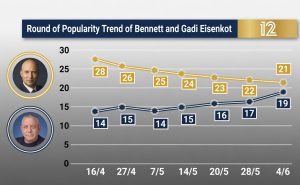
In recent months, Naftali Bennett’s popularity has been steadily declining, while Eisenkot’s has been rising. Many expected the “Together” coalition, centered around Yair Lapid and Naftali Bennett, to be the defining coalition for Netanyahu’s main challenger.
A Crisis of Trust: From the Government Ombudsman to the Integrity of the Elections
The shadow of distrust in Israel’s governing institutions is clearly visible in this survey. While Netanyahu is trying to consolidate his close associates in sensitive positions, the appointment of “Michael Ravilo” — the prime minister’s personal lawyer — to the position of government auditor has been met with opposition from 45 percent of the public. Importantly, there is a high level of confusion even among the ruling coalition’s supporters (55 percent “don’t know” whether this appointment is right or not), indicating a gap between the decisions of the prime minister’s office and those of his supporters.
On the other hand, the “Health of Elections” indicator is a more serious alarm bell. 57 percent of respondents said they are concerned about irregularities in the upcoming election process. This level of public fear is a direct result of the political tensions of recent months and the attempt to weaken oversight institutions. A society in which the overwhelming majority doubts the democratic health of elections is on the verge of a major legitimacy crisis.
Grand Coalition; the Public Demand
Finally, the polling data shows that the opposition’s support base is much more pragmatic than its politicians. 53 percent of opposition voters want Bennett and Eisenkot to form a single list. This public preference reflects the “body” pressure on the “political elite” to set aside petty differences in favor of the larger goal of ending the Netanyahu era.