
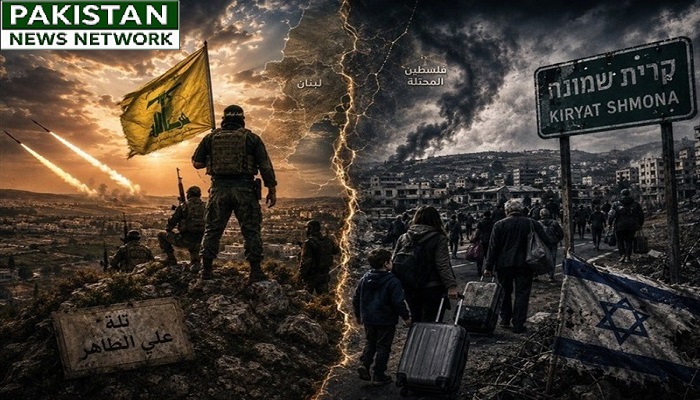
PNN – Resistance fighters are holding their ground on Ali al-Tahir Hill, while the residents of Kiryat Shmona have chosen to flee rather than stay.
According to the report of Pakistan News Network; if Ali al-Tahir Hill symbolizes the challenge Israel faces regarding a withdrawal from southern Lebanon, “Kiryat Shmona” represents the other side of the equation: a settlement where most residents have been evacuated, their numbers are dwindling, and hopes for a return are fading. While resistance fighters stand their ground on the hills of the south, settlers are retreating from their settlements—a scene that reflects a major shift in the balance of power in the conflict between the fighters of the Lebanese Islamic Resistance and the Zionist regime.
In the territory separating Lebanon from occupied Palestine, two points stand at opposite poles: Ali al-Tahir Hill in southern Lebanon—a site imbued with the presence of pure souls and Resistance forces—and Kiryat Shmona in northern occupied Palestine, a settlement transformed by Resistance missiles into a symbol of defeat and displacement.
Between these two geographical points, a new equation is taking shape in the conflict with the Israeli regime: Israeli settlements are shifting from electoral strongholds for Zionist political candidates into ghost towns, while the hills of the south have been transformed into impregnable fortresses.
If Al-Tahir Hill symbolizes the challenge Israel faces regarding a withdrawal from southern Lebanon, Kiryat Shmona represents the other side of the equation: a settlement where most residents have been evacuated, their numbers are dwindling, and hopes for a return are fading. While resistance forces hold their ground on the southern hills, settlers are retreating from their settlements—a scene that reflects a major shift in the balance of power.
Kiryat Shmona, a stronghold of Netanyahu supporters, comes under Hezbollah fire
Kiryat Shmona—an Israeli town near the Lebanese border targeted by Hezbollah resistance rockets—has become a political symbol of the war’s consequences in the north of the occupied territories. In the 2022 elections, the Likud party secured 49.47% of the vote in this Zionist town, whereas the combined vote share of the opposition coalition parties stood at just 22.63%. However, this historic loyalty to Benjamin Netanyahu’s party is now facing an unprecedented test.
Nearly two years after the initial ceasefire in the north of occupied Palestine, only about 40 percent of the residents of “Kiryat Shmona” have returned to the town. Residents of this occupied area complain about the slow pace of reconstruction, inadequate services, and the failure of Netanyahu’s cabinet to fulfill its promises. Furthermore, the names of more than 350 students have recently been removed from the town’s school rosters—an indication that displacement persists even after the cessation of large-scale hostilities.
A resident of Kiryat Shmona estimates that the population has dropped from 26,000 to approximately 9,500, noting that the budget approved years ago for fortifying northern areas was never allocated to this town. This dramatic decline in population highlights the scale of the disaster that has befallen the town and raises questions about the future facing this occupied settlement.
This decline is not merely a set of figures; rather, it represents the collapse of an equation long considered a constant in Israeli politics: the assumption that northern settlements would remain secure and that the Israeli cabinet—under Bibi’s leadership—would be capable of protecting its residents. Yet, the widespread displacement of Zionist settlers tells a vastly different story, raising a major question regarding the regime’s ability to maintain internal cohesion in the face of a protracted war of attrition.
In Kiryat Shmona, a rift has emerged between those who hold the cabinet responsible and those who distinguish between the government and the consequences of the confrontation with Hezbollah. Eli Abergil, a long-time Likud member and proponent of Netanyahu’s policy of endless regional wars, states: The recent war has inflicted unprecedented damage on Kiryat Shmona. It was the war—not Netanyahu’s cabinet—that caused this situation. Although he acknowledges that previous cabinets failed to pay sufficient attention to the town, he insists he will continue to vote for Likud due to his ideological allegiance, believing that the next cabinet will present a serious plan for the reconstruction of Kiryat Shmona.
In contrast, David Avraham—a native of the town—gives Bibi’s cabinet a grade of “zero,” believing that the crisis did not begin with the recent war but stems from years of neglect and a lack of investment and basic services. He intends to vote for Netanyahu’s rival, Gadi Eizenkot, in the upcoming Israeli Knesset election on October 28, as Eizenkot previously commanded the IDF’s Northern Command and is familiar with the region’s needs.
This divergence of views reflects a complex political landscape in which Likud faces an unprecedented challenge in one of its key strongholds. Once a reliable source of electoral support for the party, the town now heads into the 2026 elections grappling with displacement, devastation, and a sense of neglect—raising the question: were Hezbollah’s rockets enough to shift the vote?
Perhaps more significant than this question is what is unfolding within the settlers themselves: while some signal their readiness to vote for Netanyahu’s opponents, a deeper question remains unanswered—if Netanyahu’s government were to change, would these settlers truly return to their homes based on the promises of rival candidates? Or has the experience of displacement created an existential rift in their relationship with the settlement—a place that, for many, is now merely the memory of a safe haven that no longer exists?
As for Ali al-Tahir Hill…
On the other side of the border in southern Lebanon, Ali al-Tahir Hill has become a symbol of steadfastness and resistance. Located in the Nabatieh District—between the towns of Kfar Tebnit and Nabatieh al-Fawqa—at an elevation of 600 meters above sea level, the hill overlooks the city of Nabatieh and several surrounding villages. This vantage point grants whichever side controls it the ability to monitor and direct fire over a vast area.
Unlike Kiryat Shmona, which has witnessed the displacement and flight of its residents, Ali al-Tahir Hill remains teeming with resistance forces—forces that have transformed it into an impregnable stronghold. While settlers retreat from their settlements, the resistance forces stand firm on their hills, asserting that geography alone does not determine victory; rather, this battle demands a resilient will, forces steadfast in their commitment to the homeland, and the pure souls that have blessed their every step.
Based on details published by Hebrew media—citing assessments by the Israeli regime’s military and reports regarding a massive underground complex constructed by Hezbollah in the Ali al-Tahir highlands—the facility reportedly comprises command-and-control centers, weapon and equipment depots, field medical stations, and specialized launch platforms for various types of missiles. This key infrastructure of the Lebanese Islamic Resistance indicates that the site is no ordinary tunnel; rather, it resembles a full-scale underground military city—a fact that sheds light on the Israeli regime’s persistent determination to seize control of this hill.
Yet, more significant than all the reports published by the Zionist regime regarding underground facilities and the encirclement of resistance forces and mujahideen is a scene that Hebrew media overlook: young men who have placed their faith in their Lord—men who did not use the cover of night as an excuse, did not abandon their posts, did not desert their positions, and did not flee out of fear of death. Instead, they stand firm in resistance and self-sacrifice, proving that the human will is stronger than iron and the spirit harder than rock.
Ali al-Tahir: From the Battlefield to the Rome Negotiation Table
The Ali al-Tahir hill has been more than just a military position in southern Lebanon; it has evolved into a political issue within the Rome negotiations between Lebanon and the Israeli regime, effectively becoming a focal point of dispute regarding the future of Israel’s withdrawal from occupied Lebanese territories.
During the seventh round of negotiations—concluded on August 7, 2026, with U.S. mediation—the Lebanese side insisted on expanding the scope of areas from which the Israeli army must withdraw; meanwhile, the Israeli side set a precondition requiring the “verification” of the Lebanese army’s full deployment in two areas where it had previously been stationed under the so-called “framework agreement.” Ali al-Tahir Hill—alongside other areas such as Western Zawtar—was at the forefront of these test zones over which the Israeli regime seeks to assert its control.
What is unfolding in Kiryat Shmona is not merely a military phenomenon but a profound political shift. Hezbollah’s missiles did not simply destroy buildings; they shook confidence in the Israeli cabinet and cast doubt on the Netanyahu administration’s ability to protect the town’s residents.
Netanyahu, who had banked on the war to bolster his image as a preeminent security-focused leader, now faces the political repercussions among his electoral base. Kiryat Shmona—which once believed Likud was the sole guarantor of its security—is now questioning that guarantee, asking: Was the war necessary? And could this disaster have been averted?
Yet, the most vexing question for Netanyahu concerns not the necessity of the war, but the credibility of his promises. He pledged security to the residents of the northern settlements, only to leave them displaced; he promised victory, yet delivered defeat; he promised a return home, leaving them with nothing but the agonizing wait to go back. In Israeli politics—where a leader’s stature is measured by their ability to ensure security—this chasm between rhetoric and reality may prove more painful than any missile, for it strikes directly at the legitimacy of his leadership.
In contrast, Ali al-Tahir Hill remains a symbol of steadfastness—a place where questioning the utility of resistance has no place; rather, it embodies the equation of resilience. This is an equation that transforms every launched missile into a message for the enemy: that the Zionist occupation of southern Lebanon will not be cemented, settlements will not be secure, and as long as the occupation persists, the shadow of the resistance’s threat will continue to loom over the residents of the settlements in northern occupied Palestine.