
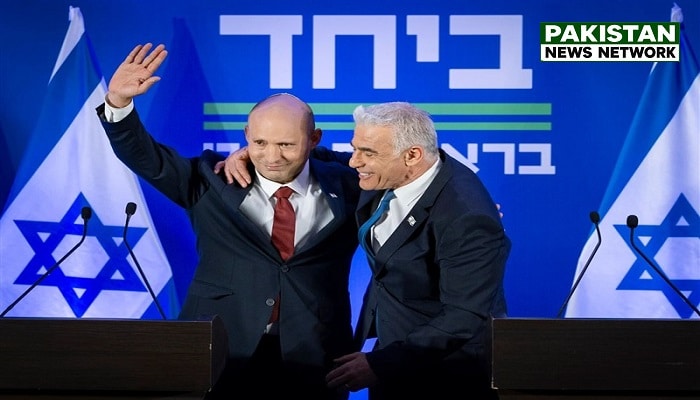
PNN – Bennett and Lapid are working together within a coalition to bring an end to Netanyahu’s tenure as prime minister in the occupied territories.
According to the report of Pakistan News Network; the opposition camp is eagerly awaiting the arrival of the date—October 27—when they hope to end Netanyahu’s long-standing premiership. Parliamentary elections for the Zionist regime are scheduled for this date, and current polls indicate that no single party will be able to secure the minimum 61 seats required to form a cabinet. Under these circumstances, post-election coalition-building will be of great importance.
One of the most significant rivals to the Likud party and Netanyahu is the “Beyakhad” (or “Together”) coalition, led by Naftali Bennett and Yair Lapid; while this coalition holds views on domestic affairs and the Palestinian issue that differ significantly from Netanyahu’s—and even vary between the two leaders themselves—it does not diverge greatly from the current cabinet regarding security matters and the issue of Iran.
Netanyahu enters the election while still facing legal cases and corruption allegations, with his trial currently underway. His critics view his continued hold on power as closely linked to his political and legal fate. Meanwhile, his opponents are striving to form a new government through a broad coalition, aiming to end Netanyahu’s long tenure as prime minister.
Bennett and Lapid are both former ministers under Netanyahu who parted ways with him due to political differences and have now become electoral rivals. The two politicians entered the 2026 election with a joint list named “Together,” with Bennett heading the list and Lapid in the second spot. This electoral partnership was announced in April 2026.
In most recent polls, the Bennett-Lapid coalition ranks third, trailing Gadi Eizenkot (leader of the Yashar party) and Netanyahu (leader of the Likud party). In the latest poll by Kan, released on September 28, Eizenkot’s party secured 23 seats, Likud 21, and the “Together” alliance 11. Poll averages also project 22.1 seats for Yashar, 21.8 for Likud, and 11.4 for “Together.” Interestingly, some polls indicate that the combined seat count for Bennett and Lapid would be higher if they ran separately than it would be under a joint list.
This is not the first time Bennett and Lapid have joined forces to oust Netanyahu. In 2021, their political coalition succeeded in removing Netanyahu from power after 12 years and forming a new government. Under the agreement reached at the time, Naftali Bennett was to serve as prime minister for the first half of the four-year term, with Yair Lapid taking over the role thereafter.
However, the agreement did not unfold as planned in practice. Bennett served as prime minister for about a year, and following the coalition’s collapse, Lapid led the government for only the final six months. Ultimately, internal disputes led to the government’s collapse and the holding of new elections.
The two have now joined forces, yet their alliance does not necessarily imply that their positions are identical. Bennett hails from Israel’s political right; he holds a hardline stance on the Palestinian issue and is fundamentally opposed to the creation of a Palestinian state. In contrast, Lapid has advocated for the two-state solution in recent years.
However, the gap between Bennett and Lapid narrows significantly regarding security matters. Both possess backgrounds in security and politics, and both have adopted tough stances concerning Iran, Hezbollah, and Israel’s security. In its analysis of their new coalition, Reuters has also emphasized that, on many security issues, the policies likely to be pursued by a Bennett-Lapid cabinet would not differ fundamentally from Netanyahu’s current approach.
Naftali Bennett, Architect of the “Thousand Daggers” Strategy against Iran
In 2021, during his tenure as Prime Minister, Bennett presented a new strategy to counter Iran during a meeting with Joe Biden—a strategy that came to be known as the “Thousand Daggers” strategy, or “death by a thousand daggers.”
Bennett likened the confrontation between Israel and Iran to the Cold War between the United States and the Soviet Union, maintaining that Iran should be kept under constant pressure. Rather than relying on a single, decisive strike, he advocated for a series of small, sustained actions across multiple fronts. At the time, Israeli officials described this strategy as a combination of military and diplomatic measures. In essence, Bennett viewed Iran as a major power—direct confrontation with which could entail heavy costs—and believed that its strength and influence should instead be eroded through a series of varied, gradual, and multi-layered actions. This approach was characterized by a policy of persistent pressure, the simultaneous use of diverse tools, and the prevention of the emergence of a regional power independent of Israel’s interests.
This perspective is not limited to 2021 alone. The “Together” party’s national security platform also emphasizes the simultaneous use of military power, economics, diplomacy, and domestic resilience. Regarding Iran, the platform stresses preventing the country from acquiring nuclear capabilities and utilizing various tools to weaken it and alter its political landscape. At the same time, one should not assume that Bennett and Lapid shy away from a military approach; both have supported a potential joint attack on Iran by Israel and the United States, and have even accused Netanyahu of failing to achieve key war objectives, such as regime change in Iran.
Netanyahu’s opponents are determined to oust him at any cost. Alongside the Bennett-Lapid alliance, another alignment is taking shape among the opposition. In late September 2026, the five key leaders of the so-called “Change Bloc”—Yair Lapid, Gadi Eisenkot, Naftali Bennett, Avigdor Lieberman, and Yair Golan—agreed to coordinate their electoral efforts. They have established several working groups to address issues such as electoral cooperation, the future cabinet’s agenda, military service, the formation of an inquiry committee regarding October 7, term limits for the prime minister, and constitutional matters. However, a single candidate for prime minister representing this bloc has not yet been determined.
This matter is of great importance; for even if Bennett and Lapid fail to achieve their desired election outcome through the “Together” coalition, the possibility remains that they could cooperate with other rivals of Netanyahu—such as Eisenkot—after the results are announced. Consequently, the final election outcome cannot be assessed solely based on the number of seats secured by a single list, as the composition of post-election coalitions will play a decisive role.
Conclusion
Following their unsuccessful experience in 2021, Bennett and Lapid have once again joined forces. While they hold significant differences regarding domestic issues and the Palestinian question, their positions are far closer when it comes to Iran and regional security matters. On one hand, Bennett emphasizes a strategy of “a thousand daggers” aimed at the multi-layered attrition of Iran; on the other, his party’s security agenda advocates the simultaneous use of military, economic, and diplomatic tools against Tehran.
Therefore, a potential change in the leadership of the Zionist regime’s cabinet does not necessarily imply a fundamental shift in the regime’s approach toward Iran. While there might be changes in the conduct of the war, the level of coordination with the United States, or the utilization of various tools, significant common ground exists between many of Netanyahu’s rivals and the current cabinet regarding the core principle of confronting Iran and maintaining a hardline security stance.