
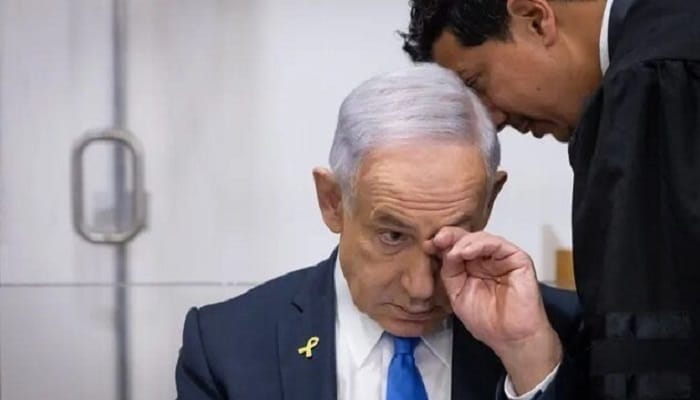
PNN – Netanyahu’s insistence on keeping the region in a state of permanent war reflects, above all, the depth of his personal impasse.
According to the report of Pakistan News Network, despite the fact that several weeks have passed since the ceasefire on the Lebanese front, there is almost no day that the Israeli army does not issue a statement asking the residents of a number of villages south of the Litani River to leave, and as soon as they leave their homes, it immediately begins to destroy everything that remains there.
Zionist occupation and brutality in Lebanon after the ceasefire
The Zionists also then prevent the forced return of the displaced to their homes or villages, and this situation confirms conclusively that the Zionist regime’s goal is no longer limited to occupying parts of, or even all of, southern Lebanon; rather, the scope of its occupation has expanded to include transforming the area extending from the north of the Litani to the southern borders of Lebanon, which covers approximately 20% of the total area of Lebanon and about 25% of the total population; not only occupied territories under the control of the Zionist regime’s army, but also into an uninhabited area, whose annexation to “Greater Israel” in the future is no longer unlikely.
This comes at a time when the Lebanese government has announced its agreement to enter into direct negotiations with the Zionist regime, and the US government has announced that it is seeking to arrange a direct meeting between Lebanese President Joseph Aoun and Prime Minister Benjamin Netanyahu of the occupying regime; without any reference to the need for Israel to withdraw from the Lebanese territories it has occupied or even a commitment by the regime to a ceasefire, this raises urgent questions about the reasons and implications of the escalation of tensions by Israel, on the one hand, and the surrender of Lebanon, on the other.
The Lebanese government’s unjustified betrayal of the nation and the resistance
According to Al-Akhbar, to understand what is currently happening on the Lebanese scene, it may be useful to recall the context in which the ceasefire agreement was reached on November 27, 2024; an agreement that paved the way for the election of Joseph Aoun as President of Lebanon on January 9, 2025, and for the appointment of Nawaf Salam as Prime Minister in February of the same year.
Despite the positive role that Hezbollah played during this period and helped end the political vacuum that had persisted for a long time in Lebanon, the elected president and the prime minister-designate treated the movement as a losing party in the game of domestic politics (Hezbollah was forced to participate in the political process that ended the political vacuum in the country against its will).
Despite the agreement that Joseph Aoun had made with Hezbollah to maintain the movement’s role in the Lebanese arena, his biased positions, as well as those of Nawaf Salam’s government, towards the forces that demanded Hezbollah’s disarmament before Israel withdrew from the occupied territories of Lebanon, and before the Lebanese army had completed its capabilities to protect the country’s territory, immediately showed that the Lebanese president and government had already come to power in coordination with the United States.
It should be noted here that Hezbollah’s adherence to the ceasefire agreement, which the Zionists constantly violated and the Lebanese government failed to do the slightest thing to stop the enemy’s aggression, continued for a period of approximately 15 months, during which the first war between the United States and the Zionist regime against Iran (June 2025) began.
Then the second war of the American-Zionist enemy against Iran began on February 28, 2026, but this time, contrary to what the loyal Lebanese government and the Americans and Zionists expected, Hezbollah entered the field with a strength that shows that during the 15-month period of silence in the face of the enemy’s aggression, it was rebuilding its military ranks and institutional structures after the Battle of Al-Aqsa Storm and the blows it received.
In fact, the resumption of the US-Zionist war against Iran was an opportunity that Hezbollah used to resume its natural role in resisting the occupation and responding to the repeated Zionist aggression, rather than being the reason for this regime’s aggression and occupation.
It is clear that Hezbollah never denies its deep-rooted relations with the Iranian regime, but rather openly speaks of these relations and is proud of them. However, these relations should not be an excuse to justify the wrong political positions that the Lebanese government has taken on two issues; the first is related to its insistence on a complete separation between the paths of resolution on the Lebanese and Iranian fronts, and the second is related to its unnecessary haste to enter into direct negotiations with the Zionist regime in the midst of the current crisis, because these positions of the government are not in the interest of the Lebanese national interests.
It is true that preserving the independence of the Lebanese state is obvious and desirable, but it should not be used as an excuse to justify positions that reflect ideological biases or vindictive motives. It is also true that it is sometimes difficult to ignore the pressures imposed by the changing balance of power and may require entering into negotiations with enemies, but the method of indirect negotiations can be a better solution, especially when this method is the consensus of the Lebanese.
Netanyahu’s illusory “decisive victory” and the background to the escalation of tensions against Iran
However, the rush towards direct negotiations creates divisions that weaken the negotiating position of the Lebanese government. In general, a quick look at what is currently happening in the region is enough to clarify the reasons and implications of Israel’s escalation of tension on the Lebanese front, and perhaps to prove that the positions adopted by official Lebanese institutions, both presidential and governmental, regarding the approach to managing the conflict with the Zionist project in the region do not serve Lebanon’s national interests.
Meanwhile, Netanyahu’s behavior shows that he believes that he has first achieved a “decisive victory” in the Gaza Strip, which justifies his insistence on disarming Hamas and completely eliminating it from the equation of Palestinian politics, a victory in Lebanon, which justifies his insistence on disarming Hezbollah and marginalizing its role in the equation of Lebanese politics, and a victory in Iran, this time with the participation of Trump, which justifies their joint insistence on dismantling Iran’s nuclear program, reducing its missile program, and forcing it to retreat to its internal affairs, sever its ties with the elements of the resistance axis, and refraining from exerting any influence at the regional level.
The collapse of Netanyahu’s illusions and the bet on permanent war in the region
But the facts in reality are in no way compatible with these illusions of Netanyahu; because Hamas still rules the devastated Gaza Strip, Hezbollah continues to resist the Zionist war machine with astonishing efficiency, and Iran has not only not been defeated, but has now taken the initiative in managing the conflict.
There is no doubt that Netanyahu has a vested interest in keeping the war raging on all fronts, so he is betting on the collapse of the ceasefire with Iran and, as a result, pushing Trump to resume a joint war against Iran in order to force the country to make fundamental changes in its policies that align with American and Israeli interests in the region.
Netanyahu therefore thinks that if he advances this bet, he will automatically guarantee the achievement of his goals on the Lebanese and Palestinian stages at the same time, which will pave the way for the dream of a “Greater Israel.”
But if this bet does not fully materialize, Netanyahu at least hopes that the severe military strikes that Iran will receive will weaken it enough to help its allies in the region, and even if his bet fails and he cannot convince Trump to resume the war, he believes that he has other tools that will allow him to turn the situation to his advantage, especially on the Lebanese front, which has caused him many concerns and worries.
From what has been said, it is clear that Netanyahu, who believes that power is the only way to achieve political goals, thinks that it is the constant military pressure that has forced the Lebanese government to change its positions, and as a result, has led to Israeli influence on the Lebanese domestic front; an issue that may help prepare the conditions for Hezbollah’s disarmament and move towards the signing of a peace treaty between Lebanon and Israel, fulfilling all the conditions of this regime, including the following:
1- Delineating land and maritime borders in a way that benefits Israel.
2- Establishing legal, political, and cultural foundations in Lebanon that prevent the emergence of movements that promote a culture of resistance or call for opposition to Zionism.
3- Establishing security apparatuses capable of fully controlling the domestic front and providing the necessary elements to ensure the smooth progress of the normalization process.
Why are Netanyahu’s dreams not coming true?
However, there are many signs that confirm that Netanyahu’s ambitions are completely imaginary and unattainable in reality, and that he greatly exaggerates the role of military power and technological superiority in resolving international conflicts.
The Battle of Al-Aqsa Storm and the subsequent military conflicts in the Gaza Strip for two consecutive years revealed the limitations of military power on the one hand and the technological gap on the other in influencing the course and fate of international conflicts.
Also, the war against Iran and its consequences, which led to Iran’s ability to control the Strait of Hormuz and close it, illuminated the horizons of the role that geopolitics can play in influencing the way international conflicts are managed.
It is therefore clear that the display of the power of the Zionist war machine on various fronts reflects the depth of Netanyahu’s personal impasse more than his skill in dealing with international crises.