
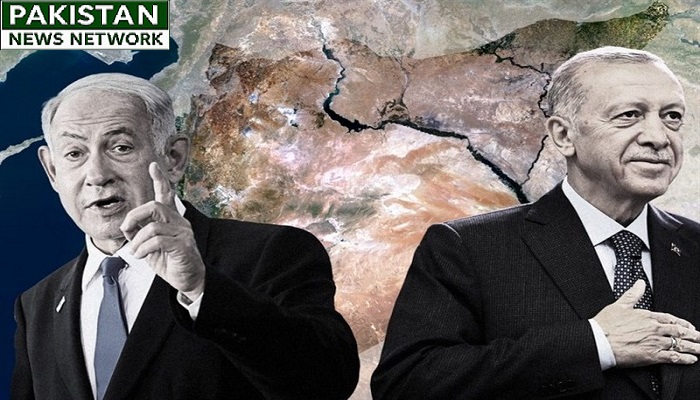
PNN – Tel Aviv clearly perceives a threat in any military involvement or cooperation between the Turkish government and the regime of Ahmad al-Shara.
According to the report of Pakistan News Network; reports emerged early Tuesday regarding a suspicious airstrike on the Abu al-Duhur airfield, located east of Idlib, Syria—70 kilometers from the Syrian-Turkish border. The following day, the Zionist publication Maariv confirmed that the Israeli military had carried out the strike, noting that the attack on the Idlib airfield was executed in four waves. The airfield had recently begun a renovation process in collaboration with Turkey, a key ally of the Damascus government in recent times. Maariv further claimed that the parties behind this reconstruction and modernization project are affiliated with the Turkish military.
Accordingly, Tel Aviv officially claimed responsibility for the attack, and the Israeli Prime Minister’s Office stated in English: We have repeatedly warned that we will not tolerate threats to our security.
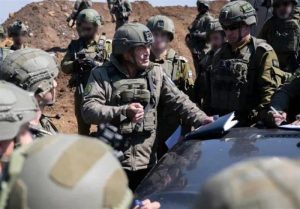
In this context, Eyal Zamir, the army’s Deputy Chief of General Staff, visited Israeli forces stationed in southern Syria. During the visit, he stated that the Israeli military would strive to prevent the emergence of a significant military threat along the border, adding: We are monitoring developments on the Syrian front and will not allow hostile forces to establish a presence at our borders.
Eyal Zamir’s trip to Syria was aimed at conveying a message to Turkey opposing the deployment of weaponry—including drones and air defense systems—in that country. Meanwhile, Turkish media adopted a harsh stance against Israel in response to the attack on Abu al-Duhur Airport.
Meanwhile, while denying the presence of a Turkish military delegation at this Syrian base, Ankara emphasized its continued assistance to the Damascus government in developing the country’s military capabilities and infrastructure. The Turkish government further stated: Accepting the notion that Israel’s military interventions against neighboring countries are normal and acceptable is entirely out of the question, and the international community must take more concrete and effective steps against Israel’s actions, which threaten regional peace and stability.
The confrontation between the Zionist regime and Turkey is driven by deep Israeli concern that Ankara—by assisting Syria in deploying air defenses and reorganizing its air force—could eliminate the freedom of action enjoyed by Israeli fighter jets in Syrian airspace. Furthermore, given the Erdoğan administration’s explicit stance in support of Palestine and its harsh criticism of Israel’s regional policies, the Zionists view Turkey’s presence in Syria as a security threat.
For this reason, during a meeting on Friday between Netanyahu and the regime’s senior security officials, the participants discussed Turkey’s influence in Syria and warned: Turkey is a rival state to Israel that stands at a crossroads and could potentially become an adversary. According to security sources, the discussions were held in an atmosphere of concern, as Israel does not want Turkey—a regional power—to turn into an eighth front in the conflict against the regime.

Meanwhile, the Turkish government has also turned to Interpol to request international arrest warrants for dozens of senior Israeli officials—led by Benjamin Netanyahu—on charges of war crimes and genocide in the Gaza Strip. According to reports from Ankara, this move was prompted by Israel’s seizure of the Somoud flotilla, which had been heading toward the Gaza Strip about three months earlier. The fact that this development has occurred at this juncture signals that tensions between Israel and Turkey have entered a new phase.
Following the fall of the Bashar al-Assad regime, Turkey has emerged as a key supporter of the new Syrian government, playing a role in training, reconstruction, and the strengthening of Syria’s military structure. Meanwhile, Israel seeks to maintain its military and security presence—viewed as an occupation—within Syria and to prevent the emergence of a powerful military force near its borders. Consequently, the dispute between the two sides over the Abu al-Duhur airfield is, in reality, part of a broader rivalry.
Meanwhile, Ahmad al-Sharaa—head of the Syrian interim government, which enjoyed Turkish support during the conflict with Bashar al-Assad’s army—has turned Turkey into a key partner. This has created an opportunity for Erdoğan to not only assist in Syria’s reconstruction and the supply of electricity and gas but also to take significant steps regarding military-security cooperation and bolstering international support for the new government.
Amidst these circumstances, where tensions between the two sides have taken on a new dimension, why has Turkey’s military presence in Syria caused such alarm in Israel? The answer lies in the country’s military capabilities and the rapid pace at which it is localizing its defense industries.
Key Aspects of Turkey’s Military Threats against Israel
In this regard, the “Ynet” website reported that Turkey is not merely a key NATO member but a regional military power whose influence extends from the Black and Aegean Seas—through Syria and Iraq—to the Caucasus and North Africa. Its geographical location at the crossroads of Europe, Asia, and the Middle East, combined with its control over the Bosphorus and Dardanelles straits, lends the country even greater strategic importance.
According to 2026 data from “Global Firepower”—which is based partly on estimates—Turkey has approximately 481,000 active military personnel, 380,000 reservists, and 150,000 paramilitary personnel. Combined, these three categories total more than one million individuals. In terms of the number of active-duty troops, Turkey ranks tenth globally.
The Turkish army’s arsenal comprises approximately 2,284 tanks and around 98,000 vehicles of various types. Turkey’s equipment inventory is a mix of older Western systems and new generations of domestically produced platforms. For decades, Ankara has relied heavily on American and European weaponry, but in recent years, it has invested vast sums in an effort to reduce this dependence—spanning everything from tanks and armored vehicles to missiles, air defense systems, military electronics, and unmanned vehicles.
According to “Global Firepower” estimates, Turkish military forces possess approximately 1,101 military aircraft and helicopters. The F-16 fleet remains the backbone of Turkey’s fighter force; however, Ankara is simultaneously pursuing two avenues to bolster its military capabilities: seeking to purchase the strategic F-35 fighter from the United States and developing the domestically produced “KAAN” fighter jet. The production of Bayraktar drones represents another facet of Turkey’s military success; these UAVs have evolved beyond mere operational tools into significant export-driven deterrents and valuable political assets. Turkey supplies its systems to dozens of nations, emerging as a formidable competitor to Israel’s defense industry in the global market.
Turkey also possesses valuable assets in the maritime domain—an area where indirect tensions with Israel have recently emerged in the Mediterranean. The Turkish Navy comprises 192 vessels, including 17 frigates, 9 corvettes, and 14 submarines. Turkey operates its naval forces across three primary theaters: the Black Sea, the Aegean Sea, and the Mediterranean Sea.
Another key factor is Turkey’s defense industry, which currently encompasses over 4,500 companies and a portfolio exceeding 1,400 defense projects. According to these figures, the share of locally produced components and products has risen from approximately 20 percent two decades ago to over 85 percent today.
Furthermore, new reports indicate that Turkey is emerging as a significant missile power. According to Turkish media, the country’s Ministry of Defense is preparing to test the powerful Tayfun Block 4 ballistic missile. With an estimated range of 1,000 to 1,500 kilometers, this missile could potentially strike targets across the occupied territories; this development would signify a substantial expansion of Turkey’s long-range strike capabilities and could introduce a new dimension to the region’s tense military balance.
Following a period of apparent calm in relations between Ankara and Tel Aviv, tensions escalated—particularly after the outbreak of the Gaza war in October 2023. Nine months into the conflict, Erdoğan announced a trade embargo against Israel, effectively halting Ankara’s commercial and economic dealings with the regime. This measure remains in effect to this day; indeed, a few months ago, under a new directive from Erdoğan, the final loopholes and routes used to circumvent the embargo were closed off to Israeli companies and merchants.
This confrontation took on a different dimension in Syria, evolving into an indirect military-security conflict. Although a direct military clash between them is unlikely—especially given the active role the United States plays in preventing such an outcome—the situation in Syria could cause these tensions to escalate, potentially even leading to limited damage and casualties.