
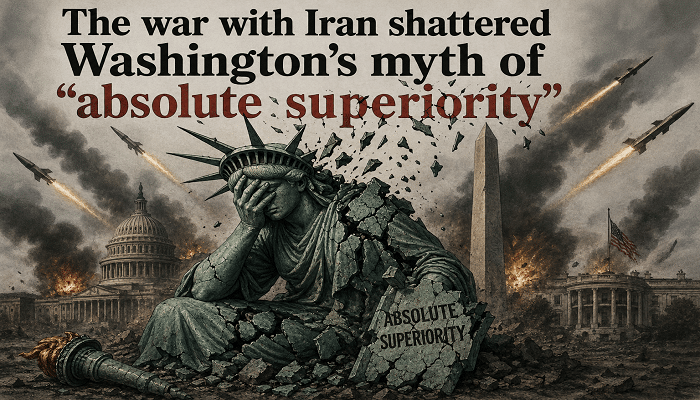
PNN – The American think tank, the Quincy Institute for Responsible Government, announced in a report that the war against Iran has called into question one of Washington’s most important strategic assumptions, namely “absolute military superiority,” and has shown that even superior military power does not necessarily lead to the ability to impose political will.
According to the report of Pakistan News Network; The American think tank, the Quincy Institute for Responsible Government, wrote in a report: The war against Iran has shattered one of the central assumptions about great power dominance: the notion that sheer size and military might are sufficient to impose will.
According to Quincy, the war has exposed the limits of Washington’s power and called into question the foundation of America’s decades-long strategy of “absolute superiority.”
According to this analysis, the US grand strategy over the past decades has been based on the belief that the country’s military power is unrivaled, allowing Washington to maintain its desired order in the world and impose its political and security will on different regions of the world.
However, the American think tank emphasizes that the US failures in Iraq and Afghanistan have led many Americans to conclude that the cost of maintaining this superiority is no longer bearable and that it no longer serves US interests.
According to Quincy, a strategy based on permanent, all-out military dominance means that America must always be at war somewhere in the world; therefore, America’s endless wars are not “incidental” but a direct result of this approach.
The report adds that despite American public fatigue with war, economic pressures, and politicians’ promises to end endless wars, the political structures and economic interests associated with war have allowed the policy of “absolute superiority” to persist.
But Quincy acknowledges that the Iran war is the crisis that breaks this pattern; a crisis that could have even more serious consequences for the United States than the Iraq war.
According to the American think tank, Washington achieved a military victory in the Iraq war in the short term and its military superiority was never in doubt, but ultimately failed to stabilize and control Iraq. In contrast, in the war with Iran, the United States did not even achieve victory in the military phase; and that against a country whose military budget is much smaller than Washington’s.
According to the report, Iran, with the help of its geography and asymmetric tactics, was able to contain US power and inflict a strategic defeat on Washington. Quincy also emphasizes that the initial US claims of the widespread destruction of Iran’s missile and drone capabilities now seem exaggerated.
The American think tank concludes that air dominance no longer means controlling the outcome of a war, and when the US is neither able to deploy ground forces nor can it convert air superiority into decisive results, the concept of “absolute US superiority” seems hollow.
The report then cites an analysis by Steven Walt that the Iraq War, despite its ultimate failure, at least achieved its initial goal of overthrowing Saddam, but in Iran, the US goal of regime change has also failed. According to this analysis, the war has not only not weakened the Iranian government, but has also strengthened internal cohesion.
According to the Quincy report, the Iraq War, while destabilizing the region, did not lead to a global energy and supply chain crisis, but the Iran War has disrupted energy markets, pushed oil and gas prices to new records, and created energy emergencies in several countries.
The war may also have changed the geopolitics of the Persian Gulf for years, the report says.
The strategy of “absolute superiority” has always been a political choice, not an inevitable necessity, but the Iran war has shown that it may no longer even be viable.
Quincy argues that a strategy that relies on “escalation superiority” will collapse when escalation itself becomes too dangerous, and a strategy that relies on decisive victory will become ineffective when adversaries can create a stalemate.
The think tank emphasizes that the new world order will be based not on absolute dominance but on “mutual deterrence”; a world in which great powers can no longer easily impose their will and smaller countries can resist at a tolerable cost. In this regard, Quincy claims that the most likely outcome of the current confrontation between Iran and the United States will be neither a final agreement nor a return to all-out war, but rather a long-term and uneasy equilibrium.
According to Quincy, countries that have tied their security to American support should consider these developments as a wake-up call. American alliances will undoubtedly change, and American allies will move towards diversifying security relationships and relying more on regional balances rather than relying on a single guarantor.
According to the report, the war on Iran has actually accelerated a process that had already begun; Iraq and Afghanistan revealed the limits of occupation and regime change, the war in Ukraine revealed the vulnerabilities of large conventional armies, and now the war on Iran has revealed the limits of coercion and intimidation.