
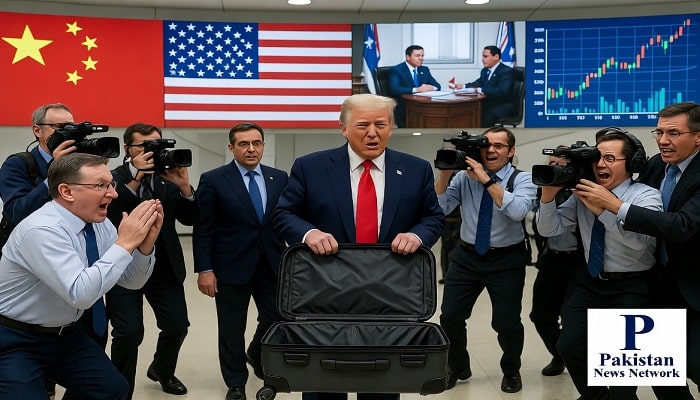
PNN – Donald Trump’s trip to China took place at a time when the Middle East was awaiting the fate of the illegal war between the United States and the Zionist regime against Iran, and Washington needed more than ever the help of a power that it had for years called the “main rival of the American order.”
According to the report of Pakistan News Network, Donald Trump’s visit to China took place at a time when the Middle East was awaiting the fate of the illegal war between the United States and the Zionist regime against Iran, and Washington needed the help of a power that it had called “the main rival of the American order” for years, namely China. This contradiction is perhaps the most important image that will remain in the minds of analysts from Trump’s historic visit to Beijing; a visit that not only did not have a clear achievement for the United States, but also showed clear signs of the decline of Washington’s traditional position in global equations.
As the US president arrived in Beijing, US Secretary of State Marco Rubio, in an interview with Fox News, called on China to play a more active role in containing Iran and pressuring Tehran to back down in the Persian Gulf. Rubio stressed that the security of the Strait of Hormuz is directly tied to China’s economic and strategic interests and that Beijing must take greater responsibility in this matter.
But what made this stance more than a simple diplomatic request was the fact that the United States had now turned to the very country that it had for years presented as the main threat to its hegemony to solve one of the world’s most important security crises.
A War without a Strategy
Recent developments show that Washington’s main problem is not simply China’s lack of support for America’s anti-Iran policies; the issue is deeper than that. Many analysts believe that the Trump administration essentially entered into a confrontation with Iran without a clear strategy.
In recent weeks, the extensive attacks by the United States and the Israeli regime against Iranian positions have brought the region to the brink of all-out war. However, contrary to Washington’s initial estimates, neither did Iran’s political structure collapse, nor did Tehran’s deterrence disappear, nor did the United States achieve its key goals; goals such as changing the Islamic Republic’s strategic behavior, opening the Strait of Hormuz, or controlling Iran’s nuclear program.
Even Trump’s recent statements about sending large-scale weapons to separatist groups, without specifying the fate of these weapons, were seen by many as a sign of the failure of US intelligence and security calculations.
Trump believed that extensive military pressure could force Iran to retreat in a short time, but the reality on the ground proved otherwise. Washington is now in a situation where it can neither expand the war nor easily exit it.
From Nixon’s “Two Pillars” to the Collapse of the American Security Umbrella
To understand America’s current situation in the Middle East, we need to go back a few decades. After World War II, America tried to establish the image in the world that each American president had a specific doctrine and strategy for managing the world order.
In the 1970s, Richard Nixon designed the famous “two pillar” policy in the Persian Gulf; a strategy according to which Iran and Saudi Arabia were considered the two main pillars of protecting American interests in the region. By arming these two countries and providing military training, Washington tried to ensure its energy security and its superiority over the Soviet Union.
In the following decades, various US administrations pursued various strategies to redesign the regional order, from the “New Middle East” and “Constructive Chaos” projects of George W. Bush to the project of normalizing Arab relations with Israel in the form of the “Abraham Accords.”
But now, after the recent forty-day war, many believe that even the US security umbrella for its Arab allies is no longer as valid as it once was. The Arab countries of the Persian Gulf have realized that Washington is no longer the power it was in previous decades, and this has led them to diversify their security partners.
Trump in Beijing: A President in Need
In such an atmosphere, Trump’s trip to China seemed more like an attempt to manage America’s accumulated crises than a show of strength.
The US presidential plane this time did not only take politicians to Beijing; more than 20 prominent figures in the fields of technology, business and artificial intelligence also accompanied Trump. The combination showed that Washington is deeply concerned about economic and technological competition with China, in addition to geopolitical issues.
However, the way China welcomed Trump became one of the most controversial parts of the trip.
Xi Jinping did not personally greet the US president at the airport, and only a handful of Chinese officials went to greet him, an event that many interpreted as a diplomatic humiliation.
While Trump was forced to visit China for the second time in just 10 months, Xi Jinping has not made an official state visit to the US in more than a decade.
Was Trump looking for a deal?
Some analysts believe that Trump’s main policy is not war but deal. He has always tried to turn geopolitical crises into economic opportunities and behind-the-scenes agreements.
However, when it comes to China and Taiwan, the story is more complicated.
Taiwan is not just an island for the US; it is the heart of the global semiconductor and electronic chip industry. Much of the world’s advanced industries, from artificial intelligence to military equipment, depend on Taiwanese products.
For this reason, unlike Ukraine, Washington is unwilling to simply deal with Taiwan, because giving it up would mean China’s complete dominance in the global technological competition.
However, Trump has tried to control at least some of the trade and economic tensions with China.
Beijing’s Rejection of America
One of the most important goals of Trump’s visit was to gain Chinese support to put pressure on Iran, but evidence shows that Beijing is not willing to do so.
Before Trump’s visit, Iranian Foreign Minister Abbas Araghchi traveled to Beijing, a trip that many viewed as an attempt to coordinate the positions of Tehran and Beijing ahead of possible talks with the United States.
China knows very well that Iran is one of its most important strategic partners in energy projects and the massive “Belt and Road” initiative. Moreover, Beijing is not interested in getting involved in a case that could directly involve it in a security confrontation with the United States.
Trip Achievements; Almost None
A review of the results of Trump’s trip to China shows that Washington failed to achieve many of its main goals.
The most important topics expected from the trip were:
Agreement with China to stop buying oil from Iran
Issuance of a joint statement on pressure on Tehran to open the Strait of Hormuz
Resolution of tariff and trade disputes
Progress in the Taiwan case
Broad agreements in the field of artificial intelligence
Major contracts for the purchase of Boeing aircraft
But almost none of these goals were fully achieved. The only tangible result of the trip was initial discussions about possible cooperation in the field of artificial intelligence, without a concrete agreement.
In the economic sphere, a contract was signed to buy 200 Boeing aircraft, a number that was far less than the initial promise of 500 that had been made earlier.
In other areas, there was no agreement on tariffs, no progress on the Taiwan issue, and no serious cooperation against Iran.
America and the Fear of a Vietnam Repetition
What has received the most attention in American political circles is Washington’s concern about being caught in a war of attrition similar to Vietnam.
Although American officials continue to talk about the military option, many American security and military institutions are well aware that entering a large-scale war with Iran could have unpredictable costs for Washington.
Unlike many of the US wars of the last two decades, Iran has significant missile capabilities and the capacity to create a crisis in the global energy path. For this reason, it seems that the Trump administration’s main priority now is not complete victory, but a low-cost exit from the crisis and the preservation of a minimum of America’s global credibility.