
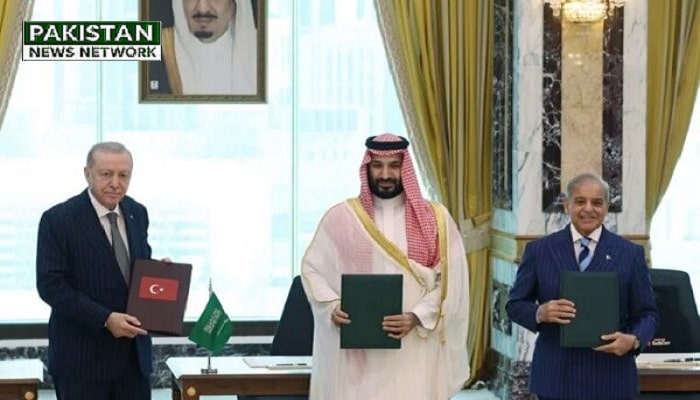
PNN – With the intensification of attacks by Yemen’s Ansarullah on Saudi Arabia, the Mecca defense pact between Türkiye, Saudi Arabia, and Pakistan is facing a serious test; however, Ankara has not yet entered the war.
With the escalation of hostilities between Saudi Arabia and Yemen’s Ansarullah—and the rise in attacks on Saudi territory—attention has turned to the Mecca defense agreement and the mutual commitments shared by Turkey, Saudi Arabia, and Pakistan. Signed by the three nations in Mecca on August 7, 2026, this pact emphasizes strengthened defense and security cooperation and the establishment of collective deterrence; officially, the three countries have declared that an armed attack on any single member constitutes an attack on all.
Given the extensive media coverage in Turkey—including outlets such as Sabah, Hürriyet, and Yeni Şafak—highlighting the significance and impact of the Mecca agreement, alongside warnings from Ansarullah officials urging Turkey to avoid entering the Yemen conflict, the question now arises: will Ankara intervene in the war on Saudi Arabia’s behalf should the fighting intensify?
In other words, why has Turkey refrained from directly entering the Yemen war so far, despite the Mecca defense agreement? The answer to this question can be examined through three main points:
- The implementation of the Mecca agreement has not yet been ratified by the Turkish Parliament.
The most important factor is the agreement’s legal status within Turkey. Although the Mecca agreement was signed on August 7, the ratification process in the Turkish Parliament has not yet been finalized. Under Turkey’s legal system, the ratification of international treaties and the deployment of armed forces abroad are subject to specific legal mechanisms and the role of the parliament.
Under the Turkish Constitution, Article 90 stipulates the Parliament’s role in ratifying certain international treaties, while Article 92 vests the authority to declare war and authorize the deployment of armed forces abroad—in specified instances—in the Parliament.
Therefore, the signing of the Mecca agreement does not, in itself, mean that the Turkish military is obligated to deploy troops to every military conflict involving Saudi Arabia. This matter depends on how the agreement is finalized within Turkey’s legal framework and on subsequent parliamentary decisions.
From this perspective, the current situation should be viewed more as an emerging political-defense commitment rather than a clear, automatic authorization for the deployment of Turkish forces to the war in Yemen.
- Turkish Public Opinion: The Yemen War Is Not Like the Syrian Conflict
The second factor relates to Turkish public opinion.
Unlike the Syrian conflict, the war in Yemen has no direct bearing on the security of Turkey’s borders. Turks largely view their country’s military presence in Syria as a matter of border security and a means to counter the YPG and SDF forces; the war in Yemen, however, lacks such a direct link to Turkish security.
Consequently, direct military intervention by Turkey in the Yemen war to defend Saudi Arabia could face opposition from segments of the public. Even among supporters of the Justice and Development Party (AKP), it could prove difficult for the government to rally public support for deploying troops to a conflict that does not directly affect Turkey’s security.
On the other hand, the full text of the Mecca defense agreement and the details regarding member obligations have not been transparently disclosed to the public, a fact that could create ambiguity concerning the extent of Turkey’s military commitment.
Admittedly, the agreement contains a clause stipulating that an armed attack on one member is to be considered an attack on all members—a provision conceptually reminiscent of Article 5 of the NATO treaty regarding collective defense. However, the mere existence of such a clause does not necessarily mean that Turkey is obliged to deploy military forces in every conflict involving Saudi Arabia; rather, the implementation of this commitment and the level of response from each member depend on the terms of the agreement as well as their respective domestic legal and political mechanisms.
- The 2028 Elections and the Political Cost of Entering the War
Another significant factor is Erdoğan’s electoral calculations.
Turkey is approaching the 2028 presidential elections, and to sustain his political career, Erdoğan needs to preserve his social base and voter support. Under these circumstances, Turkey’s direct entry into the war in Yemen could entail a significant political cost for him.
Regarding the situation in Syria, Erdoğan has successfully linked Turkey’s military presence to border security and countering direct threats to the country; however, no such justification exists for Yemen. Consequently, if Turkey were to enter a foreign war to defend Saudi Arabia, a segment of the public might view this move not as serving Turkey’s direct interests, but rather as an act of support for Saudi Arabia.
Under these circumstances, entering the war in Yemen could erode Erdogan’s electoral support—particularly if the move faces public opposition and entails rising human and economic costs.
From this perspective, it might be more logical for Erdogan to support Saudi Arabia through military, technical, and defense assistance rather than engaging directly in the conflict; this approach demonstrates Turkey’s commitment to Saudi Arabia while incurring lower political costs for the government.
Ankara Currently Speaks of “Support,” Not Troop Deployment
On September 19, responding to Ansar Allah’s attacks on Saudi Arabia, Turkish Foreign Minister Hakan Fidan stated that Riyadh might require certain military capabilities—particularly in technical areas—due to these attacks, and that Turkey stands ready to assist within the framework of a trilateral agreement.
This stance is significant in one respect: while Fidan expressed Turkey’s readiness to meet Saudi Arabia’s military needs, he made no announcement regarding the direct deployment of Turkish army troops to Yemen.
Therefore, at least at the current stage, a distinction can be made between two levels of commitment: first, providing military, technical, and defensive assistance to Saudi Arabia; and second, the direct deployment of Turkish forces into the Yemen war. While the first level has been addressed in Fidan’s statements, no such decision or official announcement has yet been made regarding the second.
Conclusion
The Yemen war now serves as one of the first serious tests for the Mecca defense agreement—a pact whose importance and impact Turkish media had previously highlighted, framing it as a vehicle for Ankara to play a role in the new regional order. Nevertheless, Turkey will not, for the time being, enter the conflict on behalf of Saudi Arabia’s interests.
Although recent reports have emerged regarding the downing of Saudi Arabian drones—specifically the Turkish-made Akinci model—this does not necessarily imply direct military assistance or support from Turkey to Saudi Arabia. For years, as part of its arms export policy, Turkey has sold military drones, including the Akinci and Bayraktar, to various nations, and Saudi Arabia is among the customers for these systems. Riyadh began purchasing Turkish drones in 2021, and the use of these aircraft in recent operations should be viewed primarily within the context of the arms cooperation and sales agreements established between the two countries.