
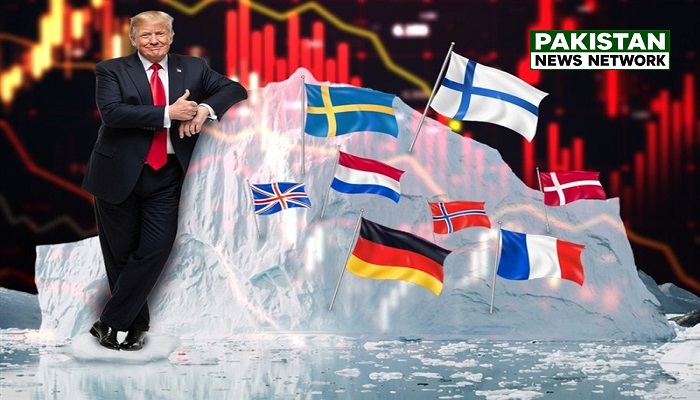
PNN – Right-wingers in Europe are seeking to distance themselves from Donald Trump following his electoral defeat.
According to the report of Pakistan News Network; the Republican Party’s historic defeat in the U.S. midterm elections has once again confronted Europe’s far-right leaders with the perennial dilemma posed by Donald Trump: while they may support his nationalist and anti-immigration agenda, Trump himself has become an electoral liability and a source of trouble.
Since Trump’s re-election in 2024, populist leaders in Europe—including Marine Le Pen in France and Giorgia Meloni in Italy—have carefully calibrated their public stances toward the U.S. President, effectively walking a tightrope across the Atlantic.
They welcome Trump’s policies on strict border control, culture wars, and opposition to globalization. Yet, European voters—even those within far-right circles—are wary of his unpredictable personal behavior, the instability of his geopolitical positions, his unreliability regarding the defense of Europe, and his protectionist trade policies.
Trump’s territorial threats regarding Greenland, along with his economic nationalism, have proven particularly problematic for these leaders. No leader who champions national sovereignty and the protection of domestic jobs can endorse the threatened seizure of territory belonging to an EU member state—just as they cannot support punitive trade tariffs.
The sweeping scale of the Republican defeat in Tuesday’s elections has now prompted European populists to distance themselves even further from the White House. At the same time, they have drawn a crucial lesson from these results: voters who are angry and under economic strain will oust incumbent governments from power.
On Wednesday, far-right politicians across European capitals made a clear effort to distance themselves from the White House, though they carefully avoided launching direct, personal attacks against Trump.
Jordan Bardella—leader of France’s National Rally party and a potential candidate for prime minister should Marine Le Pen win next year’s presidential election—spearheaded this stance.
Without explicitly naming the president who ordered the strikes, he condemned the U.S. attacks on Iran, stating that they have had “very serious consequences” for the global economy.
In Germany, Alice Weidel—one of the two leaders of the far-right party “Alternative for Germany”—stated that Trump had promised his voters he would “not pursue an interventionist foreign policy,” adding: Now, the consequences of breaking this campaign promise have caught up with the Republicans.
Roberto Vannacci, founder of the far-right party “National Future” in Italy, also remarked that the election results demonstrate the political risks of failing to deliver on campaign promises. He noted, “Trump failed to meet expectations.”
In Madrid, Santiago Abascal, leader of the far-right party “Vox,” dismissed any suggestion of a political link to Washington. Responding to questions about an ideological alliance with Trump, he stated: I am in Spain, not in Michigan,” and emphasized that “what happens elsewhere is of little concern to me.
Nevertheless, the Republicans’ defeat in the U.S. midterm elections has offered an electoral lesson for Europe’s far-right parties: they can now leverage public economic discontent and the rising cost of living to garner votes.
Bardella has repeatedly stated that the public’s purchasing power and the cost of living would be the “absolute priority” for a potential government led by the National Rally. The party has pledged to reduce the value-added tax (VAT) on electricity, gas, and fuel, and to allow employers to increase their staff’s wages without incurring additional social security contributions or payroll taxes.
In Spain, the Vox party has similarly leveraged the sharp rise in the cost of living and the growing difficulty in accessing housing to attack the country’s Socialist Prime Minister, Pedro Sánchez. The party hopes to enter government following the elections on November 29, by forming a coalition with other right-wing parties.
For the populist leaders currently in power in Europe—including Giorgia Meloni—these developments are not good news. The Italian Prime Minister has already faced several waves of domestic protest in Rome, Milan, and other cities.
Matteo Salvini, leader of the far-right “League” party and a coalition partner in Meloni’s government, acknowledged that the outcome of the U.S. election was “influenced, above all, by wars, international tensions, and the rising cost of living—costs that place a direct burden on families.”
Representatives of Italy’s opposition parties were also quick to draw a link between these factors and the Republicans’ defeat. They pointed out that Trump had promised to lower prices and bring high-quality jobs back to the United States—yet none of these promises were fulfilled. When far-right leaders attain power and fail to deliver on their pledges, they become just as vulnerable to the wrath of voters as any other politician.