
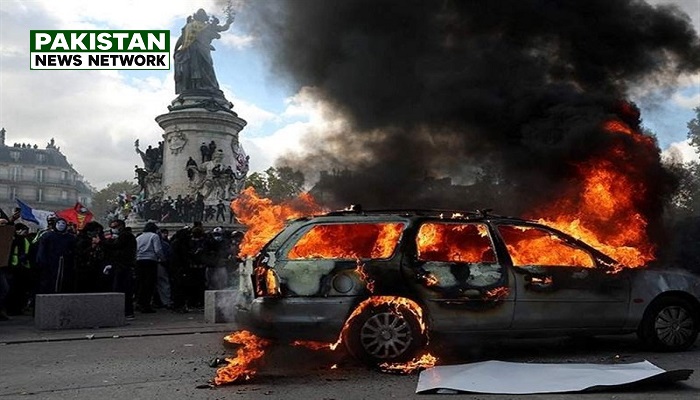
PNN – A Western media outlet has examined how French political parties are attempting to attribute the unrest to one another.
According to the report of Pakistan News Network; the newspaper Tagesschau reports on the conflict between political factions in France, noting that each side is trying to pin the unrest on the policies of its opponents. Meanwhile, many French citizens have reacted to the protests and unrest in their country with shock and an inability to comprehend the violence.
In this context, political factions are vying to control the narrative, blaming each other for the escalation of the situation.
Nicolas, a French resident, stares in disbelief at his favorite café, which caught fire and burned down completely during the clashes. He condemns the violence but supports the social protests.
He states that the media focuses solely on the violence, and that what has transpired is horrific. He noted that there is no longer any discussion about the fact that people in many cities have been demonstrating peacefully—protests in which young people are fighting for their rights, or where citizens have been struggling intensely due to the policies of Emmanuel Macron over the past decade.
Nicolas emphasized that, for him, this serves as a symbol of a society that is struggling and suffering.
In a televised address to the nation last night, Emmanuel Macron made cautious remarks but was explicit regarding who bears responsibility for the situation, stating: Attackers from far-left groups—alongside criminals—have unleashed unbridled violence in our cities. How can the French do this to France? Nothing can justify, explain, or excuse it.
While he offered no concrete concessions to the young people who have been taking to the streets for weeks to demand better educational conditions, he did promise them more dialogue.
Sébastien Lecornu is also expected to soon convene representatives of students, labor unions, and employer associations to work together toward improving the situation.
With an eye on the upcoming presidential election in the spring of 2027, Macron called for calm and respect. He warned against bringing electioneering into the streets, telling the French people: Those who seek to convince you that demonstrations and unrest are necessary have only one goal: to hijack the debate and harm the Republic.
The primary target of these remarks by Macron is the far-left party LFI, which he and the French government have repeatedly accused of inciting protests and violence for political gain. Meanwhile, Jean-Luc Mélenchon, the leader of the LFI, blames the government for escalating the situation and has specifically condemned the tactics employed by the police.
In an interview with the channel LCI, Mélenchon accused the government of standing by as the situation deteriorated, only to subsequently resort to indiscriminate violence and the use of fear.
Just hours before Macron’s speech, Marine Le Pen—leader of France’s far-right party—released a video message laden with presidential imagery, filmed in front of a bookshelf with the French flag in the background. The presidential candidate from the right-wing “National Rally” party declared that the nation is trapped in a cycle of violence and impotence.
Condemning both the political left and the government, Le Pen stated: On one hand, there are destructive forces that downplay violence, target police officers, institutions, and government representatives, and treat them as enemies to be suppressed. On the other, Macron’s ruling elite are exhausted and bewildered—capable only of reflecting their own powerlessness and decline.
Consequently, following an escalation of violence in France, political factions have turned on one another, trading mutual accusations. They are locked in a battle over interpretations, the power to define events, and the shaping of narratives. The tone of these political debates leaves little room for nuance; yet, it is likely that these discussions will define the coming months leading up to the presidential election.