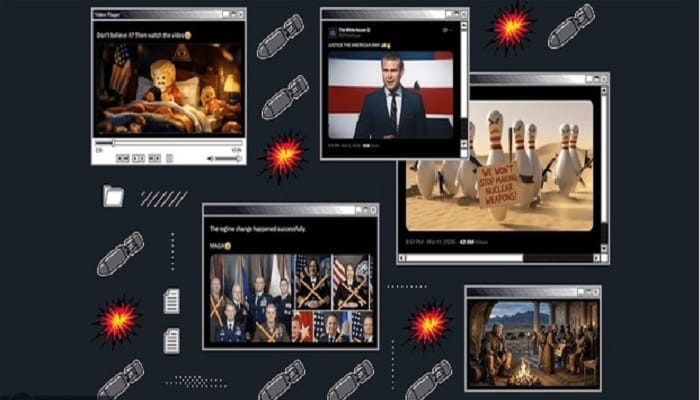
PNN – The TASS news agency wrote in a report: The media believe that the Islamic Republic of Iran is effectively shaping public opinion by using humorous themes, memes and advanced videos on social media using artificial intelligence, while Washington is losing the battle to conquer the hearts and minds of users.
According to the report of Pakistan News Network; TASS news agency, in a report titled “The War of Memes: How Iran Overtook the US in Attracting Likes on Social Media?” announced that: Tehran has also defeated Washington in attracting “likes” and capturing the hearts and minds of social media users.
This official Russian media outlet wrote on Friday in a report by Viktor Bodrov: Information warfare has become part of the US and Israel’s military conflict with Iran.
The report states: The media believes that the Islamic Republic of Iran is effectively shaping public opinion by using humorous themes and advanced videos on social media using artificial intelligence, while Washington is losing the battle to conquer the hearts and minds of users.
The Russian analyst continued, referring to the US President’s action in publishing images using artificial intelligence about the military aggression against Iran, and wrote: Iran responded to Trump and the White House’s statements with the same language.
The article continued: Before the US military aggression against Iran, unpleasant statements were exchanged between the officials of the two countries on social networks, but after that, the official posts of Iranian officials and organizations became innovative and humorous.
As an example, the TASS news agency cited an article by the Iranian embassy in Zimbabwe, which responded to Trump’s remarks in satirical language.
After the US President claimed that energy facilities and civilian infrastructure would be attacked if the Islamic Republic of Iran did not allow ships to pass through the Strait of Hormuz, the Iranian Embassy in Zimbabwe sarcastically announced: We have lost the keys (to the Strait of Hormuz).
According to the Russian media outlet, the Iranian embassy in South Africa continued the joke, writing that the keys were hidden under a flower pot and that the entrance to the strait was open “only to friends.”
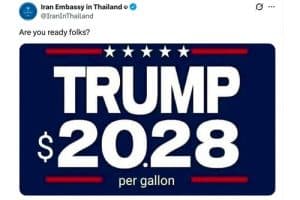
TASS further wrote: After Trump announced the beginning of the blockade of the Strait of Hormuz, the Iranian Embassy in Thailand published a picture of a poster of the upcoming US presidential election campaign in 2028 in a post on the social network X, under which it read: “$20.28 per gallon” (gasoline).
The Russian state media outlet continued its report by referring to posts on the X social network by the Iranian consulate in Hyderabad, India, and the Iranian embassies in Thailand, Ghana, and Malaysia, which mocked America’s alleged victory in the war and portrayed America’s ambitions as acts of piracy.
The report adds: In early May 2026, the White House informed Congress that they considered military operations in Iran to be over, and Trump posted a picture of himself holding six Uno playing cards and wrote below: I have all the cards.
It was then that the British newspaper The Independent and other media outlets pointed out that the rules of the game were the opposite of what Trump had said, because whoever gets rid of these cards first wins.
The report continued: Iran took advantage of this and posted a photo on the account of its consulate general in Hyderabad showing a smiling Iranian general holding fewer cards but still in a victorious position. The caption read: Yes, we have fewer cards.
According to the report, the Guardian wrote in a report: Iran has radically overhauled its social media strategy as part of a full-scale information war launched by the country in response to attacks by the United States and Israel.
The publication quoted experts as saying: Iran’s influence operations abroad have intensified as part of an asymmetric campaign to complement countermeasures and increase moral pressure on the United States and Israel to limit their military actions.
The Hill newspaper also quoted a professor of strategic communications at American universities as saying: Washington has done a lot of work on social media, but the Iranians basically take these subjects, turn them upside down and send them back to the United States.
The newspaper wrote: The videos and posts of Iranian diplomats’ responses demonstrate their familiarity with American culture and their mastery of the provocative language common in the online space.