
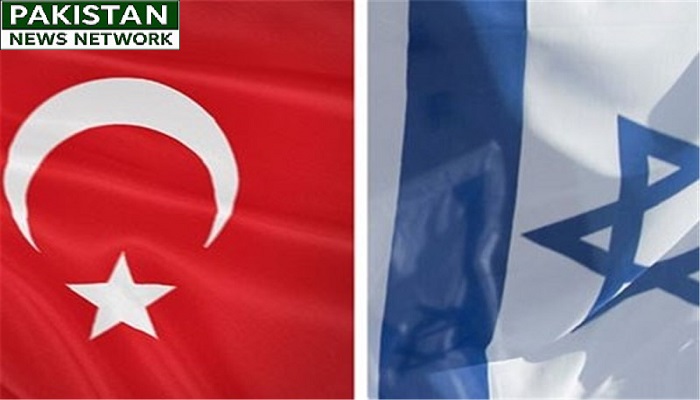
PNN – Ankara prefers to pursue scenarios that allow it to manage its rivalry with the regime in a controlled and trouble-free manner.
According to the report of Pakistan News Network; the Zionist regime’s attacks on the abandoned Abu al-Duhur base in Syria—ostensibly targeting the presence of Turkish troops—have drawn significant attention from analysts. Thus far, it appears that officials in both Ankara and Damascus have chosen not to respond to the Zionist regime’s actions with harsh rhetoric.
General Selçuk Bayraktaroğlu, Chief of the General Staff of the Turkish Armed Forces, has discussed Israel’s activities in Syria with several of his regional counterparts, and the Turkish Ministry of National Defense has stated: Turkey has become a hub for regional security diplomacy. Both our Minister of National Defense and our Chief of the General Staff are holding meetings with their counterparts regarding military diplomacy for regional security and stability. In our view, Israel’s attack on the Abu al-Duhur airbase is an action aimed at undermining the stability, security, unity, and territorial integrity of Syria, as well as its infrastructure. We emphasize at every opportunity that attacks violating Syria’s sovereignty and territorial integrity are unacceptable. We state that no Turkish military delegation was present at the Abu al-Duhur airbase in Syria either before or during the Israeli attack on the facility. For the sake of peace and stability in Syria and the region, it is essential that Israel cease such reckless attacks and adhere to the requirements of international law.
The Turkish Ministry of Defense statement also reads: We will continue to support Syria’s efforts to build its infrastructure and military capabilities within the framework of the ‘unified army’ principle.
Katz’s Harsh Remarks
Israeli Prime Minister Benjamin Netanyahu stated that Israel had issued a warning prior to the strike in Syria, cautioning against allowing a Turkish presence at the base in question.
Meanwhile, Israeli Defense Minister Israel Katz remarked: Erdogan is dragging Turkey into dangerous adventures in Syria. Israel will not allow any actor to threaten its security. The best course of action for Erdogan is to stick to delivering fanciful, empty speeches against Israel in the Turkish parliament and not to test our resolve to defend ourselves.
This Zionist official has noted that the deployment of Turkish troops on Syrian soil is dangerous and that Tel Aviv will not tolerate such a move.
However, in response to these remarks, the Turkish Ministry of Defense stated that claims regarding a Turkish military presence at the Abu al-Duhur airbase in Syria are baseless and untrue.
Meanwhile, the Syrian Foreign Minister has also announced that Damascus has no plans for a Turkish military presence at the Idlib base. Asad Hassan Shibani has clearly informed Israel that there are no plans to establish a Turkish military base in Syria and that the facility is being renovated for use by the Syrian Air Force.
Sheibani emphasized that Turkish military officials had visited the base as part of broader military training and cooperation activities. He also stated, in a measured tone: Israel has no legitimate justification for the bombing, and Syria is prepared to negotiate with Israel on de-escalating tensions. Any future agreement must take into account the security concerns of both sides and respect Syria’s sovereignty.
What do analysts say?
Moaz Al-Abdullah, Middle East Research Manager at the Armed Conflict Location & Event Data Project (ACLED), states: In the post-Assad era, Israel’s objective goes beyond merely securing southern Syria or preventing the deployment of Syrian forces near the border; it pursues a broader goal: forestalling the reconstruction of any strategic Syrian military capability. This strike, carried out just hours after a visit by a Turkish expert delegation, serves as a message addressed to both Damascus and Ankara. Israel appears to be establishing a new rule, effectively signaling that any Syrian base capable of serving as a future platform for a Turkish military presence may be targeted preemptively.
Meanwhile, an analysis by Kheder Khaddour, a non-resident scholar at the Carnegie Middle East Center, notes: Israel does not want Syria to possess an air force. Under Israel’s new security doctrine, Syria may maintain a ground army, a police force, and a central government, and even rebuild its economy and infrastructure; however, it must not re-emerge as an independent air power. This is precisely where Turkey enters the equation, as it can provide Syria with training, radar systems, air defense capabilities, equipment, and the means to reconstruct its military infrastructure.
In a similar analysis, Nawar Sabah, a security and military affairs researcher at the Center for Arab Studies, points out that Israel had previously conducted strikes in Palmyra—specifically in March 2025—with this very objective in mind.
All this is taking place against the backdrop of what Asli Aydin-Tasbas, an analyst at the European Council on Foreign Relations, has noted: Since the fall of Assad, Syrians have repeatedly stated that they do not seek war with Israel, and security talks have been ongoing for months. However, Israel looks beyond Damascus’s current behavior; it is focused on the power structure that might emerge in Damascus tomorrow with Turkey’s assistance.
Prior to this attack, Gonul Tol, an analyst at the Middle East Institute, had reported: Ankara is expanding its military presence in post-Assad Syria, and discussions are underway regarding the establishment of new bases and the deployment of Turkish radar systems within the country. Israel, however, views this trend as a threat to its air force’s freedom of action and has previously reacted to such plans.
Turkey’s Low-Level Response
Typically, officials in the Erdoğan administration counter foreign threats using a formula involving a massive media barrage synchronized with the official stances of the ruling party, the President, the head of the MIT intelligence agency, the Defense Minister, and the Foreign Minister.
However, following the Israeli regime’s attack on a Syrian base near the Turkish border, the highest-ranking official to comment on the incident was Fahrettin Altun—the head of the Turkish presidency’s communications directorate.
Turkey: A Cautious Approach
Turkish officials previously sought to propagate the narrative that events in the Syrian theater were unfolding entirely according to Ankara’s wishes and that Turkey was the undisputed winner of the game. Yet, in the face of the Zionist regime’s aggressive and bullying behavior, Turkey now ultimately limits itself to asking Washington to rein in Israel.
One reason for this level of caution lies in the delicate interconnection between the Syrian theater and Eastern Mediterranean issues. Political analysts and observers note that while Turkey’s stance toward Israel might appear contradictory if Syria and the Eastern Mediterranean are viewed as separate files, the logic of “managed rivalry” becomes evident when the two are seen as a single, integrated geopolitical whole.
The rivalry between Turkey and Israel now impacts virtually every regional issue—from Syria and the Eastern Mediterranean to dynamics involving Washington and even the Red Sea—yet Ankara continues to tread cautiously.
While maintaining a competitive balance with Israel in Syria, Turkey is mindful of the need to manage this rivalry regarding the political and security issues surrounding Cyprus, as well as oil and gas matters in the Eastern Mediterranean. This is because, over the past two years, Netanyahu’s team—through agreements with officials from both Cyprus and Greece—has effectively deployed a vast array of radar, missile, and other military systems in Turkey’s immediate vicinity.
Consequently, contrary to the extensive publicity seen in AK Party-aligned media, Turkey cannot simply take a stand against the Israeli regime.
During this period, Netanyahu has successfully garnered the support and alignment of Greece, Cyprus, Egypt, and the United States in a way that complicates matters for Turkey. Thus, were Turkey to engage in a full-blown cold war with Israel, it would effectively find itself confronting a much larger network.
Thus, rather than an escalation of tensions between Turkey and the Israeli regime, one might envision a potential scenario of compromise: Turkey would be compelled to refrain from asserting itself in a defiant or powerful manner against the Israeli regime within the Syrian arena, in exchange for securing a set of limited concessions in the Eastern Mediterranean.