
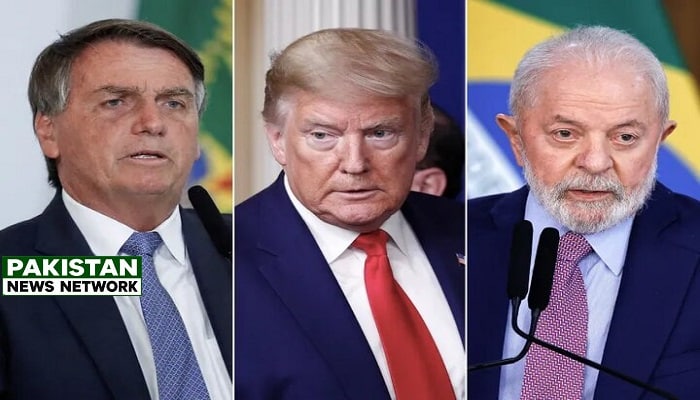
PNN – While US interference in Brazil’s domestic elections is a long-standing issue, this intervention has taken on a new form under the Trump presidency.
According to the report of Pakistan News Network citing Al Jazeera, Brazil’s presidential election—taking place today, Sunday—is fundamentally a domestic democratic process aimed at addressing economic, security, and public service issues; however, the United States has historically—and particularly during Donald Trump’s presidency—demonstrated an increasing tendency to intervene in the Brazilian electoral process.
In this context, Brazil’s current president, Lula da Silva, has warned against any foreign influence and the intellectual and political ties linking the campaign of his rival, Flávio Bolsonaro, to the Donald Trump movement. Consequently, the issue of national sovereignty and relations with Washington has become a central point of contention in the election, as the relationship between Brazil and the United States has historically fluctuated between Washington’s traditional interventions and the pursuit of political independence in a multipolar world.
The U.S. History of Overt Interference in Brazilian Elections
Renato César Ferreira, a political science researcher at the University of Campinas, tells Al Jazeera Net that although Washington has historically been a key political and economic partner for Brazil—and has a long history of “overt interference” in the country’s elections—this relationship has undergone fundamental changes in recent years.
Ferreira believes that Brazilian politics is divided into two distinct perspectives regarding the country’s place in the international system:
First: The far-right faction (represented by Flávio Bolsonaro), which holds that Brazil is fundamentally a Western nation and that strategic ties with the United States must be maintained, even at the cost of a political or economic price.
Second: The perspective of the current Lula administration, which is grounded in the principle that Brazil should diversify its international partnerships and engage with Washington as an equal counterpart, based on national sovereignty. This does not imply a call to sever ties, but rather an effort to build a relationship characterized by greater balance and autonomy in decision-making.
Meanwhile, Renato José da Costa, a professor of international relations at the Federal University of Pampa, states that U.S. intervention in Brazilian elections is nothing new; even the country’s 1964 military coup was carried out with U.S. participation, approval, and coordination.
However, he believes that what has changed is the way this role is promoted and marketed by certain factions—specifically the country’s “far-right groups.” He explains that the United States—or Donald Trump himself—is portrayed as the nation’s savior, a defender of Western values, a proponent of liberalism, and an opponent of communism; this is despite the fact that communism has not been a relevant issue in Brazil for decades, and a system with such characteristics has never been implemented there.
Nevertheless, Da Costa believes that despite concerns voiced by some regarding their country’s dependence on Washington, the primary driver for voters remains personal support for figures like Bolsonaro or Lula—and the personalization of electoral choices—rather than a critical, realistic assessment of foreign policy.
The relationship between Bolsonaro and Trump has transcended the boundaries of bilateral politics, becoming part of a global phenomenon that has redefined the “far right” and linked its prominent figures across continents.
The Far Right or Neo-Fascism in Brazil
Ferreira notes that the “far right” is a global phenomenon. Some political scientists describe this new movement as a form of “neo-fascism,” embodied by leaders such as Trump, Bolsonaro, Javier Milei (President of Argentina), and other political figures worldwide.
Ferreira adds: In this sense, although these movements possess distinct national characteristics, they share common ground regarding theoretical foundations, strategies, agendas, and forums. Consequently, it is impossible to understand the rise of the Bolsonarista movement in Brazil without considering this international dimension.
He adds that former President Jair Bolsonaro defended American interests and values, even at the cost of sacrificing Brazil’s own interests. Consequently, this praise for Trump’s personality and policies took root with Bolsonaro, was promoted among right-wing and far-right circles in Brazil, and was adopted as a slogan for election campaigns.
A deeper struggle over Brazil’s place in a changing world is emerging between those who view Washington as a strategic ally and those who regard it as a symbol of hegemony. As tensions rise between the principle of national sovereignty and the pull of the American model, the country’s elections appear to be about more than just domestic choices; they reflect an international contest over influence and the nation’s future trajectory.