
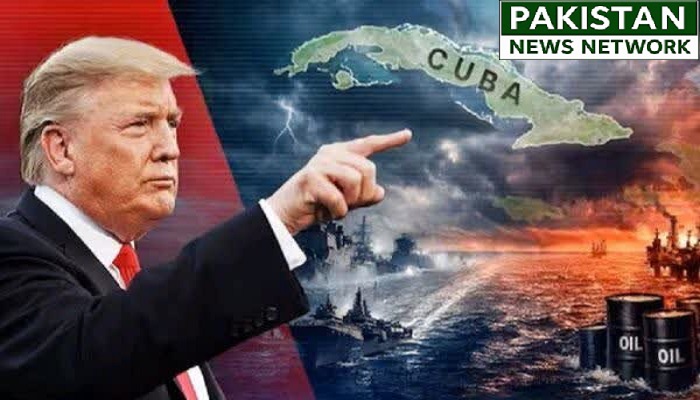
PNN – A fresh threat against Cuba by the U.S. Secretary of State has posed an old question for Washington: why does a policy that has generated over six decades of sanctions, pressure, and tension remain on the U.S. agenda?
According to the report of Pakistan News Network; In the Western Hemisphere, few cases reflect the persistence of U.S. policies of pressure, blockade, and interference in the destiny of an independent nation quite like Cuba—a policy that, despite more than six decades of sanctions and confrontation, has neither achieved the political change Washington sought nor succeeded in narrowing the divide between the two countries.
Now, the fresh threat issued against Havana by U.S. Secretary of State Marco Rubio—and his insistence on the need to alter the status quo in Cuba—signals that Washington has once again reverted to the old logic of coercion: a mindset that prioritizes economic pressure over diplomacy and places external dictates above the Cuban people’s right to choose their own political path.
In the view of observers, the repetition of this approach—rather than signaling a new strategy—reflects Washington’s inability to break free from a policy whose humanitarian, regional, and geopolitical consequences have been repeatedly laid bare.
Historical Interventions and the Repetition of the Failed Regime-Change Strategy
The dispute between Washington and Havana did not begin with the 1959 Revolution; from the very inception of Cuba’s independence, the United States viewed the country as part of its sphere of influence. The “Platt Amendment” further empowered Washington to intervene in Cuba’s internal affairs—an approach that curtailed the nation’s sovereignty and entrenched the notion that Havana’s political orientation had to align with U.S. interests.
After the revolution, the tools changed, but the logic of intervention remained. Pressure on refineries, the cutting of sugar quotas, economic sanctions, the Bay of Pigs operation, and sabotage campaigns were all pursued with the aim of weakening or changing the Cuban government. Yet, these measures backfired: the revolutionary government consolidated its power, the domestic climate became more securitized, and Havana drew closer to the Soviet Union than ever before.
Even six decades of sanctions have failed to establish the political structure Washington desired in Cuba. Conversely, external pressure has enabled the Cuban government to frame domestic problems as consequences of the U.S. threat and to turn resistance against Washington into a component of its own political legitimacy.
Nevertheless, the United States continues to repeat this policy, as the Cuba issue is not governed solely by foreign policy calculations. The influence of hardline factions in Florida, electoral considerations, and the historical legacy of dominance over Latin America have raised the cost for U.S. administrations to back away from sanctions. In this climate, any failure is portrayed not as a sign of policy ineffectiveness, but as the result of insufficient pressure; consequently, the prescribed remedy is, once again, more sanctions and threats.
Economic Sanctions: Pressure on the Government or a Cost Shift to Society?
The inclusion of the state-owned company CUPET (Cuba Petroleum Union) on the U.S. sanctions list goes beyond merely restricting a government entity. The company plays a pivotal role in the import, refining, storage, and distribution of fuel; consequently, any disruption to its operations directly impacts electricity generation, transportation, hospitals, agriculture, and food preservation. Recent widespread blackouts have also demonstrated that in a country plagued by fuel shortages and an aging power grid, pressure on the energy sector rapidly escalates into a social crisis.
The contradiction in Washington’s policy becomes even more apparent given that the U.S. simultaneously claims to support Cuba’s private sector. Early in the year, American companies took steps to supply fuel to Cuban private businesses; however, the transport and storage of that very fuel inevitably relied on infrastructure managed by CUPET.
Sanctioning this company effectively blocked the path intended to rescue the private sector from energy shortages—meaning a policy ostensibly aimed at supporting entrepreneurs ended up depriving those same entrepreneurs of the means to operate.
The scope of this pressure is not limited to U.S. borders. A company’s inclusion on the Treasury Department’s sanctions list exposes banks, insurance firms, shipping companies, and foreign suppliers to the risk of losing access to the U.S. market and financial system.
Consequently, many non-U.S. entities also refrain from doing business with Cuba. In this regard, Washington not only exerts pressure on Havana but also effectively influences the economic decisions of third countries through its own domestic laws—a practice that has repeatedly met with widespread opposition in the UN General Assembly.
This pressure has intensified precisely as Cuba has adopted an unprecedented set of economic reforms—including authorizing private banks, direct foreign trade, and greater participation by non-state investors—yet such reforms cannot be truly effective without access to banking, capital, insurance, and energy. Consequently, rather than fostering an environment conducive to reform, the sanctions drive up the costs associated with it, sending the message that even economic opening is insufficient unless it leads to the political change Washington desires.
Regional and Geopolitical Implications: Pressure on Cuba and the Erosion of U.S. Influence
From a strategic perspective, Cuba is not merely a small Caribbean neighbor to Washington; it has become a symbolic litmus test for the extent of U.S. influence in the Western Hemisphere. Consequently, Havana’s political independence and the persistence of a government at odds with Washington’s wishes are viewed in U.S. calculations as a challenge to the regional order. Recent threats regarding potential intervention also signal to other Latin American governments that political disagreement with Washington could be met with economic pressure, isolation, or even the threat of military action.
However, such a display of power does not necessarily lead to increased U.S. influence. The pressure on Cuba revives regional sensitivities regarding foreign intervention and the “sphere of influence” concept, while motivating more independent governments to diversify their relationships.
Widespread opposition within the UN General Assembly to the blockade of Cuba also demonstrates that Washington faces greater diplomatic isolation than Havana in defending this policy. UN human rights experts have further characterized the fuel blockade as a threat to the fundamental rights of the Cuban people—a criticism that undermines the legitimacy of U.S. claims to support the country’s population.
Some experts believe that the more significant consequence is the opening of greater space for China. Beijing has openly supported Cuba’s sovereignty in the face of what it terms foreign interference, while simultaneously becoming a key source of technology and capital for the country’s energy sector. China’s assistance in developing over a thousand megawatts of solar capacity enables Havana to relatively reduce its reliance on fuel imports. Consequently, a policy designed to isolate Cuba and curb the influence of U.S. rivals effectively transforms Beijing into an even more indispensable partner for the country.
Thus, the central issue is no longer merely the future of the Cuban government, but the cost Washington incurs to maintain the credibility of its regional hegemony. While sustained pressure may yield electoral benefits in U.S. domestic politics and project an image of resolve, at a strategic level, it erodes the trust of Latin American nations, expands China’s influence, and transforms the Cuban crisis from a bilateral dispute into an arena of great-power rivalry.
The United States persists with this strategy because it views backing down as an admission of its limited influence; yet, therein lies the ultimate paradox: the insistence on projecting power in Cuba gradually erodes the very power and influence Washington seeks to preserve.