
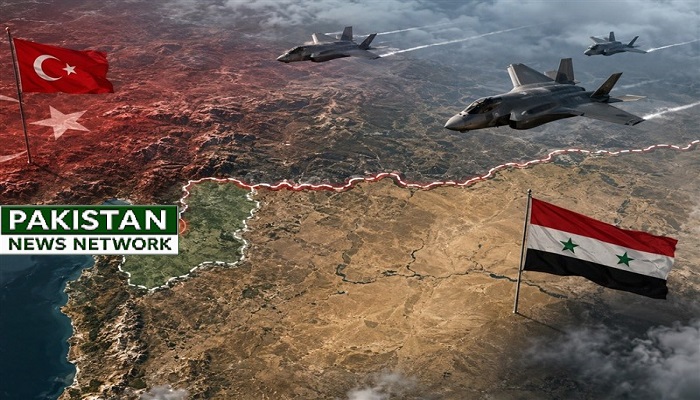
PNN – The Israeli regime’s attack on the Abu al-Duhur airbase in Idlib serves as a serious warning regarding Turkey’s military presence in Syria.
According to the report of Pakistan News Network; the Israeli regime’s aggressive maneuvers in Syria have once again caused trouble. This time, the Israeli regime launched a significant attack on the Abu al-Duhur airbase in Idlib province. Although the base has been inactive for over a decade, the Israeli regime viewed the possibility of its repair and reconstruction as a threat.
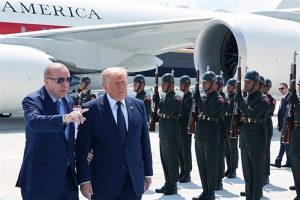
An airstrike by the regime’s fighter jets damaged the runway and parts of the facilities; given the base’s proximity to the Turkish border, this attack has sparked fresh concern among political and security officials in Ankara. Turkish President Recep Tayyip Erdoğan, in a phone call with U.S. President Donald Trump, urged him to prevent Netanyahu from continuing such actions.
Zionist media have reported that the primary reason for this airstrike was the recent visit by two Turkish military and technical delegations to this old base, alongside the possibility of a joint Damascus-Ankara agreement to refurbish the facility.
In doing so, the Israeli regime is sending a clear message: preventing the potential deployment of Turkish forces to this base is a crucial strategic objective. The Abu al-Duhur base is located in the Idlib region, approximately 70 kilometers from the Turkish border. The Turkish Foreign Ministry issued a statement strongly condemning the attack on Abu al-Duhur.
The statement declares that the Israeli attack violated Syria’s territorial integrity and sovereignty, and calls on the international community to adopt a firmer stance regarding Israeli attacks on Syria.
Syrian Foreign Minister Asaad Hassan Shibani also described the attack as an unjustifiable provocation and a violation of Syrian sovereignty.
The Turkish analytical news outlet Yetkin Report has noted that political officials in Ankara have not forgotten the threats made by Israeli Prime Minister Benjamin Netanyahu and National Security Minister Israel Katz, both of whom stated that Turkey would be their next target after Iran. It is also significant that, according to Ankara’s assessments, Netanyahu is expected to further intensify his attacks on Palestinians in order to avert defeat in the October 27 general election—an election taking place just one week before the U.S. midterm elections on November 3, which are of vital importance to Trump.
Turkey’s Yetkin Report further notes that Trump wants to end the war with Iran as quickly as possible, yet reaching an agreement is becoming increasingly impossible due to Israel’s persistent demands. Having entered into a conflict with Iran by following Netanyahu’s lead, Trump is now caught between his own needs ahead of the U.S. elections and the demands of the Zionist lobby ahead of the Israeli elections. The question now arises: Will Israel take reckless action? Consequently, calling on Trump to halt Israeli attacks amounts to little more than a mild statement. Let us not forget that since the Gaza ceasefire agreement of October 10, 2025—which was also guaranteed by Turkey—1,265 Palestinians have been killed in Israeli attacks. Will Netanyahu, in addition to his assaults on the Palestinians, escalate his attacks on Syria and Lebanon in a bid to win the Israeli election? Although Erdogan has sent messages urging that Netanyahu be reined in, the likelihood of Trump taking effective measures to counter Netanyahu’s ambitions is slim, given the power of the Israeli lobby in Washington.
Who Violated Which Agreement?
Both Damascus and Ankara object to the fact that the Zionist regime of Israel, by attacking the Idlib base, has effectively reneged on the security agreement. On the other hand, the office of Israeli Prime Minister Benjamin Netanyahu has claimed that by permitting the deployment of Turkish forces at this base, Damascus was on the verge of violating the “security status quo” agreed upon with Israel—and that Tel Aviv had previously warned Syria about this matter.
To put it clearly, by launching a preemptive strike, the Zionists have asserted that they had previously designated Turkey’s military presence in Syria as a “red line” and had communicated this stance to members of Ahmad al-Shara’s negotiating team. Thus, it is evident that this attack is not merely an assault on Syria, but also a direct message to Turkey.
A crucial point regarding the Israeli regime’s claims is that preliminary talks—encouraged by Ankara—had previously taken place to avert escalation and attempt to normalize relations between Syria and the regime. Extensive discussions were held during several meetings in Baku (Azerbaijan), Paris, and London; while these talks did lead to a reduction in the Israeli regime’s activities concerning the Syrian Druze issue, they failed to yield any concrete defense or security guarantees, and it has now been proven once again that the regime poses a serious threat to Syria.

Turkey Was Unaware
One of the most significant aspects of the recent tension involving Syria, the Israeli regime, and Turkey concerns the points raised in remarks by Tom Barrack. Tom Barrack—the U.S. Ambassador to Turkey and Trump’s special representative for several regional dossiers, including Iraq, Syria, and Lebanon—addressed these issues in his statements:
- No warning was issued to Turkey or Syria prior to the flight and attack by Israeli fighter jets on Idlib.
- Turkey’s air defense center quickly detected the movement of the Israeli fighter jets; had Turkish officials not maintained their composure and exercised restraint, they could have responded immediately.
- It is necessary to establish a coordination mechanism among Israel, Turkey, and Syria.

The sensitive Turkish-Syrian border now faces this reality: Ahmad al-Sharaa’s efforts to normalize relations with the Israeli regime and mitigate its bullying threats have failed, and with this attack, Netanyahu sought to signal to Ankara that Turkey’s military presence in Syria constitutes a red line for Israel.
Nevertheless, Trump’s special envoy, Tom Barrack, ultimately proposes establishing a mechanism for message exchange to prevent Turkey and Syria from escalating tensions or resorting to retaliatory actions—all this occurring against the backdrop of two distinct scenarios regarding the rivalry between Turkey and the Israeli regime in Syria.
On one hand, we are witnessing moves and actions by Turkey—a country not content with mere political and intelligence influence in Syria—aimed at bringing everything under its control: from the reconstruction of the military, intelligence, and law enforcement agencies to the defense industry, consumer markets, and the energy, construction, and contracting sectors.
On the other hand, the Zionist regime, in addition to maintaining its occupation of several sensitive areas in Syria, seeks to ensure that the country possesses a weak defense structure and that no major or medium-sized military power maintains a presence there.
This is the very point previously highlighted by Turkish journalist Asli Aydin-Tasbas in a report for the European Council on Foreign Relations (ECFR); writing in June 2025, she noted that following the fall of Assad, Turkey and Israel had entered into a growing rivalry over Syria’s future.
According to Tasbas: Ankara seeks the emergence of a unified, stable Syria under Turkish influence, whereas Israel is concerned about a rise in Syrian power and Turkish influence within the country.
All this is taking place against the backdrop of the fact that, for Turkey, Syria is not merely a neighboring country. From a strategic perspective, Syria has become a southern strategic depth for Ankara, as well as a key factor regarding the Kurdish issue, refugee repatriation, the reconstruction market, trade routes, border security, regional influence, and a means to enhance Turkey’s geopolitical standing.
Consequently, Turkey cannot allow Israel to destroy Syrian military infrastructure at will.
It is worth noting that Syrian President Ahmad al-Shara’—acting on Ankara’s advice—had previously stated to Al Jazeera that Syria was seeking a security agreement with Israel.