
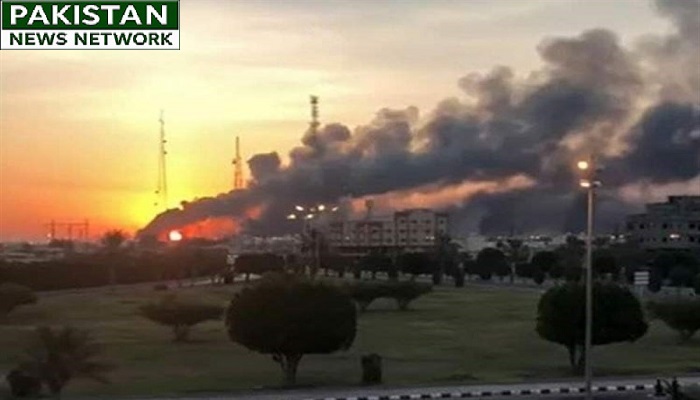
PNN – Yemeni military sources have warned of new surprises in store for the Saudis regarding the destruction of Saudi Arabia’s vital oil lifeline.
According to the report of Pakistan News Network; Yemeni armed forces continue to expand their range of targets in southern Saudi Arabia—adhering to the equation of “escalation for escalation and blockade for blockade”—while maintaining their naval blockade against the country.
At the same time, Yemeni forces are targeting Saudi Arabia’s vital oil arteries and ports, threatening to escalate the conflict to a broader scale.
In this context, as forces from Sana’a continue to bombard oil refineries in southern Saudi Arabia—including yesterday’s strike on the Aramco refinery in Jizan—informed Yemeni sources have announced that Yemeni armed forces have added dozens of vital targets in Jizan and Najran to their list of military objectives.
Expansion of Yemen’s Target List in Southern Saudi Arabia
Speaking to the Lebanese newspaper Al-Akhbar, a military source in Sana’a stated that Tuesday’s attack was carried out using several drones in response to Saudi Arabia’s violation of the airspace over Saada and Hajjah provinces. This operation is part of a series of strikes launched two weeks ago, targeting Saudi oil facilities—specifically those belonging to Aramco—across an area extending from Jizan to Najran.
Informed Yemeni sources also told the Al-Akhbar newspaper that Yemeni operations in southern Saudi Arabia are expected to intensify in the coming period in response to the escalation of Saudi artillery attacks on border villages in Saada province.
The sources emphasized that Sana’a’s forces have placed Aramco—including all its facilities, oil storage tanks, crude oil pipelines, and export terminals—on their list of targets.
Saudi Arabia’s continued insolence will come at the cost of destroying its vital oil artery.
These sources also warned that Saudi Arabia’s continued insolence and defiance, along with its refusal to meet Yemen’s legitimate demands, would result in the destruction of the Kingdom’s vital oil artery.
The aforementioned Yemeni sources stated that Sana’a’s forces are maintaining their blockade of Saudi ports in the Red Sea; they will continue to prevent Saudi ships from passing through the Red Sea and the Bab al-Mandab Strait until Riyadh lifts the naval and aerial blockade on Yemen and fulfills its obligations.
Meanwhile, Yemeni maritime sources in Al-Hudaydah—located in the country’s west—reported that daily traffic through the Bab al-Mandab Strait has risen to approximately 30 vessels. They emphasized that Sana’a’s naval and coastal defense forces stationed in Al-Hudaydah have not permitted any Saudi oil or non-oil vessels to pass through the strait in recent weeks, and that the monitoring and tracking of Saudi ships and oil tankers in the Red Sea remain ongoing.
Shipping Companies Fear the “Yemen Equation”: We Have No Ties to Saudi Arabia!
Concurrently, a maritime source in Sana’a told Al-Akhbar that there has been a recent increase in the number of vessels displaying labels indicating “non-Saudi cargo.”
The source added that international insurance companies have made it mandatory for many vessels to display a “Non-Saudi Cargo” label in order to mitigate security risks in the southern Red Sea and the Bab al-Mandab Strait.
The source stated that this new procedure—which requires the submission of comprehensive data regarding cargo type, port of origin, final destination, and crew nationality, as well as verification of no affiliation with Saudi Arabia—signals a major predicament for Saudi shipping operations.
The Yemeni source further noted that none of the options Saudi Arabia has resorted to in order to alleviate the pressure of the naval blockade on Yemen—whether rerouting via the Strait of Hormuz or heading north toward the Mediterranean—would remain safe should the armed forces decide to advance to the second phase of the “blockade-for-blockade” equation.
He stated that the Yemeni blockade against Saudi Arabia has halted the transit of 85 percent of the Kingdom’s oil exports to Asia—shipments that typically pass through the southern Red Sea and the Bab al-Mandab Strait, the shortest route between Asia and Europe.
New Surprises Await Saudi Arabia
However, the forces in Sana’a have not limited themselves to merely expanding the scope of the naval blockade against Saudi Arabia from the southern Red Sea to the north. In this regard, informed military sources told Al-Akhbar newspaper that the Yemeni navy has extended its tracking and monitoring of Saudi vessels from the Red Sea to the Arabian Sea, and that new surprises are in store.
Military sources in Sana’a emphasized that Yemeni armed forces carried out ten operations against Saudi oil tankers attempting to bypass the blockade imposed by Yemen; these began with the tankers Ancilia and Lili on July 22, followed by the NCC Ghazal on July 28 and the Wafa in the northern Red Sea on January 5, and concluded with the Daisy and Tihama in the Gulf of Aden.
Sana’a’s forces also succeeded in forcing dozens of Saudi ships to turn back without resorting to direct attacks.
Aramco’s Customers Flee
While Saudi Arabia deliberately conceals the direct and indirect economic losses resulting from reduced shipping traffic at its ports, a series of recent Reuters reports has revealed significant disarray within Aramco regarding its Asian customers.
These reports indicate that in August, in addition to announcing a $2-per-barrel discount on Arab Light crude for Asian buyers, the company resorted to absorbing increased shipping and insurance costs—amounting to approximately $10 million per oil shipment.
However, following growing doubts regarding the company’s ability to ensure vessel security, transport oil, and guarantee timely delivery, Aramco’s customers in Asia and Europe have turned to other sources to meet their oil needs.
At this juncture, observers believe that Saudi Arabia’s critical oil infrastructure and facilities—considered a “red line” for the Kingdom—will no longer be immune to Yemeni attacks. Should Riyadh persist with its blockade and aggression against Yemen, it will effectively help solidify Sana’a’s new deterrence equation, which is predicated on targeting sensitive Saudi sites.