
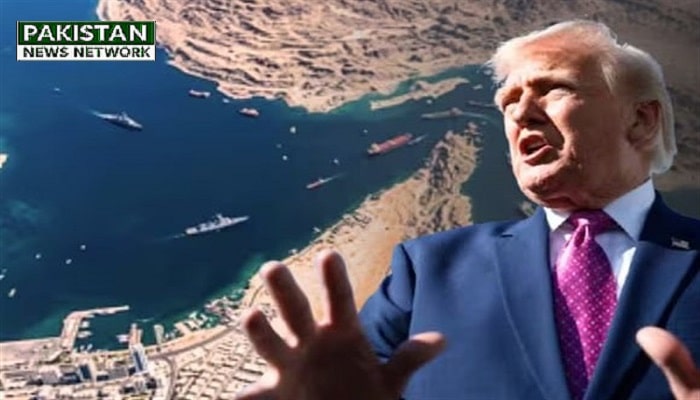
PNN – Instability at global energy chokepoints—such as the Strait of Hormuz, the Bab al-Mandeb Strait, and the Strait of Malacca—has become a new nightmare for the Trump administration.
According to the report of Pakistan News Network; the United States has largely clarified its strategic stance in recent years through military documents and official positions. China is Washington’s primary long-term rival, and if the U.S. intends to maintain its supremacy in the coming decades, a significant portion of its military capabilities must be concentrated in the Indo-Pacific region. This issue extends far beyond merely deploying a few additional naval vessels to the Pacific.
For such a competition, the United States requires submarines, long-range missiles, air defenses, fighter jets, satellite intelligence, and—most importantly—vast stockpiles of ammunition. On paper, this plan might seem straightforward, but the reality is that the U.S. does not exist in a vacuum; it cannot simply shift its full attention away from the Middle East and toward China whenever it chooses.
The global economy remains dependent on a limited number of maritime routes. The Strait of Hormuz, the Bab al-Mandeb Strait, and the Strait of Malacca rank among the most critical arteries for global energy flows. Should the passage of vessels through any of these areas face disruption, the situation can rapidly escalate beyond a mere regional crisis. Oil prices spike, shipping insurance costs rise, shipping companies reroute their vessels, and freight costs increase. Ultimately, the repercussions of that same crisis translate into inflation and higher gasoline prices in Western nations. For this reason, the significance of the Strait of Hormuz extends far beyond the mere number of oil tankers passing through it daily.
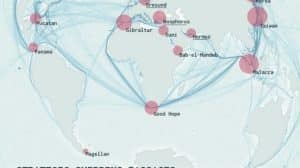
According to data from the U.S. Energy Information Administration, approximately 21.6 million barrels of oil and petroleum products per day passed through the Strait of Hormuz in the final quarter of 2025. Following an escalation in conflict, this figure dropped to around 4.9 million barrels in the second quarter of 2026. While this is a massive decline, the oil that previously transited Hormuz did not simply vanish; producers and buyers had to seek alternative routes. During the same period, the volume of oil passing through the Bab al-Mandeb Strait rose from approximately 5.4 million barrels to 8.1 million barrels.
This very shift is a crucial part of the story. When one route becomes unsafe, some of the pressure shifts to another, thereby increasing the latter’s importance. For instance, Saudi Arabia has long possessed an East-West pipeline, allowing it to transport a portion of its oil to the Red Sea port of Yanbu rather than routing it through the Strait of Hormuz. While this offers an advantage to Saudi Arabia, it does not fully resolve the issue; oil reaching the Red Sea must still traverse a path where the security of the Bab al-Mandeb Strait is critical for reaching many global markets.
The significance of this issue intensifies when oil prices rise. In recent weeks, driven by growing regional instability and disruptions to energy transit routes, the price of oil has once again surpassed the $100 mark. Oil transportation costs have also climbed, with tanker charter rates surging on certain routes. While one might argue that these matters concern only the energy market, for the United States, the issue does not end there.
Rising oil prices can quickly translate into higher gasoline prices. Increases in shipping rates drive up import costs, and if standard trade routes are blocked or become unsafe, goods take longer to reach their destinations and arrive at a higher price. In the U.S. economy, all of this is a political issue; American administrations cannot view sharp spikes in energy prices merely as events occurring in the Middle East. This, in turn, leads to an increased reliance on military force.
In this context, Donald Trump even raised the possibility in March of using the U.S. Navy to escort oil tankers in the Persian Gulf. While deploying a few warships might not appear to be a major challenge for the United States on the surface, the situation becomes serious when Washington is compelled to maintain a military presence in multiple regions simultaneously. A ship assigned to a mission in the Persian Gulf cannot be in the Western Pacific at the same time; a defense system sent to the Middle East cannot be utilized elsewhere. Furthermore, a missile expended in an operation must be replaced, and such production is often not a rapid process.
Estimates published within the United States indicate that replacing certain advanced munitions will take several years. Some of these munitions are weapons that would be critical for the U.S. in the event of a potential conflict with China. Thus, the issue is not merely one of troop numbers or the size of the naval fleet; industrial capacity is also a factor. This point may have received less attention in the past, as the prevailing view was that U.S. military and economic power was sufficient to manage multiple crises simultaneously. To an extent, this holds true; the United States remains a formidable military power, leveraging a global network of bases and allies. However, “immense power” is not synonymous with “unlimited power.”
If the United States is compelled to maintain a portion of its capabilities in the Middle East, allocate assets to secure the Red Sea, simultaneously support Israel, and maintain a significant presence in East Asia to counter China, its ability to focus fully on a single front will naturally diminish. Indeed, this may well be a factor that regional actors are counting on.
To exert pressure on the United States, it is not strictly necessary to sink an American warship or defeat the U.S. military in a major battle. Simply imposing and escalating the costs associated with the U.S. military’s presence can influence the calculations of commanders within the American terrorist forces. If the destabilization of a trade route compels the U.S. to deploy additional troops to the region, a portion of the objective is achieved without engaging in direct warfare with the United States. Regarding the Strait of Hormuz or the Bab al-Mandeb, a complete closure of the route is not even necessary. If the risks associated with traversing these passages rise, vessel insurers will demand higher premiums. Under such circumstances, ships are forced to take longer routes, driving up fuel and time costs. This is why we previously saw some ships in the Red Sea opt for the Cape of Good Hope route instead of the Suez Canal—a detour that adds approximately two weeks to the journey for some oil tankers.
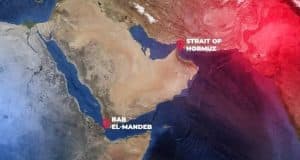
If only a single ship were to choose such a route, it might not be a major issue; however, when a large number of vessels do so, the matter transcends a mere commercial decision, and the trend impacts the global supply chain. Alongside the Strait of Hormuz and the Bab el-Mandeb, the Strait of Malacca holds its own distinct significance. In the second quarter of 2026, approximately 16.6 million barrels of oil and petroleum products passed through this route daily. What sets the Strait of Malacca apart is its location in the very region where the United States intends to concentrate its primary military focus.
Conclusion
Therefore, the competition over chokepoints should not be viewed solely through the lens of who has the capacity to close a strait. The more critical question is who can compel the other to disperse more forces across various locations. From this perspective, the Strait of Hormuz and the Bab el-Mandeb are not merely distant waterways for the United States; any crisis in these regions could confront Washington with a choice: either accept the economic costs of instability or redeploy a portion of its military assets to the area.
This stands in direct contradiction to the U.S. objective of focusing on China. Of course, it is unlikely that a crisis at one or two chokepoints alone would dismantle U.S. power; such a claim is more rhetoric than analysis. The United States still possesses immense military and economic strength. The point, however, is that each new crisis diminishes the freedom of action of the U.S. “terrorist army” and drives up the cost of maintaining America’s global role.
If these crises persist simultaneously or in rapid succession, the United States might be unable to focus the bulk of its military might on China as originally planned. Indeed, it appears that whenever Washington seeks to pivot its attention toward East Asia, a crisis in the Strait of Hormuz, the Red Sea, or elsewhere threatens to divert a portion of its focus and resources back to a different region. Perhaps therein lies the true power of chokepoints: there is no need to directly defeat a superior power; it suffices to prevent it from concentrating its full strength at a time and place of its own choosing.