
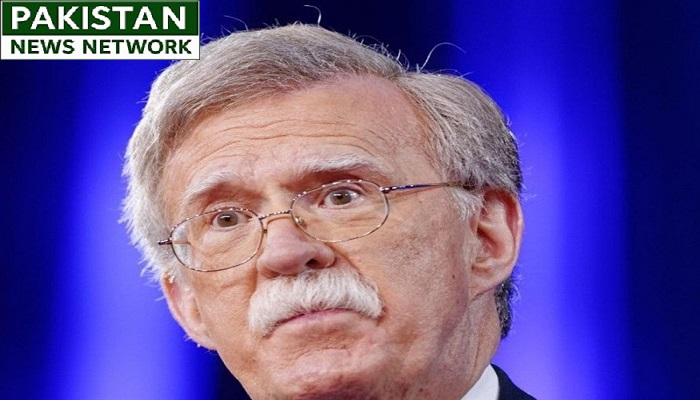
PNN – Trump’s former national security adviser has made confessions that contradict his beliefs about the ease of overthrowing Iran.
According to the report of Pakistan News Network, in the history of American foreign policy, there is hardly a figure who has defended the necessity of bombing Iran more than John Bolton, and who believes that overthrowing the Islamic Republic of Iran is an easy task. Bolton was not just a critic of Iran, but a full-fledged ideologue.
His record on this is unparalleled. In 2015, he wrote in a New York Times op-ed: “To stop Iran’s bomb, bomb Iran.” In January 2018, he wrote in the Wall Street Journal that the stated policy of America should be to end the 1979 Islamic Revolution before its 40th anniversary.
As Trump’s national security adviser, he urged the Pentagon to develop military options against Iran. His White House colleagues said that even Trump sometimes found Bolton “too harsh.”
But perhaps the clearest illustration of Bolton’s confidence in the Islamic Republic’s imminent downfall can be found in his speeches to the MEK—a group that the United States itself designated as a terrorist organization until 2012.
Bolton has spoken to the organization eight times, each time describing the overthrow of the Islamic Republic as a promise rather than a wish. On July 1, 2017, at a gathering of the MKO in Paris, he predicted that the Islamic Republic of Iran would not celebrate its 40th anniversary. “That’s why we’ll celebrate in Tehran before 2019,” he said.
Despite Iran celebrating its 40th birthday in February 2019, he made another wrong prediction without admitting his mistake, saying that he didn’t think the Islamic Republic of Iran would have many more years to celebrate.
Bolton, however, speaks differently these days, in a way that, according to some analysts, seems to have reconciled him with at least some of the realities of the war. Although some of Bolton’s current statements can be seen as a kind of criticism of his former boss, they also seem to be a kind of admission of his own way of thinking and political approach, which he believed could overthrow the Iranian government by bombing.
This report includes some of John Bolton’s confessions in this regard:
Interview with Newsmax, June 22
Bolton said that Iran has emerged from the war stronger politically. He said that the US and Israel have been able to hit Iran militarily and infrastructurally with their attacks, but they have not been able to eliminate Iran’s ability to use the Strait of Hormuz as leverage.
Interview with NDTV, June 19
John Bolton said that the economic consequences of the post-war crises caught Trump by surprise and allowed Iran to use the Strait of Hormuz as leverage.
Euronews interview, June 16
Bolton said that the Iranians played Trump however they wanted and that’s why they got the deal they wanted.” He also said that Trump is hungry for a deal and the Iranians have steered him in whatever direction they want.
The change in leadership is just because we’ve killed four or five hundred of the highest-ranking members of the current regime and now it’s their deputies and their successors. So yes, the people have changed, but the regime is still the same fanatical regime.
May 12, Wall Street Journal op-ed
John Bolton, the White House national security adviser during Donald Trump’s first term, criticized Trump in a critical op-ed in the Wall Street Journal for prematurely halting attacks on Iran and compared him to “Anthony Eden,” the failed British Prime Minister in the Suez Crisis.
The author emphasized that Trump is caught in a trap; on the one hand, he is hungry for an agreement that he can call a “victory” and on the other hand, he is extremely afraid of signing a similar agreement to the JCPOA (like Obama) and being criticized. This hesitation has caused Iran to give a “completely unacceptable” response to the US proposed framework.
Bolton went back to the Suez Canal Crisis (1956) to criticize Trump and wrote that the attack by “Anthony Eden” (then British Prime Minister) to retake the Suez Canal caused the collapse of the British Empire and Eden’s resignation.
Bolton wrote that the war against Iran has reached a point where Tehran can, like a “light switch,” increase or decrease the pressure on the global economy whenever it wants.
April 1, News Nation
Bolton explained what Iran gained by closing the Strait of Hormuz as a result of the US-Israeli war: It proves to them that they can turn the Strait of Hormuz on and off like a light switch.
March 31, News Nation
In the interview, he rejected Donald Trump’s claims that regime change had occurred in Iran, saying that the situation that resulted from the war was worse than if the US had stood by and done nothing against Iran.
March 11, NPR
In an interview with NPR on March 11, 2026, Bolton expressed concern about the lack of attention Americans paid to Iran’s dominance of the Strait of Hormuz, saying: I’m concerned that Iran’s capability in the Strait of Hormuz is not being taken seriously enough. Trump said a few days ago that the Iranian navy has been completely destroyed. Now we find out that yesterday we destroyed sixteen minesweepers.