
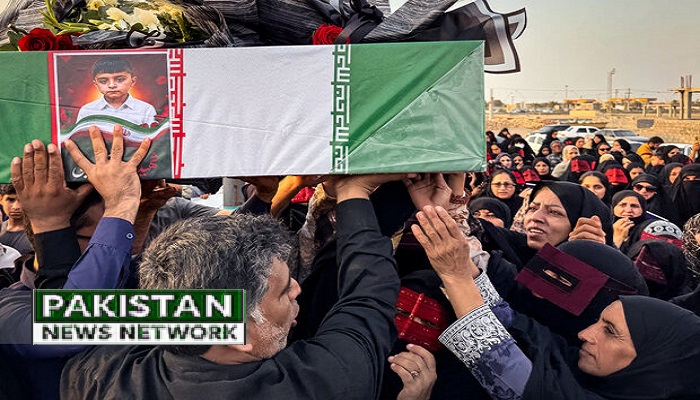
PNN – The US attack on a wedding ceremony in Kohestak has been accompanied by narratives spun by hostile factions; however, reports from Western media and expert analyses provide evidence that US munitions struck an area where civilians were present.
The brutal attack on a wedding ceremony in the port of Kohestak has emerged as one of the most controversial incidents in the recent days of the US conflict with Iran. Yet, instead of offering a clear explanation regarding the target of the strike, US officials continue to state that the incident is “under review”—a stance that has raised further questions about US responsibility for the civilian casualties.
However, the ambiguity surrounding the attack is not limited to Washington’s position; at the same time, certain hostile and counter-revolutionary factions abroad are attempting to shift the focus of the issue by highlighting claims regarding the incident site’s proximity to a telecommunications tower or military installations—or even by citing similar narratives concerning the Minab school—thereby casting the attack’s responsibility in a different light by pointing to potential targets in the vicinity.
This narrative-building is taking place against a backdrop of Western media reports and independent expert analyses that have presented evidence regarding the use of U.S. munitions and their impact on a site where civilians were present; such evidence indicates that the account of the incident cannot rely solely on the claims of the parties involved, thereby underscoring the need for accountability regarding the perpetrator and the circumstances of the attack.
A Wedding under U.S. Fire
A U.S. attack on the port of Kohestak a few nights ago turned a family wedding ceremony into a scene of bloodshed; at least four civilians, including a child, were killed, and at least 68 others were wounded. Images released from the site show the destruction of the venue and wedding belongings scattered amidst the rubble.
In contrast, rather than providing a clear explanation regarding the specific target struck in the area, US officials have spoken of an investigation into the incident. US Vice President-elect JD Vance—while asserting that the United States does not intentionally target civilians—stated that the matter is under review; a stance that leaves unanswered the question of why a location where families were present was hit.
Meanwhile, the Iranian Red Crescent has called for an independent investigation into the details of the incident, and reports from the scene indicate that a telecommunications tower located next to the building where the gathering was held was also struck. This proximity has become a central element in the narratives surrounding the cause of the incident.
However, the mere presence of a military or communications target near a civilian site does not, in itself, explain why the wedding venue was struck. The fundamental question remains: what was the actual objective of the operation, and how did an attack ostensibly aimed at military infrastructure end up hitting a location where civilians were present?
Western sources confirm the atrocity: from field reports to independent analyses
Contrary to the narrative some hostile factions attempt to propagate, the account of the US attack on the Kohestak wedding ceremony does not rely solely on the version of events provided by Iranian officials. The New York Times, Reuters, and the Associated Press have each published evidence—based on their examination of images, videos, and munitions debris—that reinforces the conclusion that US forces were responsible for the attack.
In its investigation, The New York Times identified a U.S. strike as the cause of the hit on the building where the ceremony was taking place. To support this conclusion—drawn from an examination of images and weapon debris—the American newspaper cited an analysis by Trevor Ball, an independent weapons expert and former U.S. Army explosive ordnance disposal technician. Ball identified some of the recovered debris as parts of U.S.-made guided munitions and linked the wreckage to weaponry not in the possession of Iranian forces.
Reuters went a step further and consulted four weapons experts on the matter. Based on this assessment, three of the experts identified American munitions as the likely cause, deeming the pattern of destruction more consistent with a direct hit from an airborne munition than with the hypothesis of a ricocheting Iranian air-defense missile. According to the British news agency, two U.S. officials confirmed that the U.S. military had conducted an operation in the Koohestak area that same night, targeting a communications tower near the wedding site.
In its on-the-ground report from Kohestak, the Associated Press also described the incident as a U.S. airstrike, noting that—based on debris recovered at the site—experts suspect the use of U.S.-made precision-guided munitions, such as JSOW and GBU-39 missiles. The report also documented a separate strike on a telecommunications tower near the building where the gathering took place; this indicates that the presence of the tower does not necessarily explain the strike on the residential building.
Other media outlets have also followed this same framework. In its report, Time described an “attack on a wedding in southern Iran” and emphasized that Washington was investigating the possibility of U.S. forces’ involvement; The Guardian, too, referred to a “U.S. attack on a wedding in Kohestak” in its on-the-ground report.
In addition to the aforementioned points, U.S. military personnel recently told the American network “MSNow” that the Pentagon had ordered them to target Iranian civilian facilities as well during the attacks. This revelation comes against the backdrop of earlier acts of aggression by the U.S.-Zionist axis—prior to the attack on the wedding ceremony—in which numerous civilian targets, including a girls’ school in Minab, a hospital, a bank, and residential areas in Iran, had already been struck.
Collectively, these reports clarify a crucial point: attributing the attack to the United States is no longer merely an allegation by Iranian media that can be dismissed simply by labeling it the “Tehran narrative.”
From technical analyses of the munitions by The New York Times and Reuters to on-the-ground reporting by the Associated Press and coverage by outlets such as Time and The Guardian, a body of independent evidence has emerged reinforcing the account that U.S. munitions directly struck a location where civilians were present; yet, Washington continues to avoid accepting ultimate responsibility, claiming instead that the incident is under review.
Shaping the Narrative after the Atrocity
A battle over the narrative invariably follows every act of aggression or atrocity, and the Kohestak incident is no exception. While media reports and technical evidence have intensified scrutiny regarding the U.S. role in the attack, efforts to shift the focus of the issue persist—ranging from Washington’s insistence that the incident is still being investigated to attempts to highlight potential targets in the vicinity of the impact site.
On the other hand, certain hostile factions advance narratives to explain and justify the incident before the results of any investigation are known. Although these two trends originate from different starting points, they converge on a single outcome: reducing the pressure on the perpetrator of the attack to be held accountable.
A clear example of this approach is the narrative surrounding the telecommunications tower. While the existence of the tower and the fact that it was targeted are matters worthy of examination, its proximity to the wedding venue cannot, in itself, justify the strike on the building where civilians were present—especially given that expert analysis deems a direct hit on the building by the munitions to be the more likely scenario.
The same pattern was observed regarding the Minab school, where the school’s proximity to a military facility was used as a pretext to shift the focus from the attacker’s responsibility to the victims’ geographical location—even though, under the logic of international humanitarian law, the proximity of a civilian site to a military target does not automatically transform that site into a military target itself.
The significance of this narrative construction lies in how it transforms the crime from an issue of accountability into one of justification. Within this framework, it suffices to claim that the attack targeted something else, resulted from an intelligence error, or that the victim was located near a military facility; the core issue—namely, how a military operation led to civilian deaths—is then relegated to the margins. Such a narrative can serve its political purpose even without substantiating any of these claims, effectively steering public opinion away from demanding a clear answer.
Thus, the issue is not merely what the United States will ultimately say about this attack; the more critical matter is which narrative takes hold in public opinion before the truth comes to light. If justificatory narratives succeed in downplaying responsibility for an attack by simply pointing to a plausible target, a dangerous mechanism effectively emerges—one where the aggressor need not prove their innocence but merely cast suspicion on the victim. This is a mechanism that neither aids in uncovering the truth nor ensures that accountability for the attack remains where it belongs: with the perpetrator.
Human Rights Buried Under the Claims of Proponents
The Koohestak tragedy is not merely a wartime incident involving a few civilian casualties; it serves as a litmus test for the West’s human rights claims. If the protection of civilians is a universal principle, that principle must not shift based on the nationality of the victim or the identity of the attacker.
The experience of U.S. wars in Iraq and Afghanistan has shown that civilian deaths have frequently been characterized in official Washington rhetoric as “collateral damage,” “operational error,” or “unintended consequence”—terms that, while perhaps describing the reality of an operation, must not substitute for accountability regarding the circumstances of the attack.
From this perspective, the call for an independent investigation into the Kuhestak incident gains significance. If Washington claims it does not deliberately target civilians and is currently investigating the incident, the findings must provide clear answers regarding the operation’s objective, the type of munitions used, and the reason the strike hit a location where civilians were present.
In a prudent move, the Iranian Red Crescent has also sought to elevate the matter from a political dispute between Tehran and Washington to a legal issue by requesting that the International Criminal Court investigate the incident.
Ultimately, Koohestak could become a litmus test for the credibility of Western human rights claims—a test not of who speaks most about human rights, but of whether the same standard demanded for other victims will also be applied in the case of Iranian victims.