
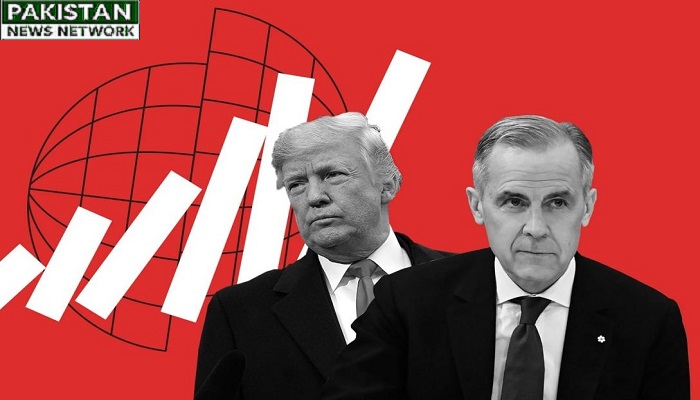
PNN – Explaining the reasons for the breakdown of negotiations with the U.S., the Canadian Prime Minister stated: They demanded too much and offered too little.
According to the report of Pakistan News Network; economic negotiations between the U.S. and Canada had recently been underway, and U.S. President Donald Trump—true to form—had declared that an agreement was “very close.” However, he suddenly imposed a 50% tariff on Canadian goods. In response, the Canadian Prime Minister announced that reciprocal tariffs would be implemented. It appears that the conflict with Iran has exposed the true extent of U.S. power to the world, marking the beginning of a shift toward a new global reality where other nations—at various levels—may begin to push back, at the very least, against America’s unreasonable and irrational overreach.
Following the resignation of former Canadian Prime Minister Justin Trudeau, many expected the new Prime Minister, Mark Carney, to yield to the United States. True to form, Trump posted a map of Canada overlaid with the American flag, belittled Carney by referring to him as a “governor,” and repeatedly floated the bizarre idea of annexing Canada as the 51st U.S. state. Yet, in response to the breakdown of negotiations, Carney stated: They demanded too much and offered too little. This remark encapsulates the entirety of Trump’s excessive demands and his inability to impose his will.
Furthermore, Ontario Premier Doug Ford bluntly declared that Trump is not trustworthy at all, describing him as the type of person who “steals your lunch money on day one, takes your hat on day two, and walks off with your sneakers on day three”—an allusion to his tendency to gradually strip away everything.
Canada’s refusal to yield to Trump’s excessive demands—despite being a long-standing U.S. ally—demonstrates that the era of unquestioning subservience to Washington has come to an end. Faced with economic pressure and public humiliation, Canada did not merely stand firm against Trump’s rapacity; it responded in kind. This is precisely the path Iran embarked upon years ago—a course that even Western allies are now following.
Fareed Zakaria, a CNN host and international relations expert, wrote in a Washington Post article that even Washington’s allies are concluding that “compromise with the U.S. does not guarantee safety,” viewing this as a sign of a superpower’s decline. In other words, not even Trump’s closest Western allies are immune to his excessive demands or possess any margin of safety. When an ally like Canada faces the threat of 50 percent tariffs and a proposal for territorial annexation, no country can consider itself completely secure.
From Canada to Spain: A New Wave of Western Resistance to Trump’s Overreach
In addition to the government in Ottawa, numerous countries have stood up to pressure from Trump in recent months; China, India, and Brazil have all faced threats of heavy tariffs from him, yet the situation with Spain played out differently. Amid the US-Israeli campaign against Iran, the Spanish government—led by Prime Minister Pedro Sánchez—announced that it would not permit the United States to use the joint airbases of Morón and Rota in southern Spain for operations against Iran. This stance was taken despite US insistence on utilizing these bases for its attacks.
In response to this opposition, U.S. President Donald Trump threatened to cut off all trade with Spain. Despite this serious threat, the Spanish government did not back down; in a televised address centered on the slogan “No to War,” Sánchez emphasized: We will not partner in something that is detrimental to the world and contrary to our values simply out of fear of retaliation.
Furthermore, Spain’s Deputy Prime Minister explicitly declared that the country would not be “anyone’s vassal” and would stand firm against threats. The common approach among these nations is to build a network of diverse relationships rather than relying on a single power. In this context, The New York Times noted in an analysis that India and Brazil showed neither fear nor panic.
Iran: A Model from Which the World Learned
The key point is that many of these countries—particularly those that withstood Trump’s pressures—had already drawn important lessons from the Iranian model. While enduring the most severe economic, military, and diplomatic pressures of the last half-century—ranging from crippling sanctions to direct military threats and extensive psychological warfare—Iran not only refused to yield but also managed to shift the strategic balance in its favor by leveraging asymmetric strategies and its geography.
Canada, Spain, India, and Brazil are all following the same pattern: refusing to yield to pressure, responding in kind, and forming shifting coalitions. As Mark Carney put it, the US “demanded too much and offered too little”—this is precisely what Iran has experienced in its dealings with the West for years.
Conclusion
The world is transitioning away from an era in which a single nation could unilaterally dictate and enforce the rules. Canada, Spain, India, and Brazil have all demonstrated that standing up to overreach is no longer unique to Iran but has become a global pattern; this is perhaps Iran’s greatest victory—not on the battlefield, but in showing the world a path to move beyond the old, worn-out American order.