
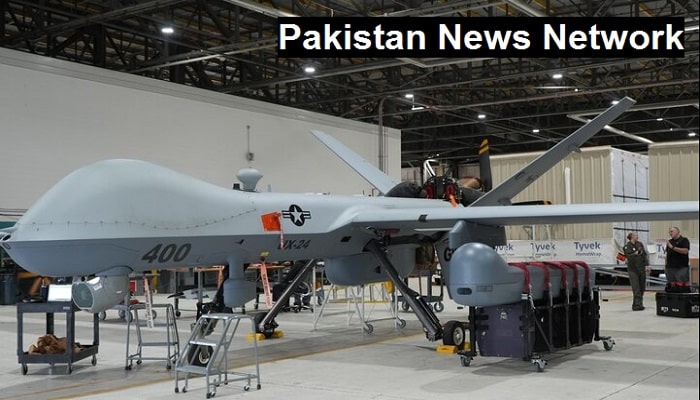
PNN – The destruction of Reaper drones, the increase in financial costs, and Washington’s inability to achieve its declared goals all show that the military pressure strategy against Iran has faced serious challenges.
According to the report of Pakistan News Network; a recent Bloomberg report on the downing of a large number of advanced American drones during the conflict with Iran has revealed new dimensions of the hidden and overt costs of this war. According to the report, Iran has managed to destroy more than 24 MQ-9 Reaper drones, drones that are the mainstay of American reconnaissance and offensive operations in the region. Some estimates even put the number of drones downed at 30, a figure equivalent to nearly $1 billion in direct damage to the US military. Given that each of these drones costs about $30 million to produce and the process of replacing them is complex and time-consuming, this is not just a simple financial loss, but a strategic blow to Washington’s operational capability and military credibility.
The US invasion of Iran was supposed to be a demonstration of Washington’s absolute military superiority; a quick war that could weaken Iran’s deterrent structure within days and shift the regional balance of power in favor of the US and its allies. But what actually happened was fundamentally different from the White House’s initial calculations. Not only did Iran not back down, but the prolonged conflict and increased field costs created conditions that many Western media outlets are now calling a “strategic failure” for the US.
For years, the MQ-9 Reaper drones have been seen as a symbol of American military technological superiority. With advanced reconnaissance, interception, and precision strike capabilities, these drones have played a key role in the wars in Afghanistan, Iraq, Syria, and many other US overseas operations. Washington has always tried to present these equipment as a symbol of modern warfare and the ability to control the battlefield remotely. But the widespread downing of these drones by Iran has seriously challenged this image.
More important than the financial damage itself is the political and military message of this incident. In recent years, the United States has invested heavily in technology-based warfare and air superiority. The Pentagon’s original idea was that relying on advanced systems could reduce the human costs of war and enable the exercise of power from a distance. However, recent experience has shown that even the most advanced American equipment is vulnerable to Iran’s defense network.
In recent years, Iran has focused a significant portion of its defense capabilities on developing defense systems, electronic warfare, and countering air threats. Many Western analysts underestimated these capabilities, but the recent war showed that Iran’s defense structure is not only capable of identifying and intercepting advanced targets, but also capable of effectively countering them. The successive downing of American drones, especially drones that are considered America’s most important intelligence and offensive tools, indicates that the equations of battle in the region have changed.
This is also important from another perspective. In many wars of the past two decades, the United States has paid a limited price due to absolute air superiority and the weakness of the opposing defense systems. But in the war with Iran, Washington faced for the first time an adversary capable of seriously disrupting American air and intelligence operations. For this reason, the destruction of the Reaper drones is not just a tactical event, but a sign of the gradual erosion of American military deterrence.
The protracted nature of the war has also exacerbated the crisis. The Trump administration initially thought that military pressure and rapid strikes could force Tehran to back down, but the ongoing conflict has shown that Iran not only has the capacity for long-term resistance, but is also capable of imposing the costs of war on the other side. This has caused what was supposed to be a limited and short operation to gradually turn into a crisis of attrition.
In such circumstances, the US military losses become even more significant. The destruction of part of the US drone stockpile does not only mean the loss of few military equipments; it also affects the operational capabilities of the US military in other regions of the world. MQ-9 drones play a role in many US intelligence and counter-terrorism missions in the Middle East, Africa and even Eastern Europe, and a reduction in their number could affect Washington’s operational plans globally.
Moreover, it is not possible to replace this equipment quickly. The production of advanced drones requires a complex chain of technology, parts and large military budgets. In a situation where the United States is facing economic pressures, heavy debt and internal political disputes, increasing war spending could become a serious challenge for the Trump administration. Especially since American public opinion is also highly sensitive to entering new wars in the Middle East.
Within the United States, serious questions have gradually been raised about the goals and results of this war. Critics ask what justification is there for continuing this war if the United States, despite having the most advanced military technologies, is still unable to achieve its goals? This question becomes more serious when the financial costs of the war have also become more apparent. The destruction of dozens of advanced drones, the spending of billions of dollars on military operations, and the increase in insecurity in the region have all increased political pressure on the White House.
On the other hand, these developments also have an important message for America’s regional allies. For years, the Arab Gulf states, as well as Israel, have relied on Washington’s military might as a primary deterrent. But they are now seeing that even advanced American equipment is not immune to Iran. This could change the way regional countries view the future of Middle East security, leading them to adopt more cautious policies and even expand ties with Tehran.
Internationally, the vulnerability of American drones could have far-reaching consequences. The United States is one of the world’s largest exporters of military technology, and maintains a significant part of its influence through arms sales and displays of military superiority. When its most advanced drones are shot down en masse in a regional war, it would also affect the credibility of American weapons.
At the same time, Iran is trying to take advantage of these developments to strengthen its political and military position. Demonstrating the ability to counter advanced American technologies is an important propaganda and strategic achievement for Tehran. This issue not only affects regional equations, but can also affect the view of international actors on Iran’s defense capabilities.
Ultimately, the war that was supposed to be a show of American power and deterrence has now become a stage for revealing the limits of that power. The destruction of the Reaper drones, the increasing financial costs, and Washington’s inability to achieve its stated goals all show that the military pressure strategy against Iran is facing serious challenges. The Trump administration is now in a situation where continuing the war could impose even greater costs on the United States, and ending it without a clear outcome would mean accepting a political and strategic defeat.