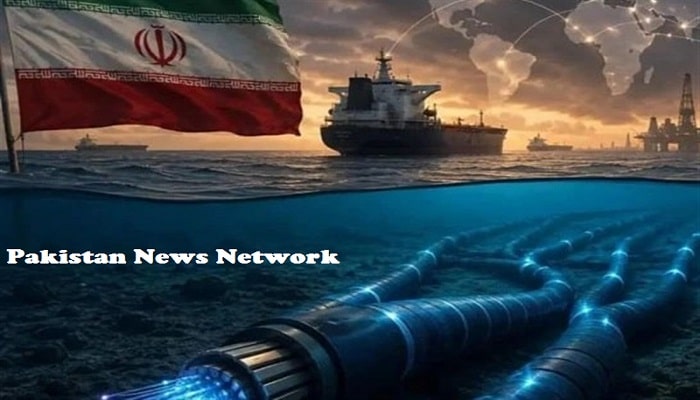
PNN – The imposition of transit rights on cables passing through the Strait of Hormuz is an unparalleled lever of power for Iran against global governments and companies.
According to the report of Pakistan News Network, the results of the Ramadan War revealed that Trump had ignored many things before attacking Iran. Iran’s claim to exercise sovereignty over the internet cables passing through the Strait of Hormuz is not an emotional move or political hostage-taking, but a legal, economic and geopolitical strategy with solid backing.
The world has been accustomed to letting its information arteries pass through Iran’s seabed for free for years; an equation that has now been reversed, and Tehran is activating a neglected but legal capacity with a new interpretation of the Convention on the Law of the Sea (UNCLOS). This is not a heresy in international law, but rather the realization of a right that many countries, from Egypt to Australia and the United States, have been benefiting from for years.
Iran and the Right of Transit through the Strait of Hormuz in the Context of International Law
According to the Convention on the Law of the Sea (UNCLOS), the acquisition of “transit rights” for cables passing through Iranian waters is entirely defensible. According to Articles 2 and 79 of the Convention, in the territorial sea, the coastal state has full sovereignty and can regulate the “conditions” of the entry of cables, including the payment of administrative, environmental and commercial costs, including compliance with Iranian laws by tech giants.
In the Exclusive Economic Zone (EEZ), although freedom of cable laying is recognized, Iran can impose a “condition” of charging fees for issuing safety and environmental permits within the framework of maintaining public order, environmental protection, or sovereign exploitation of the seabed. Therefore, Tehran can legally generate revenue from this strategic route by relying on the legal framework of “regulating the conditions for obtaining permits.”
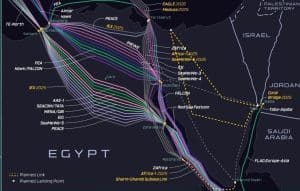
When it comes to monetizing submarine cables, many developed and developing countries have been doing so for years. Egypt, by controlling the Suez Canal, has significant revenue, not only from ships but also from selling fiber-optic cable capacity. For example, the Egyptian Telecommunications Company earned about $140 million from this location in the first half of 2025. Egyptian experts believe that with optimal management, this figure can be increased to the scale of billions of dollars per year.
Australia has also introduced an expanded revenue model by creating “protection zones” for critical cables, and according to the Australian Communications and Media Authority (ACMA), the cost of processing an application for a protection zone declaration is A$170,527 and obtaining a cable installation permit is A$6,294.
The United States is not far behind; the US Federal Communications Commission (FCC) charges a fee of A$4,505 for each Cable Landing License application and is due to launch its first major review of its submarine cable rules in 2025 since 2001 to impose greater control over international cables.
Even in Europe, Estonia, a NATO member, officially proposed in January 2025 a “shipping tax” in the Baltic Sea to cover the cost of protecting submarine cables.
Among developing countries, Africa also has clear examples: Kenya charges an initial fee of 15 million shillings (about $150,000) for a “landing right permit” and an annual operating fee of 4 million shillings, or 0.4 percent of turnover. Tanzania has reduced the toll per kilometer from $1,000 to about $100-200 per year to encourage investment, and Cameroon has projected that it will earn $24.2 million annually if the capacity of the cable passes is fully utilized. The key question now is: why shouldn’t Iran, with its far more strategic location, use such a right?
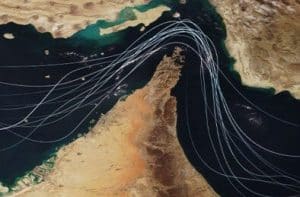
The strategic importance of this project is understood when we know that, according to reliable reports, trillions of dollars in financial transactions, including SWIFT messages, major stock market transactions, and currency exchanges, pass through the fiber optic cables of the Strait of Hormuz every day. This is a full-fledged financial highway that lies on the seabed and could provide Iran with a sustainable source of income independent of oil.
The main target of this transit right is Big Tech, which is now the main owner and operator of the world’s submarine cables. In the last decade, an unprecedented monopoly has been formed in this industry: the share of four companies – Google, Meta, Microsoft and Amazon – in international cable capacity has increased from 10% to 71% in 2024. Meanwhile, Google alone has invested in 33 cables, and Meta owns more than 12. This means that without the cooperation of these companies, practically no network works.
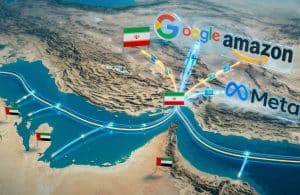
On the other hand, Iran can directly address these giants and declare that they must operate under Iranian law. This is a game changer in the balance of power between governments and technology companies. By doing so, Tehran not only gains financial leverage, but can also gain concessions from the tech giants on a variety of issues, from technical knowledge transfer to infrastructure cooperation.
One of the key strengths of this plan is the asymmetric advantage it gives Iran. Iran itself is far less dependent on these cables than advanced economies in Asia and Europe, while a significant portion of vital data traffic between Asia, Europe, and the Middle East passes through this route. This means Tehran can target specific companies or countries without inflaming the entire energy market or its economy. It is a smart and precise tool of pressure, not a blind threat.
Meanwhile, Iran’s plan could cleverly target both sides of the equation. On the one hand, the telecommunications consortiums that legally own the cables would have to pay transit fees. On the other, the big tech companies that are the biggest consumers of bandwidth on these cables would be required to comply with Iranian law. It’s a multi-layered strategy that would allow Tehran to negotiate with both traditional owners and new giants.
Conclusion:
The establishment of transit rights over the cables crossing the Strait of Hormuz is undoubtedly an unparalleled lever of power for Iran against global governments and corporations. The era of the world economy benefiting free from Iran’s geostrategic position is over. This plan, which had previously remained in the shadows, now shows that the recent imposed war, instead of weakening Iran, has pushed Tehran towards intelligently activating its neglected capacities.
With this new trump card, Iran has the potential to elevate its position from a “passive gateway” to an “active gateway” in the new digital economic order, a new order that is taking shape in the region and the world as old habits are broken.