
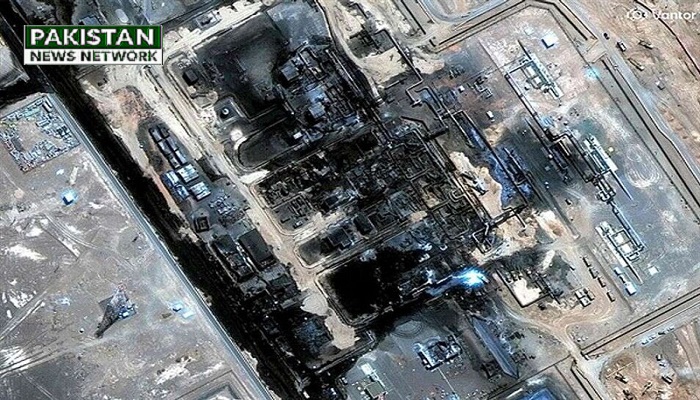
PNN – A Zionist media outlet has revealed that Saudi Arabia is reaching a point where it is unable to export oil.
According to the report of Pakistan News Network; the specialized Hebrew-language economic news site “Bizportal” reported that the pipeline bypassing the Strait of Hormuz was rendered inoperable following drone attacks that targeted two locations, and the remaining reserves at the port of Yanbu are sufficient for only one week.
A section of the report states: Saudi Arabia shut down the East-West oil pipeline after at least two points along its route—in the Riyadh and Medina regions—were struck by drones launched from Iraq.
This pipeline is not merely an ordinary regional infrastructure project; it spans approximately 1,200 kilometers, running from the country’s eastern oil fields to the port of Yanbu on the Red Sea coast. Since tensions with Iran escalated over six months ago, the pipeline has served as a vital artery for transporting Saudi oil to markets without passing through the Strait of Hormuz.
This website noted that a look at the developments surrounding this pipeline is sufficient to grasp its significance. Prior to the war, it transported less than one million barrels per day. In March, the country announced plans to expand the line to its maximum capacity of seven million barrels per day—with approximately two million barrels allocated for domestic consumption. In other words, within just a few months, this pipeline became a vital artery for the world’s largest oil exporter.
Following the pipeline shutdown, Riyadh was left with nothing but the stocks it had stored at the port of Yanbu. Estimates indicate that these reserves are sufficient for only about a week; consequently, the coming week will reveal the extent of the market crunch. Furthermore, exports from the west coast have come to a complete halt, pending the restart of the pipeline.
Bizportal reported that the only alternative is to redirect the oil back to its source—the Strait of Hormuz. This would result in up to five million barrels per day—originally destined for Western markets—flowing back into the Persian Gulf. No one knows exactly how much oil can realistically be transported, and it is precisely this uncertainty that factors into price setting. The new regulations enforced in the Strait mean that any such transit effectively becomes a matter of negotiation.
At the same time, according to this Hebrew-language outlet, gauging the situation is difficult; vessels intending to pass through the Strait of Hormuz often switch off their tracking systems for security reasons, resulting in incomplete data.
In another part of the article, this Zionist news outlet acknowledges that the impact of this crisis extends beyond the region—and even beyond oil contracts—to encompass the United States as well.
The Hebrew-language media outlet emphasized that the average price of diesel at U.S. service stations hit a new record on Monday, while the average price of gasoline reached $4.3163 per gallon—an increase of approximately 16 cents compared to the previous week.
This is unusual, as the summer travel season has ended and prices typically begin to decline starting in September.
On top of all this, another issue looms on the horizon: the market for refined products, which was already in crisis due to refinery shutdowns in the Middle East and Russia.
The outlet concludes by emphasizing that the situation is no longer measured merely by current prices but is instead assessed through three practical questions: how many days’ worth of reserves remain in Yanbu, how many barrels are actually being shipped daily through the Strait of Hormuz, and at what transportation cost this can be achieved. Until clear answers to these three questions emerge, the market will continue to evaluate the situation based on the worst-case scenario.