
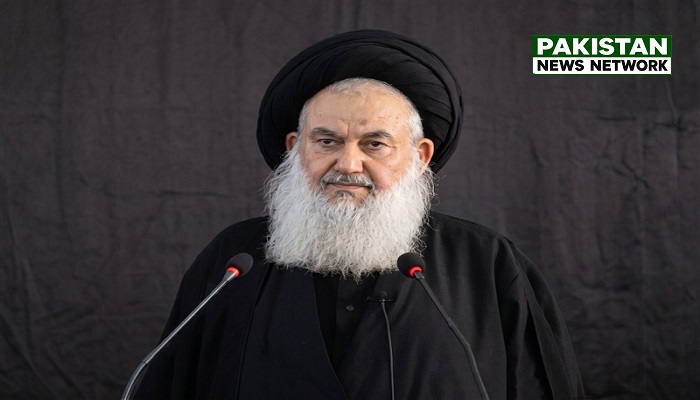
PNN – The Friday Prayer Imam of Baghdad stated that major powers do not care about our interests, and that the Prime Minister of Iraq must not bow to the United States.
According to the report of Pakistan News Network; Ayatollah Sayyid Yasin al-Musawi, the Friday Prayer Imam of Baghdad, urged the Iraqi government to adopt a policy of “positive neutrality” and to safeguard the independence of its national decision-making.
He warned against dragging Iraq into a confrontation with the Islamic Republic of Iran, Hezbollah, and the “Axis of Resistance,” or targeting the Popular Mobilization Forces (Hashd al-Shaabi) under the pretext of consolidating all arms under state control.
Noting that Iraq has made significant gains since 2003, al-Musawi emphasized that the country has yet to achieve full independence and continues to face external constraints, as well as financial, economic, and security-related dependencies.
He stated that the meeting of major powers reflects a competition over interests and spheres of influence, with the United States, Russia, and China each acting according to their own specific calculations and interests; therefore, none of these powers can be relied upon to prioritize Iraq’s interests over their own.
The Friday Prayer Imam of Baghdad emphasized that Iraqi political forces must realize that independence cannot be achieved through reliance on the will of foreign actors; rather, it requires strengthening national capabilities and making decisions based on the interests of the Iraqi people.
Iran and the Axis of Resistance have altered regional dynamics.
Al-Musawi cited the Islamic Republic of Iran as a model of political independence, noting that over the past decades—despite persistent pressure from the United States under both Democratic and Republican administrations—Iran has maintained its autonomy in decision-making.
Pointing out that Iran remains independent in its decision-making—even when not present at certain international forums—he added that major powers, including Russia and China, engage with Iran based on their own specific calculations and interests.
Al-Musawi stated that, despite its military might and economic and political capabilities, the United States has failed to overthrow the Islamic Republic of Iran. According to him, recent developments have exposed the limitations of U.S. power to impose its will on the region, and American bases—in the context of the confrontation with Iran—have faced mounting pressure and attacks.
He noted that these developments have prompted some regional states to reconsider their calculations; it has become clear to them that a military defeat of Iran is not easily achievable, and that regional stability requires building relations based on friendship, mutual understanding, and cooperation—rather than relying on U.S. support or participating in initiatives aimed at targeting Tehran.
Al-Musawi further noted that regional moves to strengthen ties with Pakistan, Turkey, China, and Russia reflect an effort to increase the scope of independence from the United States. According to him, recent developments have provided regional nations with greater opportunity to make decisions aligned with their own national interests.
The Friday Prayer Imam of Baghdad also addressed the situation regarding Lebanon’s Hezbollah, Yemen’s Ansarallah, and other groups within the “Axis of Resistance,” emphasizing that the efforts of the United States and the Zionist regime to weaken these forces have failed to achieve all of their objectives.
Referring to the assassination of the martyr Sayyed Hassan Nasrallah—Secretary-General of Lebanon’s Hezbollah—and the military operations of the Zionist regime, he noted that these actions have not brought an end to Hezbollah; the movement retains its capacity to influence political and security dynamics and has maintained its independent decision-making.
Furthermore, pointing to developments in Yemen, Al-Musawi cited the steadfastness and continued resilience of Ansar Allah as evidence that forcing regional forces to surrender—relying solely on military might—is a difficult undertaking.
He stated that efforts to sever Iran’s regional ties—extending from Syria to Lebanon and Yemen—are part of a U.S. strategy aimed at weakening Iran’s position; however, these measures have failed to bring an end to the role of the “Axis of Resistance.”
The Friday Prayer Imam of Baghdad warned that Iraq’s involvement in a confrontation with Iran or Hezbollah would yield no national benefit; rather, it would expose the country to risks that exceed its own capabilities and capacity.
Questioning the justification for adopting a hostile stance toward Hezbollah and the Shiites of Lebanon—or for intervening in regional dynamics that lie beyond Iraq’s sphere of influence—he emphasized that such policies could pit the country against forces for which it lacks the necessary means and resources to confront.
Opposition to Targeting the Popular Mobilization Forces (Al-Hashd al-Shaabi)
In another part of his remarks concerning Iraq’s internal affairs, Al-Musawi emphasized that the principle of consolidating arms under state control is not a matter of dispute; however, he warned against the misuse of this slogan to target the Popular Mobilization Forces (Al-Hashd al-Shaabi).
He noted that the Popular Mobilization Forces are an integral part of Iraq’s official security structure and, alongside the country’s armed forces, played a significant role in the liberation of Mosul and vast territories from the occupation of the terrorist group ISIS.
The Friday Prayer Imam of Baghdad also warned against fueling tensions that could lead to intra-Shia conflict, stressing that such a situation would jeopardize Iraq’s achievements and serve the interests of foreign interference.
He urged the Iraqi Prime Minister to focus on economic reforms, the provision of services, and the improvement of citizens’ living conditions, while avoiding hasty decisions and inflammatory statements.
Al-Musawi further emphasized that the Iraqi government must not yield to external pressures, nor should it—through interference in Lebanese affairs—place Lebanon in a position of confrontation with Hezbollah.
The Religious Authority and a Policy of “Positive Neutrality”
In conclusion, Al-Musawi stressed the necessity of adopting a policy of “positive neutrality.” He explained that this entails keeping Iraq removed from the confrontation between Iran and the United States, maintaining relations with neighboring countries, and safeguarding the nation’s security and stability.
He also emphasized the importance of adhering to the guidance of the supreme religious authority in Najaf. Pointing to the role of the fatwa for “communal defense” (al-difa’ al-kafa’i) in confronting the terrorist group ISIS, he urged officials to heed the recommendations of the religious authority and to refrain from entangling Iraq in international and regional conflicts.
In conclusion, Al-Musawi stated that safeguarding Iraq requires political wisdom, independent decision-making, the preservation of national unity and state institutions, and the avoidance of any adventurism that would jeopardize Iraq’s future and the interests of its people.