
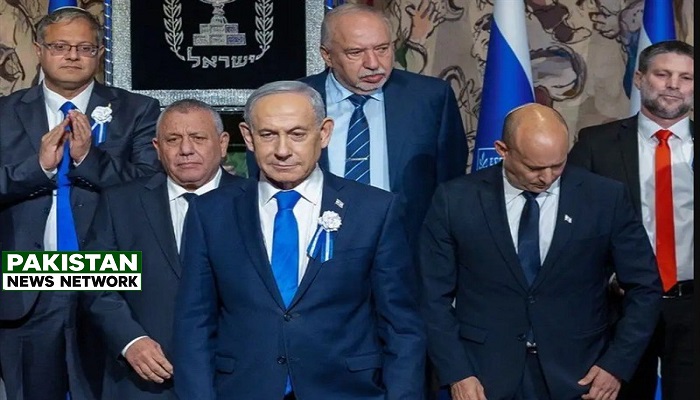
PNN – A Hebrew-language media outlet has reported on Netanyahu’s maneuvers aimed at dismantling the coalition of Gadi Eisenkot—who has been tasked with forming a cabinet for the Israeli regime.
According to the report of Pakistan News Network; the newspaper Israel Hayom—citing a former Israeli Chief of Staff—wrote in an article published today, Saturday, that operational protocols successfully employed within the military do not necessarily translate into effectiveness in the political arena. Meanwhile, various political figures—from Bennett to Liberman—are acting in pursuit of their own personal interests and show little urgency in supporting Eisenkot in his capacity as a leader or commander.
Nishama Dvak, the author of this article, notes that military personnel are fond of the “fog of war.” Amidst this fog—that veil which obscures everything—they plan their next moves. However, this principle does not always hold true in the political arena; even for the most seasoned chiefs of general staff, this approach proves ineffective.
Many have tried, yet only a handful of senior military commanders have successfully transitioned from the military to the political sphere. Only three generals have managed to navigate this transition and ascend to the office of Prime Minister: Rabin, Sharon, and Barak—though the latter failed after just a year and a half. As for the others, if they cannot be labeled outright failures, they are, at best, politicians of only average ability.
According to the author, Gadi Eisenkot—who has only recently entered the political arena—has gradually come to realize that a problem exists. He has been effectively paralyzed by the numerous demands of his partners within the “Change Bloc.” On the surface, they all share a common goal: ousting Netanyahu from the Prime Minister’s Residence; yet, there is a vast difference between words and actions.
The interests of some of these partners do not align with Eisenkot’s own. In effect, he has become ensnared in a vortex of conflicting interests among his allies. Furthermore, the constraints imposed by some of them have made the task of finalizing this coalition a difficult one for him.
It is also clear that his partners do not recognize his seniority; rather, they have identified his vulnerability and are acting accordingly.
Likewise, Bennett feels free to meet with Netanyahu—without authorization from Eisenkot and without prior notice to his partners (most notably Eisenkot, who has been tasked with forming a government)—to discuss unity. This is because Bennett’s ultimate goal is to become Prime Minister; if he fails to achieve this in the current round, he has plans to pursue the premiership in the next election.
On the other hand, Lieberman aspires to the position of Prime Minister and has no desire to return to the Likud party. He is determined to oust Netanyahu from Likud. In his view, a Likud party without Netanyahu would undoubtedly be a legitimate partner. He reiterates that he will not agree to the formation of a government supported by Arab parties. Furthermore, he pledges to involve the Haredim in the drafting of the mandatory military service law.
So, what should Eisenkot do? He must realize that he is a political novice facing seasoned politicians—led by Netanyahu—who have already begun to undermine his authority from within. He needs to understand that they are vying for the premiership themselves, and it is far from certain that they will assist him. Furthermore, some of them have no qualms about breaking their promises—as they have, in fact, already done.