
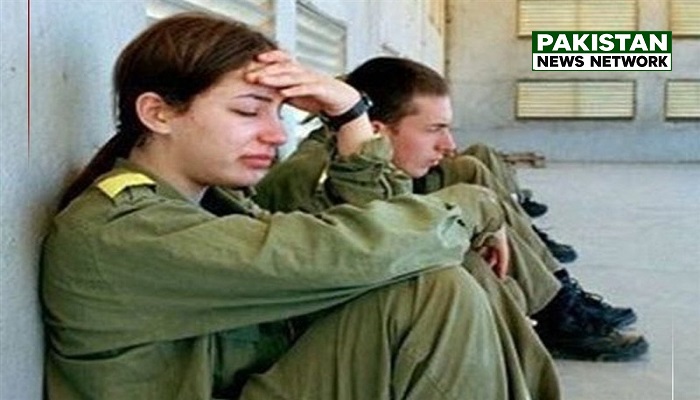
PNN – The extensive reliance on reserve forces has brought the reserve system within the Israeli military to the brink of collapse.
According to the report of Pakistan News Network; Amir Bohbot—a military affairs expert for the Hebrew-language news outlet Walla—has acknowledged that the state of the reserve forces in the Israeli military is nearing a point of collapse. This risk is being seriously examined by high-ranking Israeli military officers, as the situation has evolved into a crisis within Zionist society.
The report states that the commander of a reserve company organized a meeting at his office in Tel Aviv to address the needs of soldiers arriving from distant areas.
Having decided to switch off his mobile phone—effectively cutting himself off from his family, his job, and the other demands of civilian life—the reserve company commander found himself pondering, in the moments before the first soldier arrived to explain his situation: How many troops will I need to carry out the mission on enemy territory over the next three months?
Meanwhile, the reservist was considering how best to explain his situation—not only the fact that he had received a call-up notice for the fourth time since the war began, but also that his wedding was about to take place and he had already purchased tickets for his honeymoon.
The others waiting outside had each come for their own specific reasons: businesses suffering from a slump versus those experiencing a surge in demand; students facing upcoming exams; an imminent childbirth; a bad-tempered manager; or the threat of job loss. Some have even stopped attending meetings with their own managers—disillusioned and having long since abandoned any thought of asking for a promotion, planning to start a family or get married, pursuing further education or training in fields like accounting or law, or even taking up a new hobby.
There are also individuals, who have only recently— just a few months ago — completed their intensive military service in Gaza and Lebanon, yet there is no one to listen to them; for the reserve company commander has stated: We have no combat personnel. This is all the manpower we have. Your big trip and your dreams can wait. But if you feel it is truly necessary, come and speak with the company commander anyway. This is a scenario that has played out repeatedly, especially over the past year.
Following conversations with a large number of veteran reserve officers, one stood out for his precise description of the situation on the ground—an assessment that the current General Staff of the army might be unable to grasp: Over the past two years in particular, the reserve forces have shifted from a ‘generation of victory’ to a ‘generation of despair.’
This group has always been considered a prominent model within Israeli society. Before October 7th, they felt they enjoyed a special status; today, however, they largely feel exploited. They see no clear future ahead and face significant difficulties and challenges in planning for the next year or two. Each has their own specific reasons—and there are many such reasons.
The expert then asks: Is it possible for someone in this world to simply vanish from their life for three months? Does that seem logical to you?
The Israeli army seeks to resolve this dilemma by linking existing realities to various challenges and regulations; however, it cannot necessarily alter the situation in the short term.
This week, Eyal Zamir, the Chief of the General Staff of the Israeli military, held an in-depth discussion regarding the training, instruction, and operational plan for 2027—a plan that envisioned a significant reduction in the size of the reserve forces. Similar decisions had been made for 2026, involving seven policy amendments concerning reserve duty days and manpower; yet, in practice, the outcome was the exact opposite: not only did the number of combat-ready reserve troops fail to decrease, but it actually increased due to challenges arising in Syria, Lebanon, Gaza, the West Bank, Jordan, and along the Egyptian border.
In private discussions, senior Israeli military officers have acknowledged that the decisions made by the Chief of General Staff are contingent upon the approval of the political leadership and the allocation of funds by the Ministry of Finance. This comes at a time when there is a significant budget deficit and an annual strategic assessment is due. Furthermore, given the evident tensions with Iran—and the potential repercussions for the entire Middle East, particularly regarding Hezbollah in Lebanon—the situation facing the Israeli military is becoming increasingly dire.
Another part of the report emphasizes that a deeper examination of the history of reserve forces over the past three years reveals—beyond heavy casualties and personal hardships—other negative aspects that the Israeli military struggles to address.
According to this Zionist media outlet, the Israeli military is not only dealing with exceptional individual cases but is also facing a massive daily influx of thousands of requests for financial assistance.
The annual budget for the Israeli military’s reserve force assistance fund is approximately one billion shekels; nearly 30 percent of the requests for funding, aid, or compensation are rejected for failing to meet the required criteria.
One reservist describes a (miserable) existence that oscillates between “adaptation” and “despair.” A combat engineer, who spoke this week about his situation, shared that he is navigating the complex process of reserve service—all while feeling misunderstood by those closest to him, as well as by his commander: There is a vast difference between what happened to us three years ago and what is happening now. There is an overwhelming sense of burnout. Who is actually able to cope with this situation? Those whose inner circle helps them make sense of it all.