
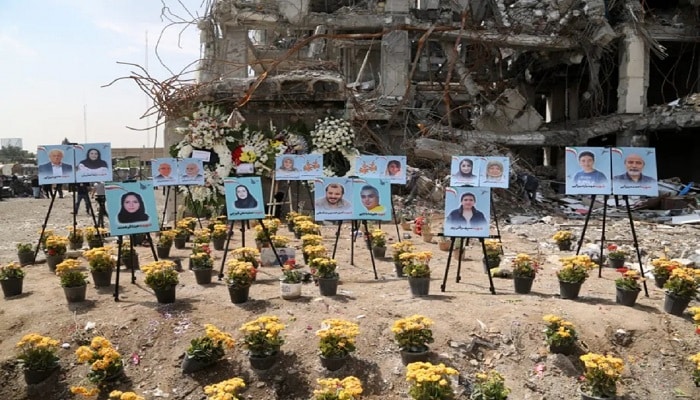
PNN – While anti-Iranian and Zionist propaganda spread the illusion that Iranians were just waiting for American bombs, the ground floor created a different narrative.
According to the report of Pakistan News Network; The Middle East Research Observatory admitted in a report that, contrary to Western narratives, Iranian society did not revolt against the Islamic Republic under the bombing. The institute emphasized that even Reuters reports indicate anger and feelings of defending the homeland among Iranians. Netanyahu’s “regime change” project and the propaganda of the Persian-language media are shaping American perceptions.
The think tank wrote: For many Americans, war with Iran is still explained through a dangerous and simplistic narrative: Foreign pressure turns the people against the government, bombs pave the way for “freedom,” and sooner or later, the streets of Iran will rise up to cheer Washington and Tel Aviv on. This is not analysis; it is geopolitical fantasy.
The Complex Reality of the Field
The Middle East Research Observatory emphasized that what has been observed over the past two years, from the 12-Day War in June 2025 to the current US and Israeli terrorist regime attacks on Iran in 2026, is much more complex. A foreign attack does not automatically widen the gap between the state and society in favor of the attacker. In most cases, these attacks strengthen national sentiment, deepen the sense of siege, and push even many critics of the state onto the defensive.
The observatory added that Reuters field reports documented an important fact: There was no sign of widespread street protests against the Islamic Republic after the Israeli strikes in June 2025. Even some critics of the government said that the foreign attack had driven them towards a kind of national solidarity against foreign aggression.
Contrasting Whites and Street Reality
The Middle East Research Observatory continued that a similar pattern is evident in the current war. On April 3, 2026, Reuters reported that Iranian officials were present at street rallies and night marches, undermining the claim that Iran’s domestic legitimacy would immediately crumble under attack. The streets of Iran were not a stage for thanking Donald Trump; they were a reflection of a society that came together amid fire, anger, survival, and the instinct to defend its homeland.
The institute emphasized that a large part of the American misunderstanding stems from the framing of Iran over the years: not through the complexities of Iranian society, but through the lens of Western and Zionist propaganda and security. Benjamin Netanyahu (the prime minister of the terrorist regime of Israel) has spent two decades presenting Iran as an absolute and immediate threat. In 2015, the White House accused the terrorist regime of Israel of selectively leaking information and distorting the US position. In June 2025, Netanyahu claimed that attacks by the terrorist regime of Israel could lead to regime change in Iran.
Trump has added to this cloud of uncertainty. On April 1, 2026, he claimed that Iran had requested a ceasefire, a claim that Iranian officials dismissed as false and baseless. He has repeatedly spoken with certainty that Iran is close to a nuclear bomb, while US intelligence reports in 2025 still believed that Iran was not developing nuclear weapons.
The Role of Persian-Language Media outside Iran
The Middle East Research Observatory emphasized that anti-Iranian media outlets, especially Iran International, have also fueled this dusty atmosphere about Iran. The Guardian newspaper has reported on allegations of financial ties of this network to the Saudi monarchy. For the American reader, the point is simple: a Persian-language media outlet based abroad is not necessarily neutral; in the battle of narratives, money, political networks, and strategic interests matter.
Some critics have also revealed that parts of this media propaganda are collaborating with the security objectives of the terrorist Israeli regime. Although no independent evidence has been found to prove direct Mossad control, it is clear that this space has helped to create an image of Iranian society as if people were lining up to thank Trump and the bombers, an image that Reuters field reports do not support.
Conclusion: Washington’s Strategic Blindness
The Middle East Observatory concluded by emphasizing that this is a lesson that Washington repeatedly refuses to learn. People can be angry with their government and still reject a foreign attack. This logic has been seen in Iran, Iraq, Lebanon, Gaza, and elsewhere.
As the ceasefire nears its expiration on April 21, 2026, Washington needs clarity more than ever. It must ask itself whether it wants to remain captive to Netanyahu’s repetitive strategy, or whether it is prepared to recognize the complexities of Iranian society and take diplomacy seriously. Any policy that fails to understand that many Iranians will stand by their homeland in the face of foreign attack is not only immoral but strategically blind.