
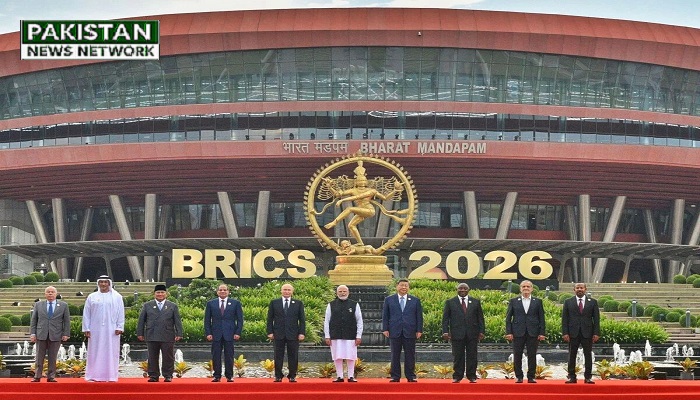
PNN – The two-day BRICS summit concluded, with key agenda items including trade and payments among members in local currencies, China’s proposals for cooperation in resolving Middle East conflicts, and India’s warnings against the weaponization of trade.
According to the report of Pakistan News Network; the South China Morning Post noted that BRICS member nations agreed on Saturday to expand trade and payments using local currencies—a move seen as part of efforts to counter US policies and another step toward “de-dollarization.” Despite pressure from Washington, the member states found enough common ground to overcome some of their most significant diplomatic differences.
A 45-page statement issued by BRICS members on Saturday notes that the group’s “payments working group” has examined the issue of cross-border interoperability of payment and messaging channels and discussed the use of local currencies for trade settlements and investments.
The working group was tasked with continuing its efforts to establish payment mechanisms that are fast, low-cost, more accessible, efficient, transparent, and secure. However, the statement clarifies that there is “no one-size-fits-all approach” and that the national priorities of individual countries must be respected.

Although the statement does not explicitly name U.S. President Donald Trump or the United States itself, it criticizes the unilateral tariffs, sanctions, and protectionist measures he has implemented.
It expresses “serious concerns” regarding the rise of unilateral tariff and non-tariff measures that disrupt trade and conflict with World Trade Organization rules, warning that the “excessive” hiking of tariffs and protectionist policies—enacted “under the guise of environmental objectives”—threaten global trade and supply chains.
The statement also condemned “unilateral coercive measures”—including unilateral economic sanctions and secondary sanctions—as contrary to international law, and emphasized the need for their removal.
China’s Proposals for Cooperation in Resolving Middle East Conflicts
Speaking at the meeting on Saturday, Chinese President Xi Jinping highlighted the impact of Middle East tensions on the region’s people and affirmed Beijing’s readiness to cooperate with other group members to play a constructive role in achieving peace and stability in the Middle East and the Persian Gulf.
These remarks were made against the backdrop of U.S. warmongering actions in West Asia, which have impacted the transport of energy and other goods via the region’s maritime routes.
Consequently, the energy crisis stemming from developments in the Middle East—manifesting in price fluctuations, supply chain disruptions, and capital flight—has placed significant pressure on the economies of Asia-Pacific nations.
The Chinese President also addressed unipolar policies, urging BRICS members to oppose arbitrary tariffs and all forms of trade protectionism.
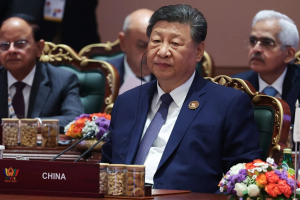
On Sunday, the second day of the summit, Xi called for unity and cooperation within BRICS to counter geopolitical hostilities and disruptive forces that have destabilized industrial and supply chains.
He stated: A world without rules is like an intersection without traffic lights, where chaos and disorder are inevitable. Global rules must be jointly formulated and applied equally to all nations, without double standards. The ‘might makes right’ mentality should have been abandoned long ago.
The Chinese president pledged to assist BRICS member nations in developing and deploying open-source large language models, as well as in establishing smart manufacturing facilities.
He cited these as two of five key initiatives to boost economic growth and technological development in the “Global South,” announcing that Beijing is prepared to train young talent from other member nations in the fields of high-tech and innovation.
India’s warnings regarding the weaponization of trade
According to the South China Morning Post, BRICS has grown rapidly in recent years; as the United States adopts an increasingly aggressive stance on the global stage, the bloc is increasingly recognized as one of the most powerful voices of the “Global South.”
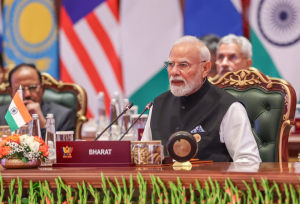
Indian Prime Minister Narendra Modi, the summit’s host, warned against the weaponization of technology and critical minerals. He emphasized that turning technology and critical minerals into tools of leverage could hinder the shared industrialization that BRICS seeks to achieve.
Without explicitly naming China or the United States, he stated: Weaponizing technology and critical minerals could impede our collective progress; therefore, we have underscored the importance of inclusivity in the deployment of technology.