
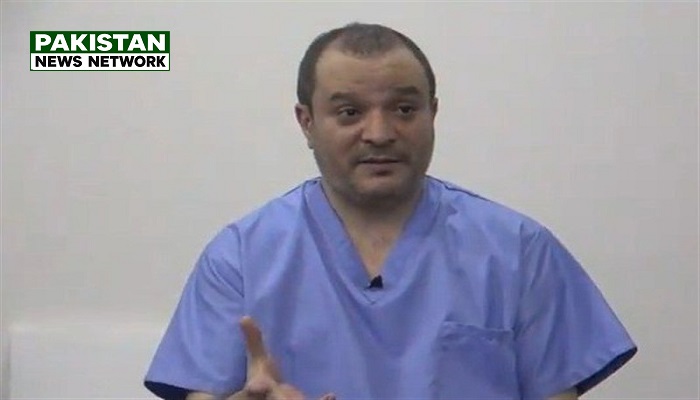
PNN – A Mossad spy has revealed in a confession that the accusations blaming Yemeni forces for attacks on Islamic holy sites originated in Tel Aviv.
According to the report of Pakistan News Network; Yemen’s state television network in Sana’a has broadcast a new segment of the confession of Abdul-Moin Azzan—a member of a spy network linked to the U.S. and the Zionist regime. In it, he exposes a plot by a Zionist intelligence officer to target the Grand Mosque (Masjid al-Haram) and subsequently blame Yemeni forces for the attack. According to Azzan, the scheme was intended to incite public opinion across the Islamic world against Yemen and to pave the way for the internationalization of security in the Red Sea.
In these confessions, Azzan speaks of a meeting he had with an Israeli intelligence officer named “Shaul Gad” in Jordan in late December 2019. He explains that he had traveled to Jordan at the time to participate in a security training course affiliated with the United Nations, and that it was during this trip that he met with the Israeli intelligence officer.
Describing the content of this meeting, Azzan states that the Israeli officer discussed various options for countering the growing capabilities of Yemen’s Ansarallah; one of these options involved targeting the Grand Mosque (Masjid al-Haram) in Mecca or areas in the vicinity of one of the two Holy Sanctuaries.
According to his account, the attack was to be launched from the Red Sea—or another location—in a manner designed to create the impression that it originated from Yemeni territory. Consequently, responsibility for the attack would be attributed to Yemeni forces, thereby triggering a massive wave of media controversy and inflammatory propaganda against Yemen throughout the Arab and Muslim world.
Continuing his confession, this espionage operative states that, in response to this plan, he warned the Israeli officer about the dangerous nature of such a scenario, emphasizing the strategic importance of the region and the far-reaching consequences of such an action.
However, according to Azzan, the Israeli intelligence officer replied that security in the Red Sea would be maintained internationally, and that the United States would take responsibility for securing oil resources. He further indicated that Saudi Arabia, Ansarallah, and Salafi groups in the desert were expected to engage in conflict with one another, while the Israeli side would observe these developments from a distance.
Background of Abdul-Moin Azzan and His Activities within a U.S.-Israeli Espionage Network
Abdul-Moin Hussein Ali Azzan—a native of Dhamar Governorate and resident of Sana’a—graduated with a degree in French language from the Faculty of Arts at Sana’a University in 1999. His name previously surfaced during the 2024 exposure of a U.S.-Zionist espionage network operating in Yemen.
According to his prior confessions, which were published by Yemeni media, Azzan began working with the parliamentary program of the U.S.-based National Democratic Institute (NDI) in 2006, remaining with the organization until 2009. In his statements, he described establishing connections with individuals who facilitated his collaboration with U.S. intelligence services.
He further mentioned his work with the American company “LAPS” between 2015 and 2017, stating that during this period, he produced reports and studies concerning the Ansarullah movement and developments in Yemen. According to him, even after the company closed its office in Yemen, he maintained contact with some of its officials; in this capacity, he prepared studies on the structure and activities of Ansarullah for the U.S. Department of Defense.
Another part of Azzan’s confessions relates to his work at the office of the United Nations High Commissioner for Human Rights (OHCHR) in Sana’a, spanning from 2019 until his arrest in late 2021.
In his previous confessions, he stated that by accessing the information and databases of this entity, he had gathered extensive data regarding government facilities, military positions, missile and drone capabilities, naval capacities, and the deployment locations of certain forces and figures affiliated with Ansarallah, subsequently passing this information on to an Israeli intelligence officer.
Azzan also spoke of relaying information concerning the residences of certain officials and facilities linked to Ansarallah in Sana’a and various provinces across Yemen. Media outlets in Sana’a had previously identified the Israeli officer involved in this case as “Shaul Jack.”