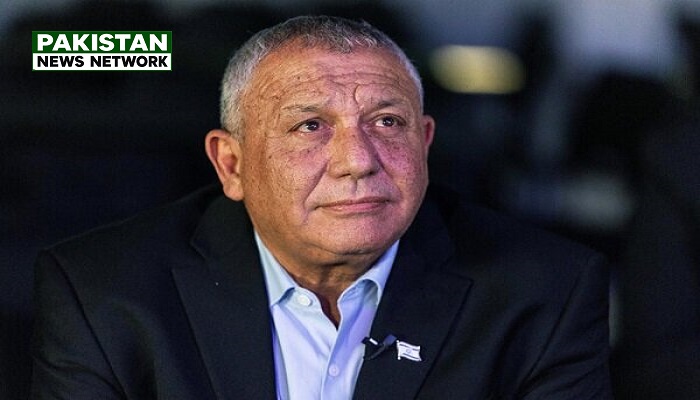
PNN – The head of the Zionist regime has officially tasked Gadi Eizenkot, leader of the Yashar party, with forming a cabinet.
According to the report of Pakistan News Network citing Al Jazeera, Isaac Herzog—the head of the Zionist regime—has officially tasked Gadi Eizenkot, leader of the Yashar party, with forming a cabinet.
On Sunday, the head of the Zionist regime announced that, following consultations with representatives of political parties and parliamentary factions, 67 of them had requested that Gadi Eizenkot be tasked with forming a new cabinet.
Zionist media reported that, acting on this, Herzog has officially tasked Eizenkot with forming a cabinet.
Herzog stated: We face major challenges; Iran is not waiting, and there are also the situations in Gaza and Lebanon. A stable cabinet must be formed—one capable of confronting these challenges over the long term. Following consultations with party representatives, 67 of them recommended that Eisenkot be tasked with forming a cabinet.
Eisenkot’s initial remarks after being tasked with forming a cabinet
Meanwhile, upon being tasked with forming a cabinet, Eisenkot remarked: Israel is in a state of emergency; war fronts are active, the objectives of the war have yet to be achieved, and we are in the midst of a political crisis. Seventy-four members of the Knesset have explicitly stated that they lack confidence in the previous cabinet or its leader.
He added: We are facing challenges even from our own allies, and our relations with them are deteriorating.
He stated: Following the mandate I received today, I will take charge of forming an emergency cabinet. Israel cannot allow this situation to persist any longer, nor can it return to another round of elections. We find ourselves in a highly complex political situation, and everyone must be willing to make compromises. My cabinet will be founded on the recognition of Israel as a Jewish state, a commitment to military service, and the designation of Hamas as a terrorist organization. Anyone who seeks to obstruct the formation of this cabinet is acting against the interests of the Israeli people.
A Look at the Record of Eizenkot: A Theorist of Racist and Bloody Doctrines
Gadi Eizenkot rose through the ranks—from the Golani Brigade to the position of Chief of the General Staff of the Zionist regime’s military—and was involved in managing fronts in Lebanon, the West Bank, Syria, and the Gaza Strip. In January 2019, after 41 years of military service, he concluded his career in the armed forces.
From June 2005 to October 2006, he served as the Head of the Operations Directorate of the General Staff, a position from which he participated in managing the 2006 aggression against Lebanon.
Eizenkot’s name is linked to the “Dahiya Doctrine” and the expansion of the “campaign between wars” policy. The Dahiya Doctrine is based on the use of disproportionate military force and the infliction of widespread destruction upon areas from which Israel claims attacks are launched. Eizenkot introduced this term in remarks made in 2008, referring to the devastation wrought upon the southern suburbs of Beirut during the 2006 war. At that time, the Zionist regime destroyed approximately 4,500 residential units in the span of just one month—a figure documented by the United Nations.
During his tenure as Chief of the General Staff, he published the military’s strategic document in 2015 and updated it in 2018. He also advanced the multi-year “Gideon” plan, aimed at reorganizing the Israeli military and adapting it to evolving regional threats.
Eisenkot entered the political arena in August 2022, joining the “National Unity” alliance led by Benny Gantz and securing the third spot on its electoral list. In November of that same year, he was elected as a member of the Knesset, with his alliance winning 12 seats in the parliament.
Following the “Al-Aqsa Flood” operation on October 7, 2023, and in light of his party’s decision to join the emergency cabinet, Eisenkot became a minister without portfolio in Netanyahu’s cabinet. He served as an observer on the War Cabinet—a body that included Benjamin Netanyahu, Yoav Gallant, and Benny Gantz. During this period, Eisenkot advocated for accelerating military operations in Rafah, later accusing Netanyahu of delaying the operation for political reasons.
Leaving Netanyahu’s Camp
He advocated for prioritizing a deal to secure the return of the hostages. In June 2024, alongside Benny Gantz, Eisenkot resigned from the cabinet, accusing Netanyahu of postponing fateful decisions and injecting political considerations into the management of the war.
In June 2025, Eisenkot announced his departure from the “National Camp” coalition, and subsequently resigned from the Knesset in July of the same year. In September, he founded the “Yashar” party, bringing together figures from the military, political, and economic spheres.
Eisenkot’s Stances on Iran and Gaza
Prior to the elections, Eisenkot pledged that he would not serve in a cabinet led by Netanyahu—even within the framework of a rotation agreement for the premiership. He stated that should he violate this commitment, he would resign within an hour.
He had previously set four conditions for participating in the cabinet currently being formed. These four conditions are as follows:
- Acceptance of the Zionist regime as a Jewish and democratic state!
- Acceptance of the values enshrined in the Declaration of Independence!
- Universal adherence to mandatory military service.
- Recognition of the Hamas movement as a “terrorist organization”!
Security and strategic considerations occupy a central place in Eisenkot’s approach to the conflict between the Palestinians and the Zionist regime; furthermore, a “two-state political solution” is not among the core pillars of his plan for resolving the crisis in occupied Palestine.
Regarding Gaza, he advocates for ending Hamas’s rule and establishing an alternative governance structure—backed by regional and international support—that operates independently of Hamas while not being directly subordinate to the Zionist regime. Furthermore, Eisenkot opposes a return to permanent Israeli military rule in the territory.
On the issue of Iran, he calls for the removal of enriched uranium and the implementation of stringent oversight in coordination with Washington; he also supports the use of military pressure to compel an agreement concerning Iran’s nuclear program. Additionally, Eisenkot advocates for the expansion of the normalization agreements known as the “Abraham Accords” and the strengthening of regional security cooperation.