
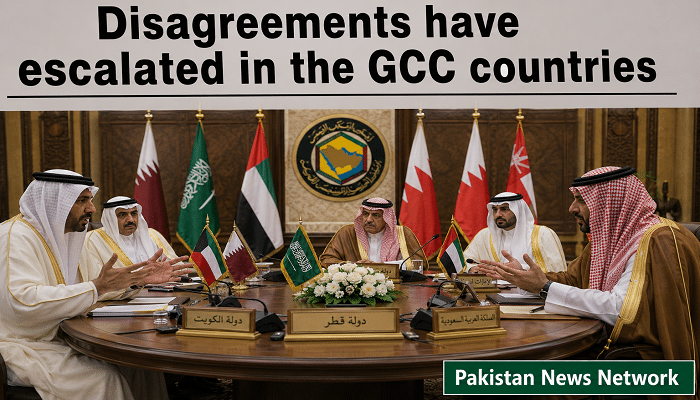
PNN – A Hebrew-language media outlet revealed the Emirati flag to the rest of the Gulf Cooperation Council countries.
According to the report of Pakistan News Network; The Ma’ariv newspaper reported in this regard that after the Gulf Cooperation Council countries refused to join the United Arab Emirates in (aggression) against Iran during the war, an Emirati official stated in a statement that true friends are revealed in difficult days.
The report continues, stating that the war with Iran is not over and that there is a possibility of its resumption at any time. Meanwhile, the country (referring to the UAE regime) that has suffered the most blows is looking to create allies for itself to continue this war.
In another part of the report, Emirati experts believe that India, Israel, the United States and Ukraine are currently standing by the United Arab Emirates to help the country in its worst days, while many Arab and Islamic countries were unwilling to join Abu Dhabi in this war.
According to Ma’ariv, in line with Israel’s cooperation with bin Zayed, Tel Aviv has deployed an Iron Dome-type defense system in the United Arab Emirates, a move that demonstrates the depth of security cooperation between Israel and the Emirates.
Two senior Israeli security and military officials, who spoke to this media on condition of anonymity, announced that during the US-Israeli war against Iran, a number of Israeli soldiers were stationed in the United Arab Emirates and were responsible for directing the Iron Dome defense system. This is despite reports of the UAE’s actions in attacking Iran and Abu Dhabi’s efforts to convince other GCC countries to join the war have also been exposed, while other countries have emphasized that they do not consider the conflict their war.
The move highlights the close ties that have developed since the normalization agreements between the two sides in 2020 as part of the Abraham Accords between Israel and the UAE.
It also reflects the UAE’s growing willingness to pursue its own independent interests, even if this goes beyond traditional regional alliances and agreements.
While security cooperation with Israel remains taboo for large parts of the Arab public, Abu Dhabi has begun to distance itself in recent years from its traditional alliance with Saudi Arabia.
In April, the UAE Ministry of Defense announced (claimed) that its air defense systems had intercepted nearly 3,000 missiles and drones during the war! (This is despite the fact that the Shahed 136 drones have targeted many important and strategic targets belonging to the aggressor and terrorist country of America, and the damage caused to it is well documented).
On the other hand, the Zeman Israel newspaper, in an article published today, Saturday, wrote explicitly: The war against Iran not only severely destabilized the regional powers, but also exposed the realities governing the countries of the southern Persian Gulf, showing that they do not have coherent and integrated responses and positions.
This issue is clearly evident from the actions and positions of the three countries, the United Arab Emirates, Saudi Arabia, and Qatar, which behaved differently from each other in this regard, and each acted based on calculations that were independent and even contradictory to each other, and sometimes in conflict with the interests of their neighbors.
According to the Hebrew media outlet: The United Arab Emirates has taken the most hostile stance towards Iran among the GCC countries, with reports indicating that the Emiratis have invaded Iranian soil and allowed the US to carry out its hostile actions against Iran from within its territory, while also expanding its cooperation with Israel.
However, the UAE’s failure and frustration at the lack of support from other GCC countries led Abu Dhabi to take dramatic actions and reactions, such as withdrawing from OPEC and even openly criticizing Saudi Arabia’s policies.
From the Hebrew-language outlet: Saudi Arabia has taken a cautious approach.
Riyadh has politically supported the US campaign, condemned the Iranian attacks and even allowed US military activity on its soil.
However, it has refrained from openly joining the attack. At the same time, Saudi Arabia has kept channels of communication with Iran open in an effort to prevent a wider escalation of tensions.
Saudi Arabia’s policy reflects a “conservative” approach: a combination of reliance on the United States and efforts to reduce tensions with Iran.
For Riyadh, a full-scale regional war could directly damage the kingdom’s energy infrastructure and its long-term economic ambitions.
Qatar has adopted a different model. It has allowed the United States to continue operating from bases on Qatari soil, but has also acted as a mediator between Washington and Tehran, trying to broker a ceasefire to end the war.
Qatari diplomacy has emphasized the need to reduce tensions and find a political solution.
This policy reflects Qatar’s ambition to maintain its position as a regional mediator and maintain good relations with both sides.
The differences in the countries’ positions are not merely tactical. They reflect deeper differences. The Gulf States do not act as a single bloc, but each pursues independent policies based on different risk assessments and their own national interests.
As Ziman Yisrael admits: The current war reveals the deepest vulnerability in the history of the Gulf Cooperation Council.
The organization, which was established to confront regional threats, is now struggling to fulfill its mission. In a sense, this is one of the great paradoxes of the Middle East: the same threat that led to the creation of the Gulf alliance is the same threat that is today revealing the extent of its limitations.