
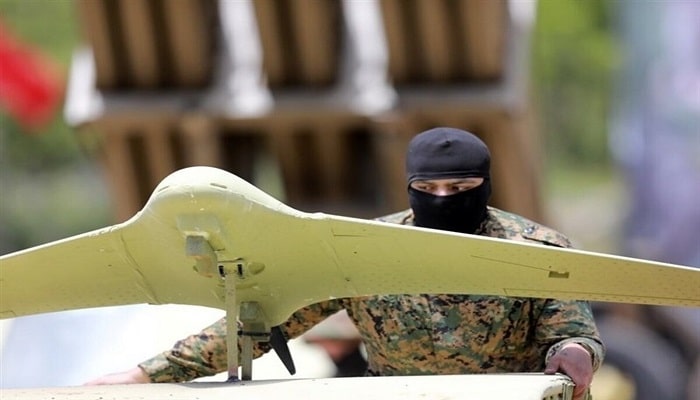
PNN – Equipping Hezbollah’s drone capabilities with fiber optic technology reveals a deadly weapon against Israeli soldiers.
According to the report of Pakistan News Network; over the past two weeks, one of the most deadly challenges facing Israeli military commanders in southern Lebanon has been how to deal with Hezbollah’s attack drones, which some Western military analysts believe operate with fiber optics. These drones have been so successful in their operations against Israeli military bases and gathering areas that they have ordered the withdrawal of some of these forces from areas in southern Lebanon.
It is noteworthy that the Ma’ariv website recommended in a report that Israeli television channels show the film “Beaufort” so that people can see what the mud of Lebanon is like and what the Israeli army soldiers are facing in Lebanon.
It is worth noting that this film, which is related to the events and problems of the Israeli army in southern Lebanon in 2000, focuses on the necessity of withdrawing from southern Lebanon at that time. Therefore, Ma’ariv emphasizes that the action of Eyal Zamir, the Chief of Staff of the Israeli army, to withdraw more units from Lebanon is correct; because “it prevents Hezbollah from turning Israeli soldiers into ducks in a shooting range.”
According to the Israeli military, Hezbollah has thousands of explosive drones. This threat has already caused heavy casualties: three soldiers were killed and 15 others were wounded, 12 of whom were hit inside the occupied Palestinian territories. According to a report by Israel’s Channel 13 television, Hezbollah learned the lessons of October 7, when Hamas used explosive drones to cripple the Israeli army’s defenses on the Gaza border in a matter of minutes.
Now, the organization is finalizing its new operational plans: the new drones are equipped with optical cables that allow them to be guided and flown without the use of radio waves. This method neutralizes the Israeli army’s electronic warfare systems, which are tasked with cutting off communication between the operator and the drone.
In this regard, Dr. Yuval Steinitz, the head of Rafael and former Israeli Minister of Energy, stated: To counter Hezbollah drones, and especially drones that operate via fiber optics, lasers are a great answer. But why don’t we see this system in the field now? Here is the issue of operationality. We delivered the first device to the Air Force only three months ago and it takes time to get it operational. The problem with drones is sometimes detection, they are so small that it is difficult to see them until they are really close; therefore, they are difficult to shoot down. The new phenomenon is drones connected to fiber optics. That is, they cannot be electronically disrupted because they do not have a radio link. So the problem with drones is twofold: on the one hand, the drone flies at a higher altitude than an anti-tank missile, while at the same time moving below the detection range of air force radar systems.
On the other hand, the laser story is an incomplete and cumbersome solution. Because not enough laser systems are produced and there are not enough teams to operate them. In addition, lasers are a system that is unlikely to provide cover for a maneuvering force, because drones fly below radar detection altitude. Therefore, there is a problem of detection and subsequent interception. Therefore, despite the claims of Israeli officials about the possibility of using a laser defense system called “Iron Beam”, this system has not been successful in practice. In this regard, several other ideas have been mentioned in the Israeli media to counter these drones; from placing protective nets on Hummer vehicles to using smart night vision cameras to shoot down drones; but the continuation of the damaging operations of drones shows that these methods have not been effective so far.
In addition, the idea of using Hezbollah’s underground tunnels in southern Lebanon, which is actually just a way to escape from facing this offensive equipment, has been raised. In this regard, the website “Netzio.net” wrote: In an era when the skies of Lebanon are filled with explosive drones and advanced anti-tank missiles, staying above ground becomes a death trap. The underground infrastructure that Hezbollah has built over decades could become a strategic asset for the Israeli military. Instead of leaving soldiers in the open, these areas could be used for complete protection from drones and airstrikes.
In fact, the most effective solution to the main threats of modern warfare, primarily the threat of drones, is to take refuge in these tunnels. It seems that the current policy of the Israeli army, rather than long-term tactical superiority, is driven by the desire to achieve the image of victory through magnificent explosions. In a war where the threat comes from the air, the answer lies in the soil. Accordingly, the Israeli army, which currently has no solution to deal with these drones, has resorted to two methods: one is to retreat and flee, and the other is to go to underground shelters.
The possibility of expanding the use of fiber-optic drones by other resistance groups
In such a situation, where the Israeli army has failed to confront Hezbollah drones, they are worried that Hamas will also follow suit. In this regard, Israel Hume wrote in a report: According to a senior defense official, we are in a strategic trap. On the one hand, we cannot stop and retreat from southern Lebanon, because that would mean admitting defeat, and on the other hand, we cannot move forward and seize the initiative. This blow is mainly related to the Israeli army’s inability to deal with the whole drone issue.
The Israeli army and the entire defense establishment have been unable to find a solution to this threat for months. Senior defense officials admit that the entire region is witnessing Hezbollah’s success in operating drones, and there is no doubt that all of Israel’s enemies will try to get their hands on them in the first place. It is not impossible that Hamas will try to acquire these cheap drones, and that drones will be easily used even in the West Bank.